

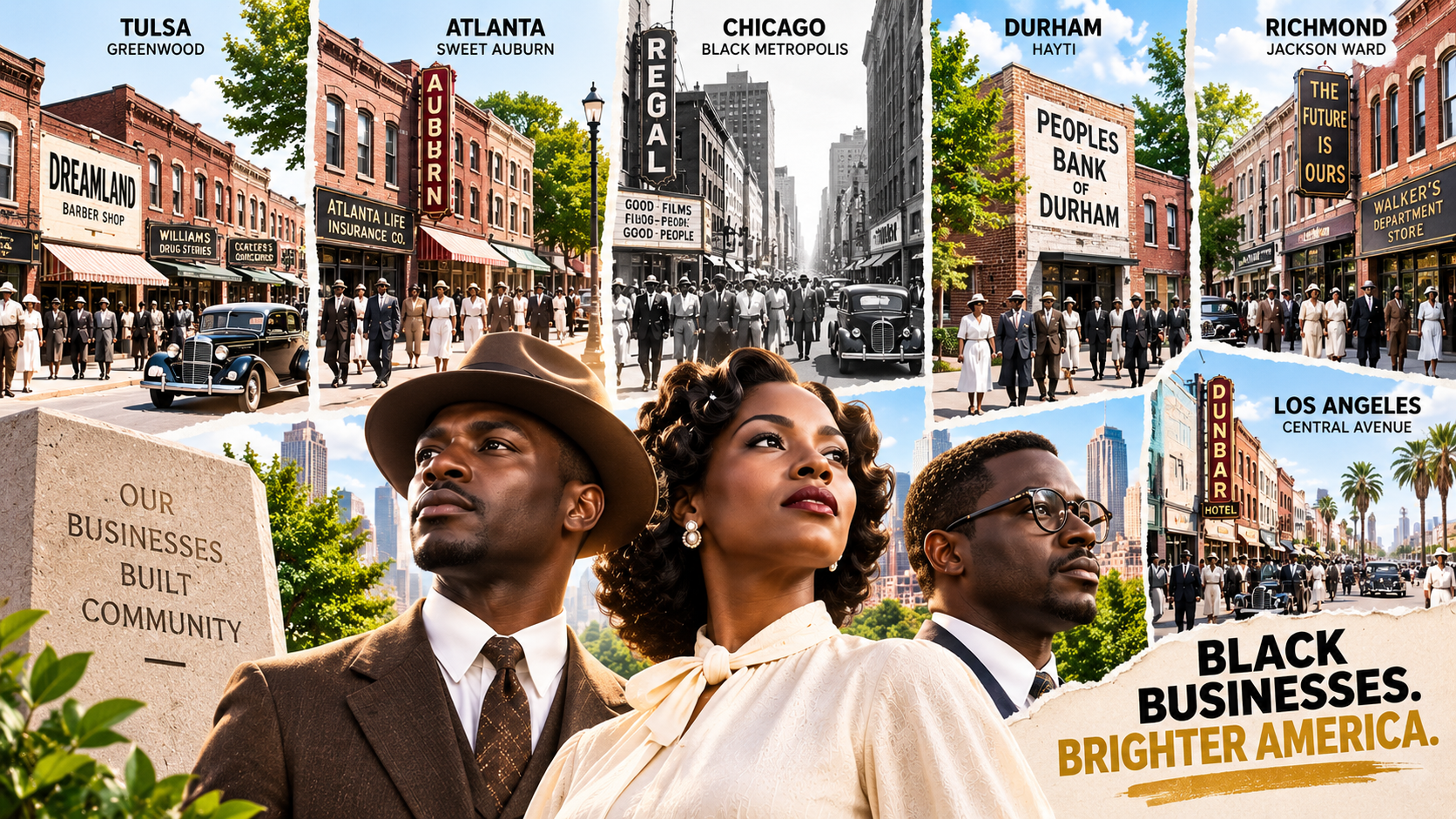
When people hear “Black Wall Street,” Tulsa’s Greenwood District usually comes to mind first. That makes sense. Greenwood became one of the most famous examples of Black wealth in American history, especially after the 1921 Tulsa Race Massacre nearly destroyed the district. But the larger story of Black business districts stretches far beyond Oklahoma. Across the country, Black entrepreneurs were building banks, insurance companies, newspapers, hotels, restaurants, theaters, stores, and entire commercial ecosystems at a time when segregation often blocked them from doing business freely elsewhere.
Greenwood was extraordinary, but it was not alone.
In Tulsa, Greenwood grew after O.W. Gurley purchased land in 1906 and helped establish a district where Black residents could own businesses and property. By 1921, Tulsa City-County Library records show Greenwood had 108 Black-owned businesses, including grocery stores, restaurants, hotels, and boarding houses. In a segregated city, spending money inside the community was not simply about supporting Black businesses. The library notes that “buying Black” became “more a matter of survival and less a matter of choice.”
But hundreds of miles away, Black communities were developing similar economic centers.
Richmond, Virginia’s Jackson Ward may be one of the clearest examples. After the Civil War, the neighborhood became increasingly Black, even as white political leaders worked to restrict Black voting power. By the early 1900s, Second Street had developed into a major center for Black banking, insurance, entertainment, and entrepreneurship. The National Park Service says Second Street was being called “Black Wall Street” by 1903, making it one of the earliest documented uses of the phrase.
@joshuadairen Richmond, Virginia’s Jackson Ward community was the epicenter of Black community, commerce, and entertainment, so much so, it was called the Harlem of the South. Many firsts came from here and this self-sustaining neighborhood that showed resilience by rising to the top. #history #blackwallstreet #education #jacksonward #whmpartner ♬ original sound – Joshua Dairen
Jackson Ward also produced one of the most important Black business leaders in American history: Maggie L. Walker.
Walker founded St. Luke Penny Savings Bank in 1903 and became the first African American woman in the United States to charter a bank. Her larger goal was economic circulation within the Black community. In a speech preserved by the National Park Service, Walker put it plainly: “Let us put our money together; let us use our money.”
That philosophy was not unique to Richmond.
In Durham, North Carolina, Parrish Street developed its own reputation as Black Wall Street. During the early 20th century, Black entrepreneurs built a compact financial district that included North Carolina Mutual Life Insurance Company and Mechanics and Farmers Bank. North Carolina’s Department of Natural and Cultural Resources says North Carolina Mutual became the nation’s largest Black-owned insurance company.
@blackinnc Durham Black Wall Street is one of the most important stories in Black business history in America. On and around Parrish Street, Durham, NC, became a national example of Black entrepreneurship—Black-owned institutions, professionals, and businesses building real community power. Comment your favorite Black-owned business in North Carolina so people can support. Image source: The News & Observer #Durham #BlackWallStreet #BlackHistory #BlackOwnedBusiness #NorthCarolinaHistory ♬ original sound – BlackinNC
Durham’s economic success became so notable that W.E.B. Du Bois visited in 1912 to study it. Nearby, the Hayti neighborhood grew into a largely self-sufficient Black community with businesses, schools, churches, a library, a hotel, a theater, and a hospital. In an era when Jim Crow determined where Black people could shop, eat, and receive services, Hayti allowed residents to spend money in spaces where they could be treated with dignity.
Atlanta had its own powerhouse.
Sweet Auburn became one of the South’s most important Black commercial corridors. By the early 1900s, Auburn Avenue was packed with Black-owned restaurants, banks, insurance companies, doctors’ offices, funeral homes, clubs, and retail businesses. Major institutions included Atlanta Life Insurance Company, Standard Life and Citizens Trust Bank. The Atlanta History Center describes those institutions as the “three-legged stool of black finance.”
Sweet Auburn’s rise also showed how segregation could unintentionally concentrate Black economic power. As discriminatory laws and racial violence pushed Black Atlantans into restricted areas, money, businesses, and institutions increasingly clustered there. What was meant to limit Black mobility helped create a commercial center powerful enough to gain a national reputation.
Chicago’s Black Metropolis took the concept to another scale.
As thousands of Black Southerners arrived during the Great Migration, Chicago’s South Side developed what the National Park Service describes as a “city-within-a-city.” Black residents built their own financial, commercial, political, and social institutions as white banks and businesses frequently ignored or discriminated against them. Banker Jesse Binga established Chicago’s first Black-owned bank in 1908, and the area around 35th and State became known as the Wall Street of the Black community.
Entrepreneur Anthony Overton built businesses in cosmetics, banking, insurance, and publishing. His Overton Hygienic Building housed several enterprises under one roof, including the Douglass National Bank. By the 1920s, Black Metropolis represented something larger than a collection of stores. It showed what could happen when Black money, property ownership, and business leadership were concentrated in one community.
And the pattern reached the West Coast.
Los Angeles’ Central Avenue developed into the center of Black life in the city during the early 20th century. Black-owned businesses included real estate firms, restaurants, newspapers, hotels, entertainment venues, and professional services. By 1919, researchers at the University of Southern California found that Los Angeles had 185 Black-owned businesses, with roughly a quarter located directly on Central Avenue and many others nearby.
Central Avenue later became famous for jazz, nightlife, and the historic Dunbar Hotel, but its foundation was economic as much as cultural. Housing restrictions kept many Black Angelenos from moving into other parts of the city, helping concentrate residents, businesses, and institutions around the corridor.
That is where this history gets complicated.
Many of these districts grew partly because racism left Black Americans with few alternatives. Segregation restricted where people could live, shop, borrow money, or operate businesses. Black communities responded by creating institutions of their own.
Then, several of those same communities were hit by forces that destroyed or weakened what they had built.
Greenwood faced racial terror in 1921. Hayti was heavily damaged by urban renewal and freeway construction. Chicago’s Black Metropolis suffered during the Great Depression and later lost blocks to redevelopment. Central Avenue declined as population patterns shifted and Black residents gained access to neighborhoods that had previously excluded them.
There is an irony sitting inside that history.
Segregation helped force Black dollars inward, creating concentrated business districts. Greater access and integration later gave Black consumers more choices, but it also meant money no longer had to stay inside those same neighborhoods. At the same time, highways, redevelopment, discrimination, lack of capital and economic downturns dealt additional blows.
That does not mean segregation created Black prosperity. Black people created that prosperity despite segregation.
And that distinction matters.
Tulsa’s Greenwood deserves its place in American history. But when Greenwood becomes the only Black business district people know, it can make Black economic success look like one exceptional moment instead of a national pattern.
Richmond had Jackson Ward. Durham had Parrish Street and Hayti. Atlanta had Sweet Auburn. Chicago had Black Metropolis. Los Angeles had Central Avenue.
Different cities. Different industries. Same larger story.
Black Americans were not waiting for access to someone else’s economy.
They were building their own.
