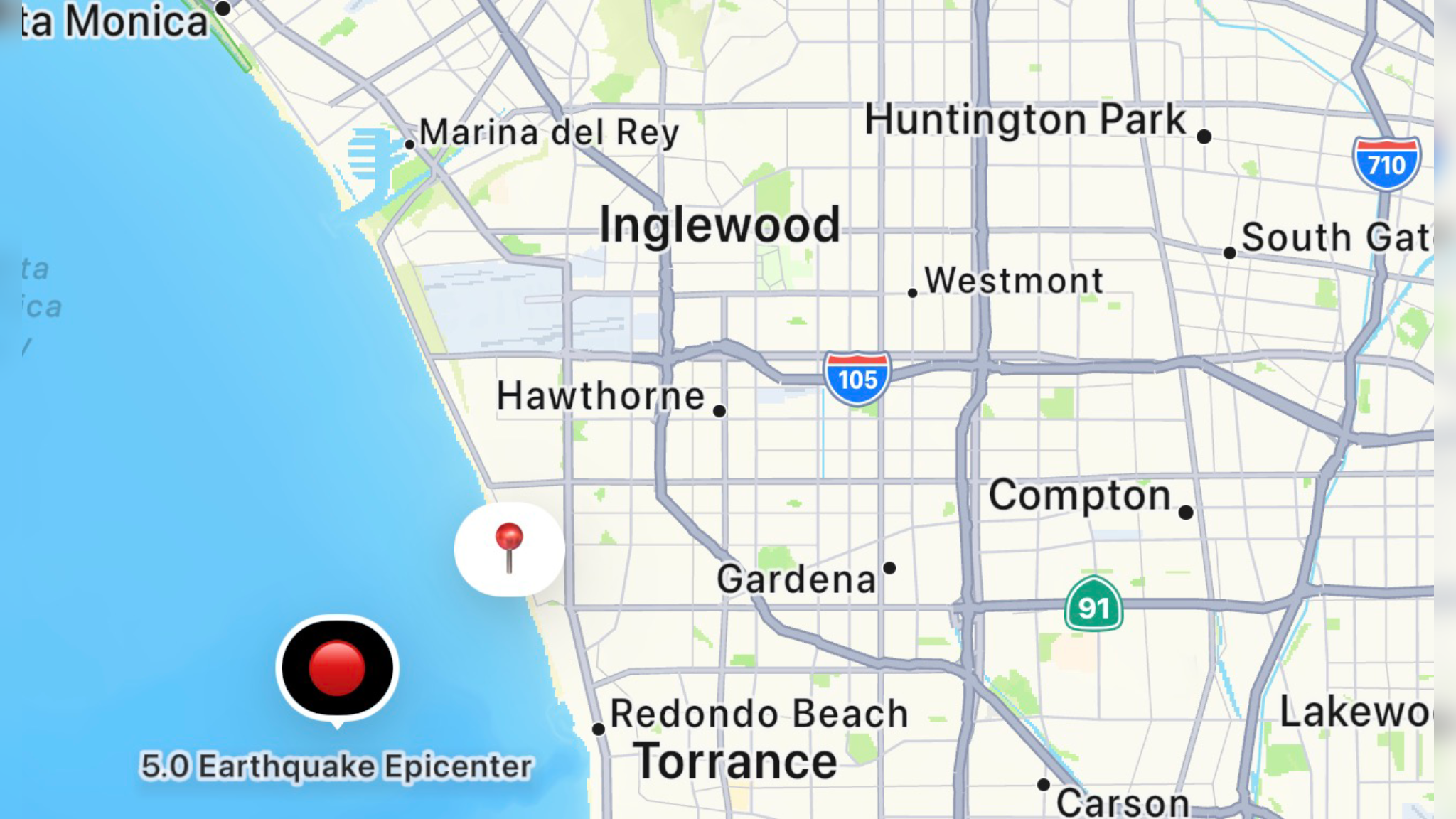
The Manhattan Beach earthquake that rattled Los Angeles Saturday morning has now produced more than 100 aftershocks, and the U.S. Geological Survey says more shaking is likely through the end of the week.
The magnitude 5.0 quake hit at 9:30 a.m. Pacific about 3 to 4 miles west southwest of Manhattan Beach, roughly 7.6 miles beneath the ocean floor. The USGS first measured it at 4.7 before it settled on 5.0. People felt it from Santa Barbara down into Orange County, and more than 26,000 sent felt reports to the USGS.
The aftershocks started almost right away. The biggest so far was a magnitude 4.5 at 11:41 a.m., about two hours after the main quake and close to where the 5.0 started. A 4.0 followed at 2:08 p.m. and a 3.9 at 2:27 p.m. By Sunday morning the count was well past 100, and the strongest jolts overnight measured around 3.0.
The Manhattan Beach earthquake left its mark across the South Bay. Shaking shattered windows along a walkway in Terminal 7 at LAX, and air traffic controllers ordered an incoming Delta Air Lines flight to abort its landing at the last minute and circle the airport. The plane later landed safely. Manhattan Beach and Hermosa Beach closed their piers as a precaution. A chimney collapsed in Manhattan Beach, and in Hermosa Beach dozens of wine bottles fell off store shelves while diners and staff rushed outside during aftershocks.
No injuries or major structural damage were immediately reported. The Los Angeles Fire Department found no significant damage during its standard survey after the quake, and the Department of Water and Power said service was not affected. The USGS issued a green PAGER alert, its lowest level, which signals a low likelihood of casualties or damage. There is no tsunami threat.
The USGS aftershock forecast is a statistical estimate. It looks at how California aftershock sequences usually behave and calculates how likely more quakes are in the area where this sequence is already happening, then updates as new quakes come in. In its latest update for the Manhattan Beach earthquake, issued around 3:30 a.m. Pacific Sunday, the agency put the chance of a magnitude 4 or larger aftershock at 12% within a day and 33% within a week. That rises to 51% over a month and 78% over a year. Smaller aftershocks of magnitude 3 or higher, which are strong enough to feel nearby, are close to certain this week.
The odds of something bigger are low. The USGS puts the chance of a quake larger than the 5.0 in the next week at 3.8%, or about 1 in 26. That’s down from about 5% in the first forecast Saturday. Seismologist Dr. Lucy Jones explained that about 5% of the time, an earthquake is followed by a larger one within three days, so scientists never fully rule it out. “Every earthquake has the potential to be a foreshock,” she said. A foreshock is a quake that turns out to come before a bigger one, and there is no way to know which kind it is while it’s happening.


Made to order and shipped to your door.
Jones also said the sequence is “probably a bit more active than average, but well within the normal range.” She added that one quake’s ability to trigger another only reaches a short distance from where the first one hit, and these aftershocks are all clustered in that same offshore spot. Caltech’s Seismological Laboratory said more earthquakes are possible and expected in the coming days.
Aftershocks from the Manhattan Beach earthquake should fade quickly. The USGS says the first day of a sequence usually has about 10 times as many aftershocks as the tenth day, so the shaking should become much less frequent over the next several days. They can still show up for weeks, and the agency says the rate may stay higher than normal for a year or longer. Later aftershocks come less often, but they are not automatically weaker, so a jolt next week can feel as strong as the ones on Saturday.
If the ground starts shaking again, drop to your hands and knees, take cover under a sturdy table or desk, and hold on until it stops. Stay inside during the shaking, because falling glass and debris near building exteriors cause many quake injuries. If you’re in bed, stay there and cover your head with a pillow. If you’re driving, pull over away from overpasses, power lines and buildings, and stay in the car.
After any strong aftershock, check your home. If you smell gas or hear hissing, leave, shut off the gas at the meter if you can do it safely, and call the gas company from outside. Look for new cracks in walls, ceilings and chimneys, and stay away from any fireplace that cracked or shifted until someone inspects it. Keep clear of downed power lines. This is also a good week to anchor bookshelves and TVs to the wall and move heavy items off high shelves, especially over beds and couches.
Emergency officials recommend keeping a kit with at least three days of water and nonperishable food for everyone in your home, about a gallon of water per person per day, plus first aid supplies, flashlights and portable phone chargers. Add any medications, some cash and food for your pets. Keep shoes and a flashlight next to your bed in case glass breaks overnight, and agree on a plan for how your family will check in with each other. Texts often go through when phone lines are jammed.