

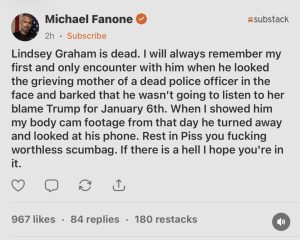
The most talked about response to Lindsey Graham’s death did not come from a senator, a cable panel, or a statement released through a communications office. It came from a former police officer typing on Substack, and the Fanone Lindsey Graham history behind those few sentences is the reason the post traveled the way it did.
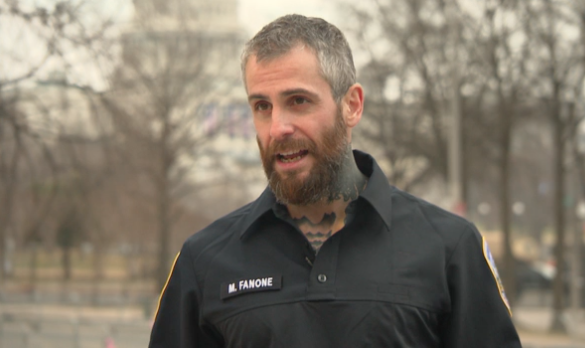
Michael Fanone, the Metropolitan Police Department officer who was dragged into the mob outside the Capitol on January 6, 2021, beaten, tased, and left with a heart attack and a traumatic brain injury, wrote that he would always remember his first and only encounter with Graham. He described Graham looking at the grieving mother of a dead police officer and barking that he would not listen to her blame Trump for January 6. He wrote that when he tried to show Graham his body cam footage from that day, Graham turned away and looked at his phone. Then he closed with a line no publicist would ever approve. Rest in Piss. If there is a hell, he hoped Graham was in it.
Graham died Saturday night at 71. His office initially attributed it to a brief and sudden illness, a phrase that explained nothing and invited everything. By Sunday evening, his office announced that a preliminary examination pointed to an aortic dissection caused by arteriosclerotic cardiovascular disease. Taylor Reidy, Graham’s communications director, said the death certification remains pending until toxicological and microscopic testing is complete. Police scanner audio obtained by the Washington Post placed a 911 call around 8:30 that night. FBI Director Kash Patel said the bureau is assisting local authorities, without explaining why the FBI would be involved at all.
The official mourning moved fast. Trump called Graham one of the greatest people he had ever known and a true American Patriot. Benjamin Netanyahu told Meet the Press he had lost a beloved friend and was still in a state of shock. Joe Biden noted that the two of them disagreed often but shared a love of public service. That is the version of Lindsey Graham that will be read at the funeral.
The Fanone Lindsey Graham version is the one that is harder to argue with, because Graham documented it himself. On May 27, 2021, Gladys Sicknick, the mother of Capitol Police Officer Brian Sicknick, came to the Capitol with Sicknick’s partner Sandra Garza, Capitol Police Officer Harry Dunn, and Fanone. They went office to office asking Republican senators to support an independent commission to investigate January 6. Graham took the meeting. Afterward, his office put out a press release calling it a productive and emotional meeting and promising he was committed to making sure the story of January 6 was fully and completely told. In the same release, he said he opposed the bill, because a commission would turn into a partisan food fight.
That is the entire case against him, published on Senate letterhead. He sat with a mother who buried her son, called it emotional, and voted the way he was always going to vote.
Fanone has been carrying more than that. In his 2022 memoir Hold the Line, he wrote that during that period Graham told the officers they should have shot the rioters in the head, a remark Fanone repeated on CBS Mornings, saying he did not know whether Graham was trying to be funny. Set that next to a man who would not look at thirty seconds of body cam footage, and the Fanone Lindsey Graham encounter stops reading as a grudge and starts reading as testimony.
He was not alone. Steve Schmidt, the Republican strategist who co founded the Lincoln Project, posted his own Substack piece Sunday describing Graham as a lonely and unprincipled man who betrayed his country for power and his decency for attention. Two of the sharpest posts about a dead senator, both on Substack, both outrunning the wire copy. The reaction economy has quietly relocated, and the people with the most standing to speak are no longer waiting for a booking producer to call.
Trump, meanwhile, did not manage a full day of reverence. On State of the Union with Jake Tapper, he said Graham wanted to keep the war in Ukraine going, that Graham was very militant about it, while he himself wanted it over. Graham had been in Ukraine meeting with Volodymyr Zelenskyy about Russia sanctions shortly before he died. Trump also told reporters Graham had called him hours before his death to talk about the SAVE America Act, and described the loss primarily as a blow to that bill.
Graham spent a decade constructing a public self that could survive contact with Trump. He called Trump a race baiting, xenophobic religious bigot in 2016 and warned that nominating him would destroy the party. He told the country to use his words against him if a Supreme Court vacancy opened in an election year, then confirmed Amy Coney Barrett weeks before the 2020 election. The Fanone Lindsey Graham story is not a departure from that record. It is the same record, told by someone who was bleeding while it was being written.
South Carolina now has an open Senate seat and a scramble already underway, with Nancy Mace saying she will consider a run. The obituaries will keep coming from both directions, and the split is not really about a man. It is about which version of January 6 gets written into the record. Fanone spent five years refusing to let it be sanded down. He was not about to start on the day the sanding got easier.

What a pathetic human being. He was a DC officer and he speaks badly about a US Senator. His “ilk”. Needs to be purged from our government. Taxpayers are paying this POS. He should be ushered out right now.
Fanone is retired, stupid.