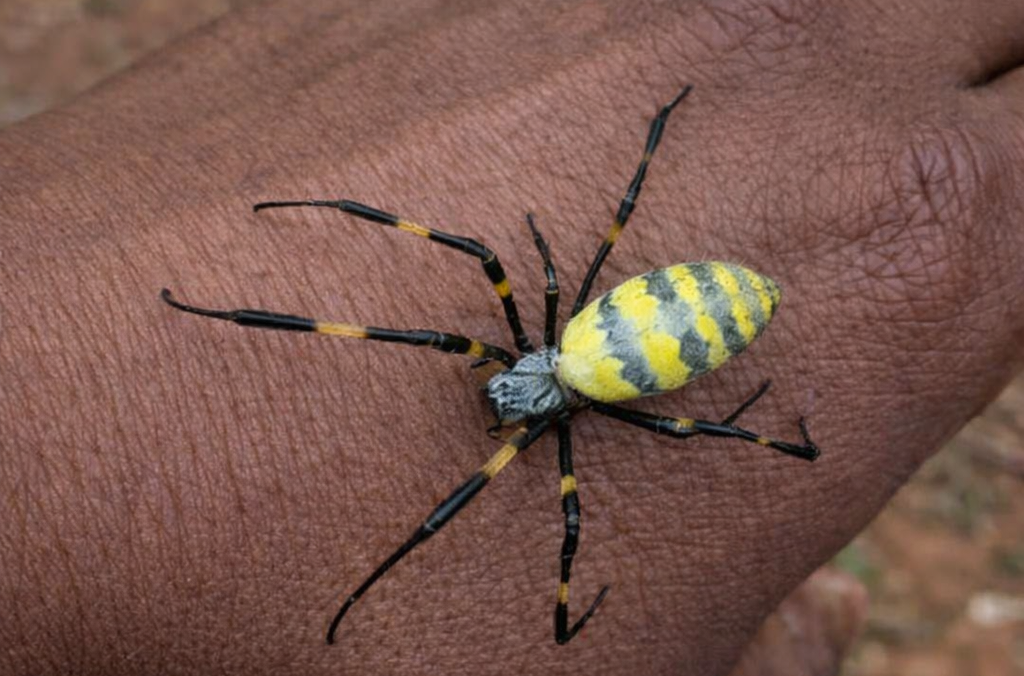
A hand sized spider from Asia that can travel by air is continuing to expand in the US, with the potential to invade the Northeast. This striking species, known for its yellow, blue, and red coloring, has moved well beyond its initial arrival point. What began as a localized discovery in the South has transformed into a multi-state migration that has researchers and residents across the Mid Atlantic taking notice.
The journey started in 2013 when the Joro spider first appeared in Georgia, likely arriving via international shipping containers from East Asia. Since that time, the invasive species has successfully established itself in 12 different states, including Tennessee, the Carolinas, West Virginia, and Maryland. While a move into New York and New Jersey has been predicted for some time, the true extent of their northern expansion is expected to become clear after the current spring hatching.
The most fascinating aspect of their spread is a unique mobility tactic. After hatching in the spring, the spiders begin “ballooning,” during which the Joro deploys silk, parasail-like strands so they can be borne aloft by the wind, which can carry them anywhere from a few feet to across oceans. This allows the Joro to glide over obstacles that usually stop other crawling insects. By the time late summer arrives, the females can reach a span of four inches and build massive, golden-colored webs.
Research indicates these spiders are exceptionally well-suited for life in developed areas. A study from the University of Georgia’s Odum School of Ecology highlights that the species is notably “urban tolerant,” meaning the noise and vibrations of heavy traffic don’t disrupt their behavior.
Lead scientist Andy Davis observed that these spiders frequently thrive in the heart of loud, busy environments where other native wildlife often struggles to survive.
While their size and fangs might seem alarming, experts maintain there is no reason for public panic. The spiders are non-aggressive and generally avoid human contact. “There have been no documented fatalities, nor any notable medically significant bites,” explained ecologist José R. Ramírez-Garofalo. He added that because of their shy nature, they “really pose no threat to humans or our pets.”
The real worry for scientists is the potential for these spiders to outcompete native species. To help track their movement, the public is encouraged to log sightings on platforms like iNaturalist or Joro Watch. If you find them around your home, they are easy to manage. Virginia Tech entomologist Theresa Dellinger says that if they become a nuisance, “they can be removed the same way as any other spider, using a broom or an aerosol insecticide spray.”