

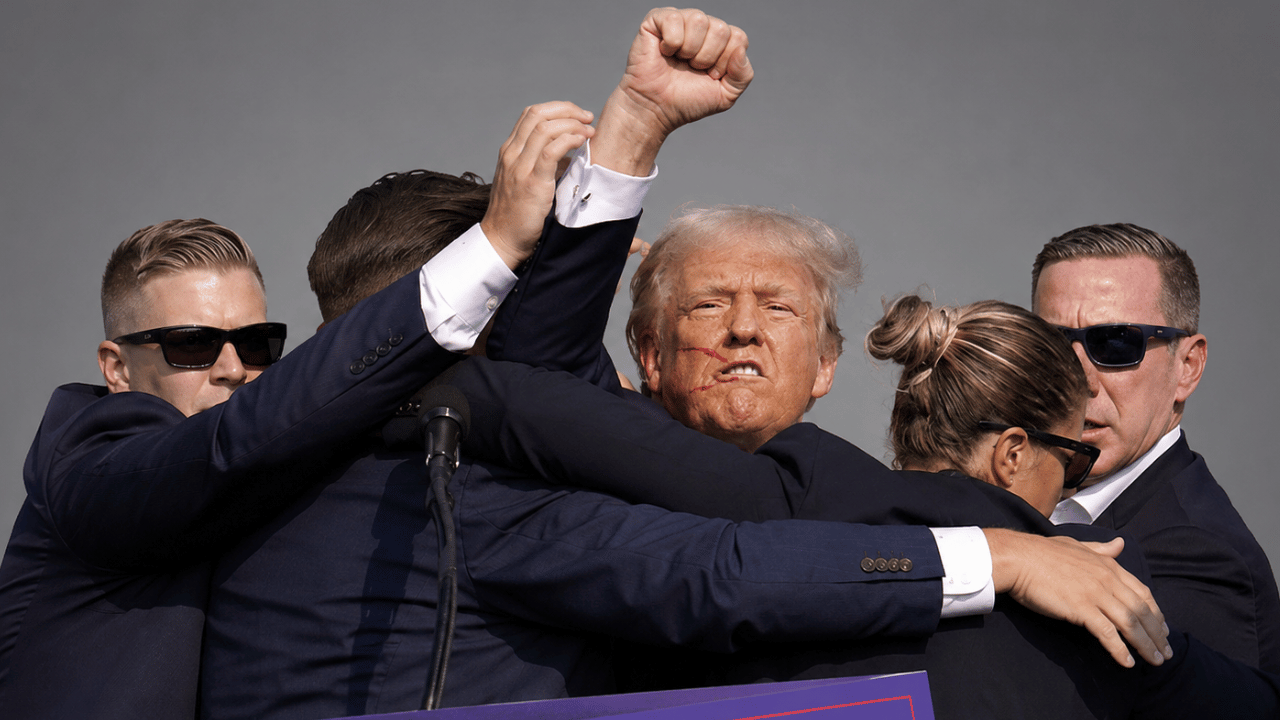
Secret Service failures are back under the microscope after a new government watchdog report found that agents missed 102 local radio transmissions warning about the gunman before the widely debated 2024 shooting at Donald Trump’s campaign rally in Butler, Pennsylvania.
According to Reuters, the Department of Homeland Security’s Office of Inspector General found that the agency did not receive 102 radio transmissions from local law enforcement about Thomas Matthew Crooks on July 13, 2024, because the Secret Service failed to establish a joint communications room with local authorities. The report said the agency’s shortcomings “set the conditions that led to missing opportunities to prevent and detect the attempted assassination.”
Local officers had been communicating about what the report described as “an increasingly intense search for a suspicious person” before Crooks opened fire from a nearby rooftop. The report said agents received only five phone calls and three text messages about Crooks before the shooting, a gap that kept urgent information from reaching Trump’s protective detail in real time.
“Instead, we found that the Secret Service received only five phone calls and three text messages about Crooks.” That line is now one of the clearest snapshots of the communication breakdown, because the Secret Service was not lacking warnings from local law enforcement; the agency was missing the system needed to hear them.
Those missed communications included reports that Crooks had a range finder, possessed a long gun, and had reached the roof of the American Glass Research International complex. Crooks had access to a rooftop with a direct line of sight to Trump while Trump was speaking on stage, and the shooting left one bystander dead and others injured, including Trump, whose ear was grazed by a bullet.
The July 13, 2024, shooting in Butler was investigated as an assassination attempt and potential domestic terrorism. According to the FBI’s July 2024 update, investigators said at that stage that the shooter appeared to have acted alone, that no motive had been identified, and that suspicious devices found at his home and vehicle had been rendered safe.
The Secret Service report also raises serious questions about drone security. The OIG found that Crooks flew a drone over the area hours before the shooting, but the flight went undetected because the Secret Service counter-drone system was inoperable. The watchdog report also said the counter-drone system was handled by one undertrained operator who did not test it before the rally.
The OIG report said the Secret Service did not secure the perimeter around the rally and did not use available resources to block the line of sight from the American Glass Research International complex to Trump. The report’s recommendations included fixes for information sharing and “line of sight vulnerabilities,” language that shows the watchdog viewed the Butler shooting as a preventable security collapse, not just a split-second failure.
The report also said the agency failed to communicate intelligence about a long-distance threat against Trump to the Pittsburgh Field Office, which the field office’s special agent in charge said could have led to additional personnel at the rally. According to the House Task Force on the Attempted Assassination of Donald J. Trump, its earlier 2024 report also found significant failures in planning, execution, and leadership involving the Secret Service and law enforcement partners.
Its investigation reviewed nearly 20,000 pages of documents, conducted 46 transcribed interviews, held more than a dozen briefings, and issued 37 recommendations connected to the July 13 attack and broader structural changes. According to the same House Task Force release, the report said: “preexisting issues in leadership and training created an environment in which the specific failures identified above could occur.”
The accountability piece has also been unfolding for months. The Secret Service said in July 2025 that six agents connected to the Butler security failures received suspensions ranging from 10 to 42 days, though the agency did not publicly identify them or give specific reasons for each suspension. Secret Service Director Sean Curran, who was in charge of Trump’s detail at the Butler rally, said the agency had taken “many steps to ensure such an event can never be repeated in the future.”
The Secret Service said in 2025 that it had implemented 21 of more than 40 recommendations made after the assassination attempt, with 16 more in progress and nine aimed at outside stakeholders. Those reforms included clearer lines of accountability, improved information sharing with local law enforcement, a new Aviation and Airspace Security division, and changes to how the agency accounts for and applies security assets.
In a statement, Curran said, “Nothing is more important to the Secret Service than the safety and security of our protectees.” Curran also said, “As director, I am committed to ensuring our agency is fully equipped, resourced, and aligned to carry out our important mission each and every day.”
Still, the newest Secret Service findings cut through the usual government language because they put a number on the breakdown. The agency concurred with the inspector general’s recommendations, and a Secret Service spokesperson said, “Many of these recommendations were already identified … and have since been implemented as part of our ongoing reform efforts.”
The bigger issue is that Secret Service protections depend on seconds, shared information, and everyone being on the same page before a threat becomes a tragedy. The Butler report lays out failures involving missed radio traffic, an inoperable counter-drone system, unblocked sight lines, incomplete intelligence sharing, and a lack of coordination with local law enforcement.
For the Secret Service, the 102 missed transmissions are not just a statistic. According to the OIG findings, they represent repeated chances to detect, delay, disrupt, or prevent a shooting that exposed a dangerous gap between what local police knew and what federal protective agents were prepared to act on.
