


The U.S. has begun retaliatory strikes against Iran after Donald Trump accused Tehran of bringing down a U.S. Army AH-64 Apache helicopter near the Strait of Hormuz, turning the U.S. Iran strikes into the latest flashpoint in a conflict that was supposedly inching toward a deal. U.S. Central Command called the military action “a proportional response to unjustified Iranian aggression,” while Iranian state media reported explosions on Qeshm Island in the Strait of Hormuz, the Associated Press has confirmed.
The move came after the Apache went down off the coast of Oman while patrolling regional waters. CENTCOM said two crew members were rescued by American forces at 7:33 p.m. ET on June 8, roughly two hours after the helicopter was lost at sea. Both service members were in stable condition, and the cause remained under investigation.
Trump, however, did not wait for quiet phrasing. In a social media post, he said military officials told him “the Iranians shot down one of our highly sophisticated Apache Helicopters.” He added that both crew members “are safe and uninjured,” before making the next step plain: “Nevertheless, the United States must, of necessity, respond to this attack.”
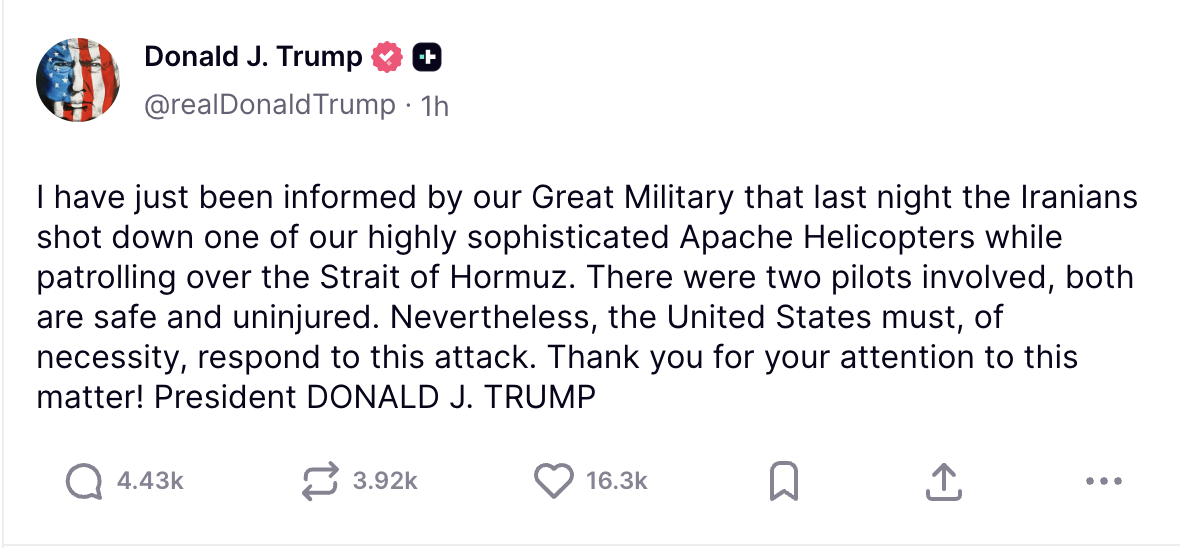
That is where the tension sits. AP reported that a U.S. official said the helicopter went down after colliding with an Iranian drone, though officials had not publicly confirmed whether the collision was intentional. Axios also reported that a U.S. official said the investigation had not determined intent. So, while Washington moved fast, the facts around what happened in the sky are still being sorted out.
Iran’s foreign minister, Seyed Abbas Araghchi, pushed back by pointing to the U.S. military presence near Iranian territory. He said the strait is “thousands of miles away from U.S. shores,” and warned that “Foreign forces in proximity to our territory are at constant risk on account of their own human errors, plain accidents, or potentially being caught in crossfire.” Then he added, “To reduce risk, best solution is for them to leave.”
The rescue added a new layer to the story. Reuters reported that a Navy surface drone found and rescued the two crew members, marking a first-of-its-kind moment for U.S. military operations at sea. CENTCOM said the rescue included U.S. Naval Forces Central Command, the 82nd Airborne Division, U.S. Air Force and Navy units, and U.S. 5th Fleet’s Task Force 59.
Task Force 59 is not random background. The Navy says the unit was created in 2021 to integrate unmanned systems and artificial intelligence into regional maritime operations, and it has used those systems across waters tied to the Strait of Hormuz. In other words, the same region at the center of the oil crisis is also becoming a testing ground for future warfare.
That location is why this story travels far beyond Washington and Tehran. The U.S. Energy Information Administration says the Strait of Hormuz connects the Persian Gulf with the Gulf of Oman and the Arabian Sea, and in 2024 about 20 million barrels per day moved through it, equal to roughly 20% of global petroleum liquids consumption. The EIA also notes there are few alternatives if that route is closed.
The timing makes the escalation even messier. Before blaming Iran for the helicopter crash, Trump said, “We have a good chance” of signing a deal in “two or three days.” He also said, “We’re very close to having a very, very good, strong, powerful deal.” Iran was less convinced, with Mohammad Bagher Qalibaf saying Trump’s comments “contradicted the agreed-upon sections” and showed the U.S. was “neither seeking a ceasefire nor dialogue.”
Now, the diplomatic track has to compete with fresh military action. The crew survived, the drone boat rescue made history, and the investigation is still open. But the message from Washington already landed: after the Apache crash, the U.S. chose retaliation first.
