

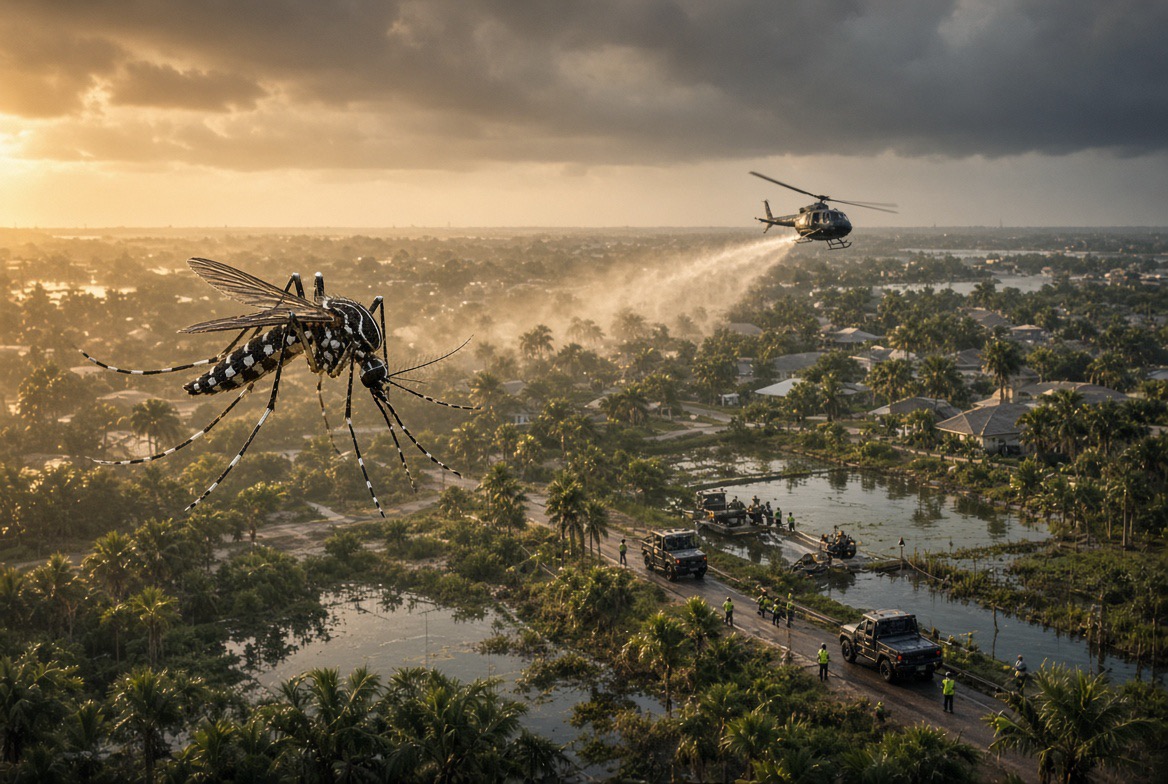
Florida’s dengue fever outbreak has reached 252 locally acquired cases this year, the most the state has ever recorded, as three Tampa Bay counties remain under states of emergency.
Dengue is a viral illness spread by mosquitoes. It is common in tropical places like the Caribbean, Central and South America and Asia, but rare in the continental United States. Locally acquired means these people were bitten and infected in Florida, not while traveling abroad.
Hillsborough County, home to Tampa, is the epicenter. The county added 53 new cases in the Florida Department of Health’s latest weekly report, which covers September 20 through 26, bringing its total to 223. Neighboring Pinellas County has 13. Every one of the state’s 252 local cases has come since July, and health officials say the real number is likely higher because many people with mild symptoms never get tested.
The spike is dramatic for an area that rarely sees dengue at all. Hillsborough recorded just one locally acquired case in all of 2025. Kristi Miley, a public health professor at the University of South Florida, said the county has not seen this level of dengue infection since the 1930s. “This is wildly unusual for us,” Hillsborough County spokesperson Chris Wilkerson said.
The outbreak has already turned deadly. An 80 year old Hillsborough County woman died at Tampa General Hospital after being bitten by a mosquito near Tampa Bay. It is the first dengue death in the Tampa Bay area in almost a century.
Pasco County was the first to declare a local state of emergency, and Hillsborough and Pinellas followed the next day. Both Hillsborough and Pinellas extended their emergency orders on Thursday. The declarations free up money and resources for mosquito control, and Hillsborough has asked for outside help. The Lee County Mosquito Control District has sent helicopters and crews to expand aerial spraying.
The Centers for Disease Control and Prevention says it is closely tracking dengue activity and what the agency described as an unprecedented number of cases in the Tampa area.
Officials point to the weather as a major driver of the dengue fever outbreak. Heavy rains have left standing water across the region, giving the Aedes aegypti mosquito, the main carrier of the virus, ideal conditions to breed quickly. A mosquito picks up the virus by biting an infected person and then passes it on to the next person it bites.
Tampa Bay is not the only part of the state seeing local spread. Locally acquired cases have also been reported in Miami-Dade, Orange, Palm Beach and Pasco counties, and Polk County confirmed its first case last week. Orange County, home to Orlando, issued its first mosquito-borne illness alert since a West Nile virus outbreak in 2011.
Dengue is sometimes called breakbone fever because of the severe muscle and joint pain it can cause. According to the Florida Department of Health, it can look like the flu, with fever, intense body aches and sometimes a rash. About one in 20 people who get sick develop severe disease, which can be life threatening. People can catch dengue more than once, and Emory University biostatistician Natalie Dean warned that the second infection is usually the more dangerous one.
There is no specific treatment for dengue. Doctors manage the symptoms, so prevention matters most. Health officials are urging residents to wear insect repellent, cover up outdoors and dump any standing water around their homes, including in flowerpots, buckets, birdbaths and old tires. Anyone who develops a high fever and severe body aches should see a doctor.
