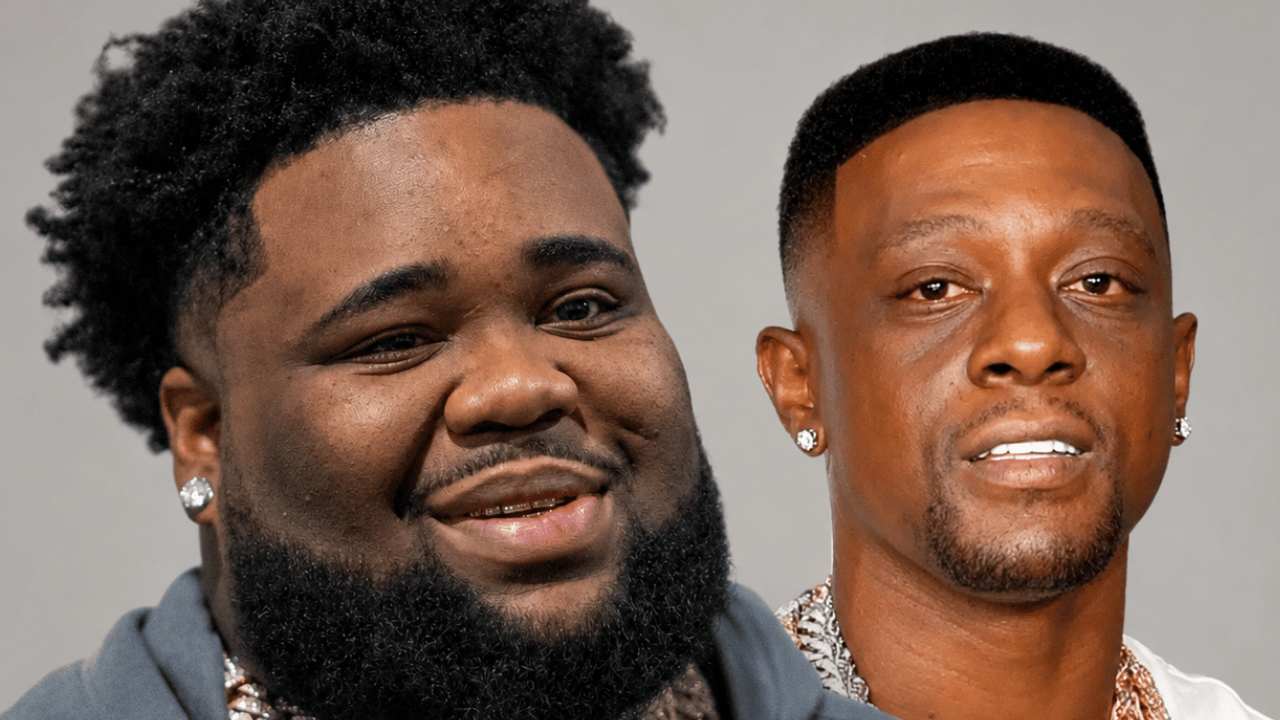
Boosie is nowhere near finished with Rod Wave.
Video
Hours after the two artists traded words over their long-running sampling dispute, Boosie returned to Instagram with two more videos attacking Rod’s use of other artists’ music, disputing Rod’s version of their financial talks and suggesting the timing of the renewed controversy was no coincidence.In the first Instagram video, Boosie immediately went on the offensive, calling Rod a “cap rapper” and accusing him of building his career by taking from other musicians.
“Boy, shut your big p*ssy a** up, boy,” Boosie began. “You then took 15 n***as’ music and made a career out of it, Boy, you’re a straight b***h.”
Moments later, Boosie changed the number while continuing the accusation.
“Let’s talk about, you done took 20 music and made a motherf**king career out of it, Boy, you a big old b***h,” he said.
Boosie also mocked the emotional subject matter that has become central to Rod’s music. “Talking about your heart ain’t never been broke. But every song, you talking about your heart broke. You a cap rapper,” he said.
The Boosie Rod Wave feud became even more pointed in a second Instagram video. This time, Boosie claimed he had searched Rod’s sampling history through ChatGPT and received an even higher number.
“ChatGPT says you then took 31 songs; you owe everybody, not including me, you owe everybody. You a serial stealer,” Boosie said.
That “31 songs” figure should be treated as Boosie’s allegation, not an independently verified total. Boosie himself cited three different numbers across the two videos, first saying 15, then 20, and finally 31. Public music databases do document numerous samples and interpolations throughout Rod’s catalog, but the use of a sample or interpolation does not by itself establish that anything was stolen or used without permission. For example, the credits for Rod’s 2023 album “Nostalgia” publicly identify multiple interpolations and samples, including material associated with Boosie and Webbie, Paramore, Jay-Z, and Joni Mitchell.
Boosie’s second video also introduced a potentially important new claim about the money at the center of their dispute.
“So you offer me 100, yeah, you offer me, and we agreed!” Boosie said. “We agreed, say you was gonna give me 150. We agreed. You say for all the shit you did took, you was gonna look out for me; we was talking friendly.”
That version differs from what Rod said during his latest response to Boosie. As Baller Alert previously reported, Rod said he offered Boosie $100,000 after their dispute over “Long Journey,” but claimed Boosie told him the amount was not enough.
“I already had a relationship with your label. I knew from the jump you didn’t own the music, so when I reached out and offered you $100,000, you said that wasn’t enough. You got me f**ked up,” Rod said.
Boosie is now claiming the conversations went further than that initial offer and that the two eventually agreed on $150,000. Neither artist has publicly produced documentation confirming the alleged agreement, so whether a final deal was actually reached remains disputed.
The Boosie Rod Wave disagreement originally became public in November 2023 after Boosie objected to Rod’s “Long Journey,” which appeared on the album “Nostalgia.” The song interpolates Boosie and Webbie’s earlier record of the same name. At the time, Boosie said he appreciated younger artists using his material but wanted to receive his proper financial share.
Rod initially responded by offering to settle the matter without litigation. Rod publicly told Boosie to give him a reasonable number and said the Baton Rouge rapper did not need to sue him.
Boosie argued then, just as he is arguing now, that the issue was business. Boosie said several artists had used his records and maintained that he was seeking compensation rather than objecting to being sampled altogether.
The controversy exploded again this week after Rod addressed Boosie during his August 26 appearance on “Club Shay Shay.” The episode’s official description confirms that Rod discussed his previous misunderstanding with Boosie while talking about older artists, mentorship, and the music business.
Rod said Boosie was someone he admired while growing up and framed his original use of the music as an act of appreciation. But Rod also said the threat of a lawsuit permanently changed how he viewed the situation.
That prompted Boosie to accuse Rod of “playing victim,” followed by Rod telling Boosie, “I ain’t letting s**t go. You broke my heart threatening a n***a with a lawsuit.”
Now Boosie is questioning something else entirely: why Rod chose to revisit their dispute right before releasing a new project.
“Now it’s time for you to drop an album tonight. Now you want to bring up Boosie on the couch?” Boosie said in his second video. “You, you ain’t slick. This s**t been dead! Why you ain’t been saying something? The night before you drop, you won’t say something.”
Rod’s new album, “Don’t Look Down,” is scheduled for release on August 28, one day after Boosie posted his latest responses.
There is no evidence, however, that Rod discussed Boosie specifically to promote the album. The “Club Shay Shay” interview covered a wide range of subjects, including Rod’s career, finances, business interests, mentorship, family, and the upcoming project.
Still, Boosie clearly believes the timing matters.
The feud has now shifted beyond the original question of one interpolation. Boosie is accusing Rod of having a larger pattern of leaning heavily on other artists’ music, while Rod says his use of Boosie’s work came from admiration and that he attempted to compensate him. Now they cannot even agree on what happened during the negotiations that followed.
Boosie says $100,000 was discussed and that a $150,000 agreement was eventually reached. Rod says his $100,000 offer was rejected. Boosie says Rod has repeatedly taken music from other artists. Rod says the threat of legal action from somebody he once looked up to is what made the situation personal.
And with Boosie now accusing Rod of dragging the dispute back into public view on the eve of “Don’t Look Down,” a disagreement that started over who was owed what for “Long Journey” has turned into a much bigger argument about respect, business, and whose version of the story listeners should believe.