
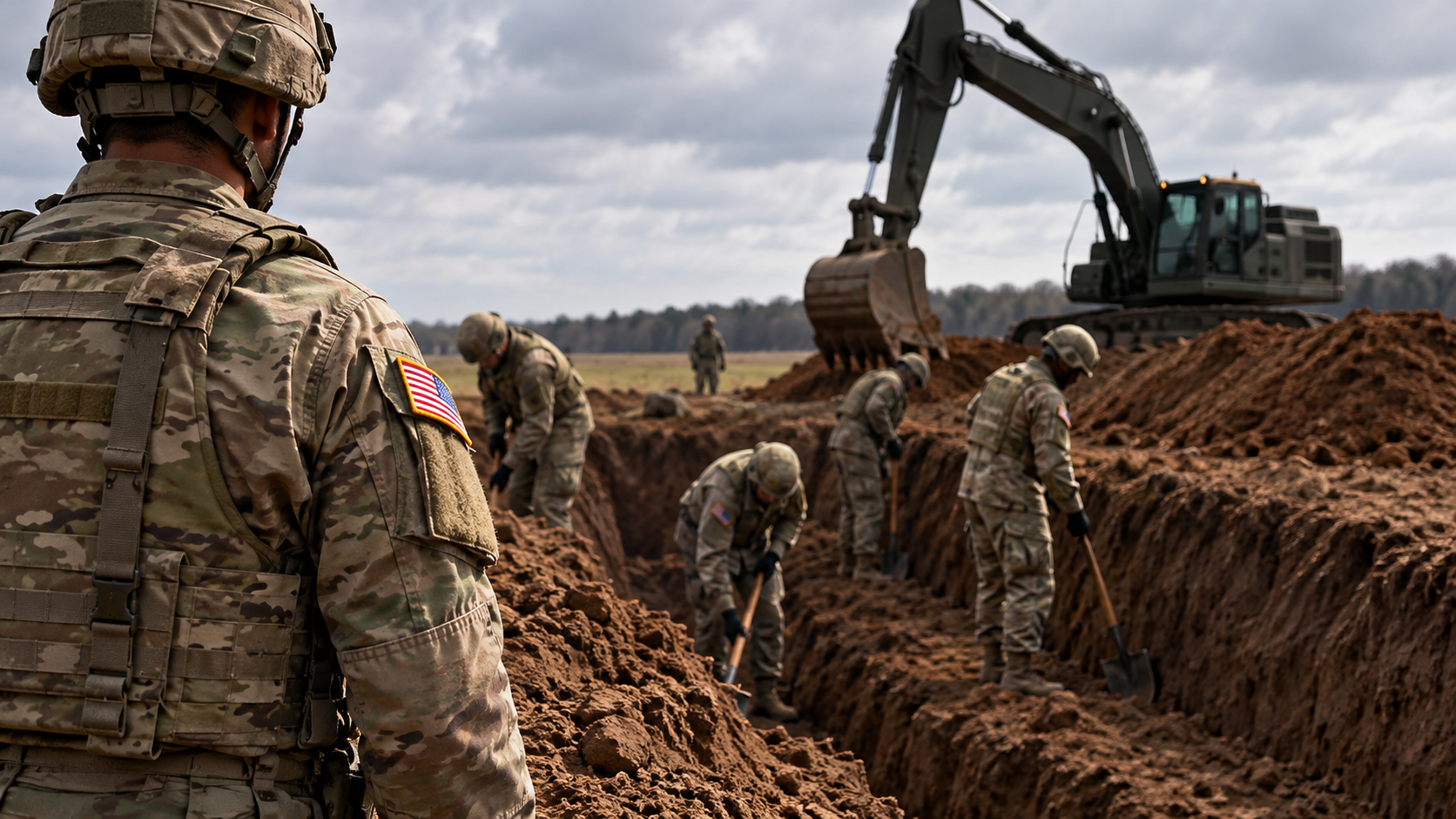
The US Army is practicing how to dig mass graves for fallen soldiers, testing a burial procedure it has not used on a large scale since the Korean War. The drills took place October 20 and 21 at Fort Bragg in North Carolina as part of an exercise called Operation Dragon Covenant.
The graves are meant to be temporary. The military calls the process temporary interment, which means burying remains in the field for now so they can be dug up, identified and returned to families once a conflict ends. Engineers, preventive medicine teams, chaplains and fatality management specialists all took part.
For more than 20 years in Iraq and Afghanistan, the US controlled the skies, so the military could quickly fly fallen troops home. The Army is now preparing for what it calls large scale combat operations, meaning a major war against a powerful enemy where that may not be possible. Military guidance already allows temporary graves during mass casualty events when remains can’t be safely moved, when there is no transportation, or when deaths are caused by chemical, biological, radiological or nuclear weapons.
To make the training realistic, engineers used heavy equipment to dig and then refill burial trenches holding mock remains made from skeletal models and water containers. The goal was to cover the trenches without damaging what was inside, so future forensic teams could recover and identify everyone buried there.
The numbers from the exercise are sobering. Army doctrine calls for burial plots made of five parallel trenches holding 100 bodies, with ten placed along each side of a trench. In earlier trials, crews using standard backhoes could dig only one trench every three hours. This time, operators using D6 bulldozers dug a trench large enough for 20 remains in about an hour and 15 minutes. Based on that pace, the Army says a single engineer company working nonstop could dig and cover graves for up to 2,400 bodies in 24 hours.
One of the soldiers involved admitted the military has not been ready for this. “If we went to war tomorrow, we would be making this up as we went along,” said Sgt. 1st Class Delbert Ruede, the senior fatality management leader for the 3rd Corps Sustainment Command. He said the exercise was about building a tested system so the Army can keep track of and respectfully care for its fallen.
The drills also exposed problems in the Army’s own rulebook. The written standards call for seven feet between burial rows, but crews found that was too narrow to drive a bulldozer through without disturbing the trenches. The Army says that finding and others will be used to update its official guidance.


Made to order and shipped to your door.
Chaplains had to rethink how faith fits into a battlefield burial. Maj. Warwick Fuller led a prayer to consecrate the burial site before any remains were placed in the ground. Lt. Col. Ruska, a chaplain with the 3rd Corps Sustainment Command, explained that teams running burials around the clock in combat can’t stop for individual graveside services, and they may not know a fallen soldier’s religion. After consulting chaplains from smaller faith groups, the team decided that blessing the site ahead of time would assure families their loved ones were buried with dignity.
The rules apply to more than American troops. Under military guidance, anyone buried in a temporary grave, including civilians and enemy fighters, must be treated with dignity, and the Geneva Conventions require that even enemy bodies be recorded with identifying information. Cremation is rarely allowed except for health or religious reasons.
The Army says the training will continue next spring with a third phase that adds security, medical facilities and a collection point for remains.