

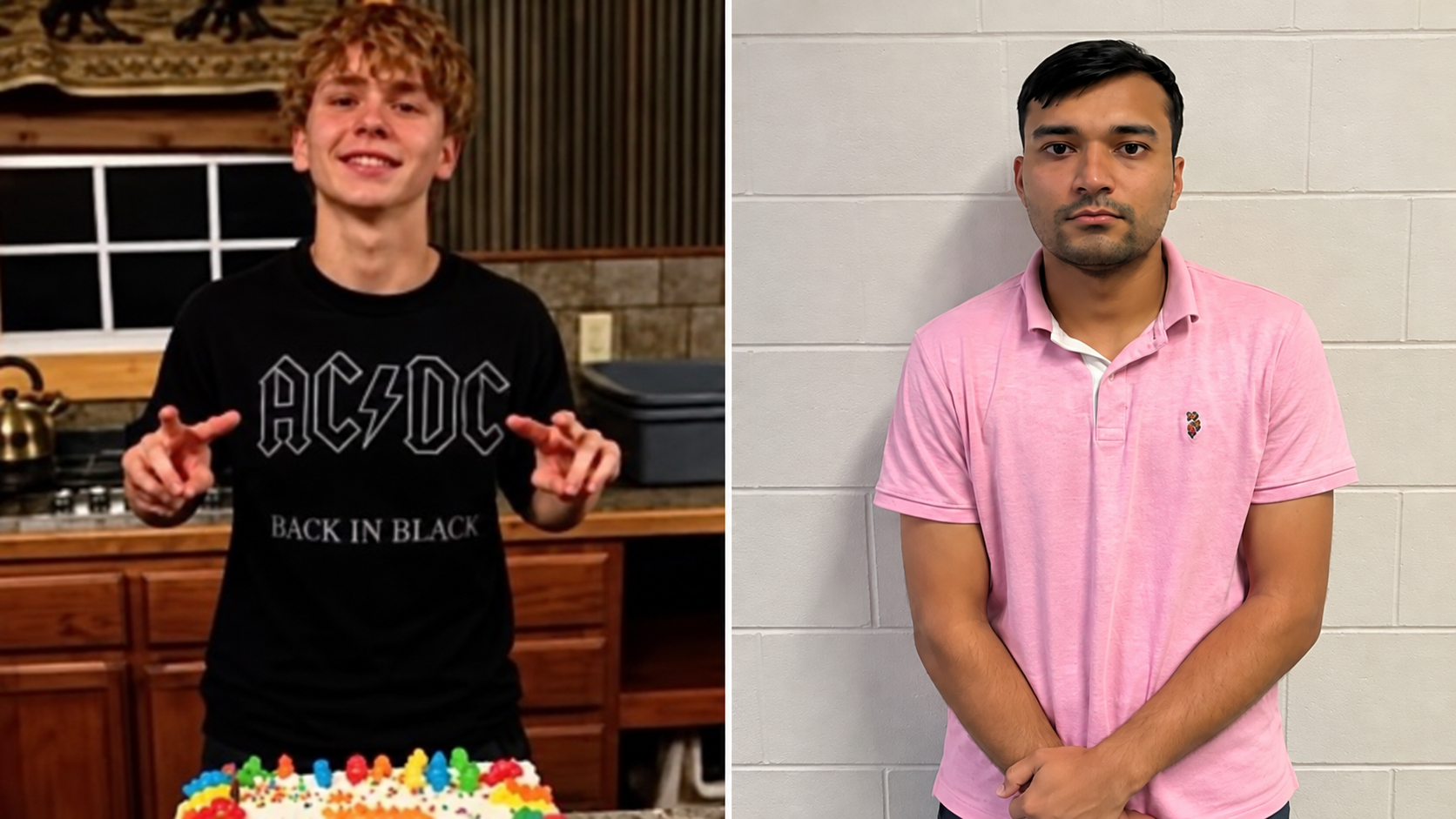
A Florida store owner is facing a murder charge after police say he chased a 14-year-old boy over a reported burglary, intentionally hit him with his car, and drove away, leaving the child critically injured.
Hunter Russey died on October 17, 2026, four days after the incident in West Melbourne, Florida. The business owner, 32-year-old Kavan Vishnubhai Patel, was rearrested the following day and charged with second-degree murder.
According to ClickOrlando, the incident began early October 13 when Patel reported a burglary at his convenience store. Investigators said Patel told officers he saw Russey break through the store’s door but initially failed to disclose that he had pursued the teenager in his vehicle for approximately half a mile.
Russey was riding an electric bicycle when the collision occurred along Cocoanut Grove Avenue.
Surveillance footage showed a vehicle matching Patel’s striking the teenager before crashing into a mailbox and trash cans. Investigators alleged Patel acknowledged intentionally hitting the person he was pursuing.
Patel reportedly told investigators he returned to look for the teenager but could not locate him. Authorities said he subsequently contacted police about the burglary without reporting the collision, delaying the discovery of the injured child.
Officers eventually found Russey unresponsive in a ditch with multiple skull fractures and other severe injuries.
He was rushed to Holmes Regional Medical Center before being transferred to Orlando Health Children’s Arnold Palmer Hospital, where he remained on life support.
During Patel’s initial court appearance on aggravated battery and leaving the scene charges, the judge expressed concern about the circumstances.
“The fact that the alleged victim is a juvenile, that’s something,” the judge said in court.
Following Russey’s death, authorities upgraded the case to second-degree murder. Patel remains in the Brevard County Jail without bond. The charge is an allegation, and his guilt has not been determined.
The case bears similarities to another store owner killing involving a 14-year-old, one that ended with a not guilty verdict just four months earlier.
In South Carolina, convenience store owner Chikei Rick Chow fatally shot Cyrus Carmack-Belton, a Black teenager, on May 28, 2023, after wrongly suspecting him of stealing four bottles of water.
Chow and his son chased Carmack-Belton away from their Columbia convenience store. The pursuit continued more than 130 yards from the business before Chow shot the teenager in the back.
Investigators determined Carmack-Belton had not stolen the water.
The teenager possessed a semiautomatic pistol, but prosecutors disputed the defense’s claim that he pointed it toward Chow’s son. Prosecutors argued the weapon fell during the pursuit and that witnesses did not see Carmack-Belton threaten anyone.
Chow’s attorneys maintained he fired because he believed his son’s life was in danger.
During closing arguments, prosecutor Byron Gipson told jurors Chow had “chased a kid down, shot him in the back.”
Despite the prosecution’s arguments, a jury acquitted Chow of murder on June 1, 2026.
The verdict devastated Carmack-Belton’s family and sparked renewed protests. His relatives also pursued civil legal action.
While Russey’s death involved a vehicle and Carmack-Belton’s involved a firearm, both cases began with suspected crimes at convenience stores and escalated into fatal pursuits of 14-year-old boys.
Another case involving a Black teenager and a store owner occurred in Los Angeles in 1991.
Fifteen-year-old Latasha Harlins was shot and killed by store owner Soon Ja Du after an accusation involving a $1.79 bottle of orange juice.
According to the Los Angeles Times, the confrontation escalated into a physical struggle before Du shot Harlins in the back of the head. Store surveillance footage documented the incident.
Unlike Chow, Du was convicted of voluntary manslaughter. However, she received a suspended 10-year prison sentence, five years of probation, community service, and a fine rather than incarceration.
The punishment prompted outrage among Harlins’ relatives and members of Los Angeles’ Black community, who believed the punishment did not reflect the severity of the killing.
These cases occurred under different circumstances and legal standards, but the acquittals and light sentences remain significant examples of store owners escaping murder convictions after killing Black children. It’s unclear if this will be the case in the Patel trial.
In Florida, the law draws a distinction between protecting property and using deadly force.
Under Florida Statutes Section 776.031, deadly force in defense of property requires a reasonable belief that it is necessary to prevent the imminent commission of a forcible felony. A suspected burglary does not automatically authorize someone to pursue and kill a fleeing suspect.
Whether Patel’s actions meet the elements of second-degree murder will be determined through the criminal proceedings.
According to West Melbourne police, Russey’s family made the decision to donate his organs after his death, allowing the 14-year-old to help others through organ donation.
