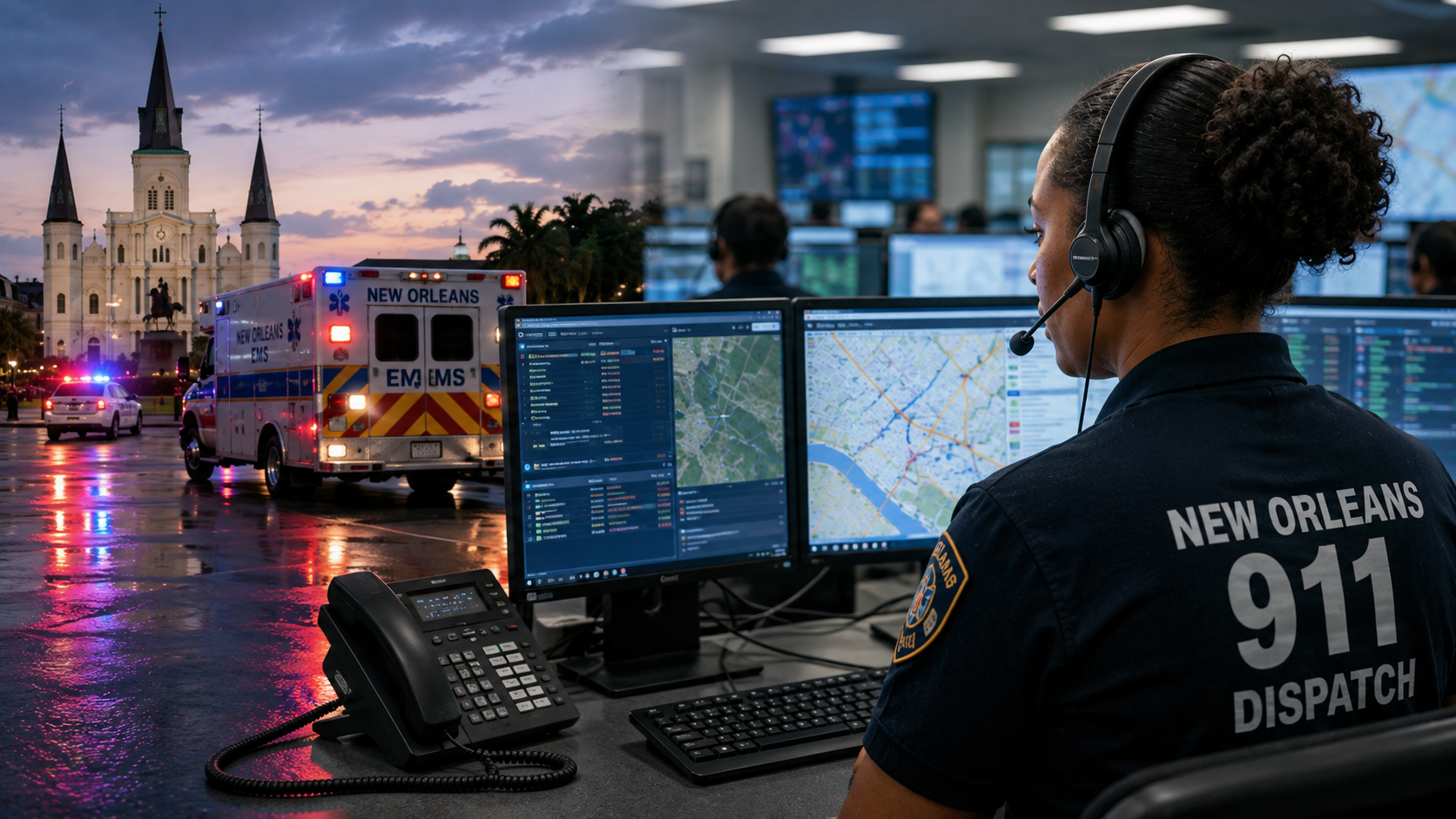
New Orleans’ AI 911 system is drawing national attention as emergency officials defend a technology that can speak directly with some callers while critics question whether artificial intelligence belongs anywhere near a life or death call.
Despite reports suggesting AI is broadly replacing human operators, the Orleans Parish Communication District says the technology has a much narrower job. According to OPCD, the system is only activated when every human call taker is busy and a new caller is located within roughly 200 meters of an already reported vehicle crash. Calls that do not meet those conditions are supposed to default to a human operator.
The agency also pushed back against claims that the technology was recently introduced. OPCD said it has used the tool for about two years. Local station FOX 8 reported that the agency began working with emergency communications company Carbyne in 2022 before rolling out its AI call triage program in 2023.
In practice, the AI 911 system is meant to deal with something emergency centers regularly face during crashes: multiple people calling about the same incident. FOX 8 reported that the automated voice can ask callers whether they are contacting 911 about an accident at a particular location. The system can then determine whether the person needs additional assistance or is simply reporting a crash authorities already know about.
Still, the idea of AI speaking with a person who dialed 911 has generated concern. One online critic identified by the New York Post as Boxy claimed to have spent years working as a dispatcher.
“I was a 911 dispatcher for 11 years and this is the worst idea you could possibly think of,” the commenter said.
The critic argued that emergency calls often depend on details that may not be obvious from the caller’s words alone.
“You have scenarios where the person can’t speak well [or have strong accents] — or if they’re in a domestic situation and they pretend to call for pizza or something — you have to be able to determine how someone feels or pick up on what they aren’t saying,” Boxy said.
“You need a person.”
OPCD maintains that its AI 911 system is not being used for domestic violence calls, medical emergencies or other categories that could require that kind of interpretation. In its public response to the controversy, the agency said the technology has guardrails designed to send calls to humans unless they fit the specific vehicle crash scenario for which the system was created.
Officials have also pointed to staffing pressure as one reason for using the technology. According to FOX 8, OPCD Executive Director Karl Fasold said in July that the agency had 42 call takers and 35 dispatchers while ideally needing 64 call takers and 68 dispatchers. The station reported that New Orleans pays roughly $600,000 annually for a contract that includes the AI triage technology.
FOX 8 also reported that OPCD monitored every call handled by the system during its first three months. Fasold told the station officials found no false positives or false negatives during that initial review. OPCD estimates cited by FOX 8 indicated that AI can handle between 15 and 18 calls out of every 20 associated with some vehicle accidents, potentially keeping human operators available for unrelated emergencies.
New Orleans is not alone in bringing artificial intelligence into emergency communications. The Seattle Fire Department has used AI since December 2023 to listen to medical 911 calls and alert dispatchers when certain callers might be routed to a nurse line. Human dispatchers retain final authority over those decisions, according to the report.
That broader use of AI makes claims that New Orleans is simply the first city to bring artificial intelligence into 911 operations difficult to apply without context. What stands out about the New Orleans AI 911 system is that, under its limited crash protocol, an automated agent can actually interact with the caller instead of only assisting a human dispatcher behind the scenes.
The debate is likely to grow as emergency agencies search for ways to manage staffing shortages without sacrificing judgment during critical moments. New Orleans officials insist humans remain at the center of their operation. Critics are asking a harder question: when somebody calls 911 on what may be the worst day of their life, how much responsibility should a machine ever be allowed to carry?