

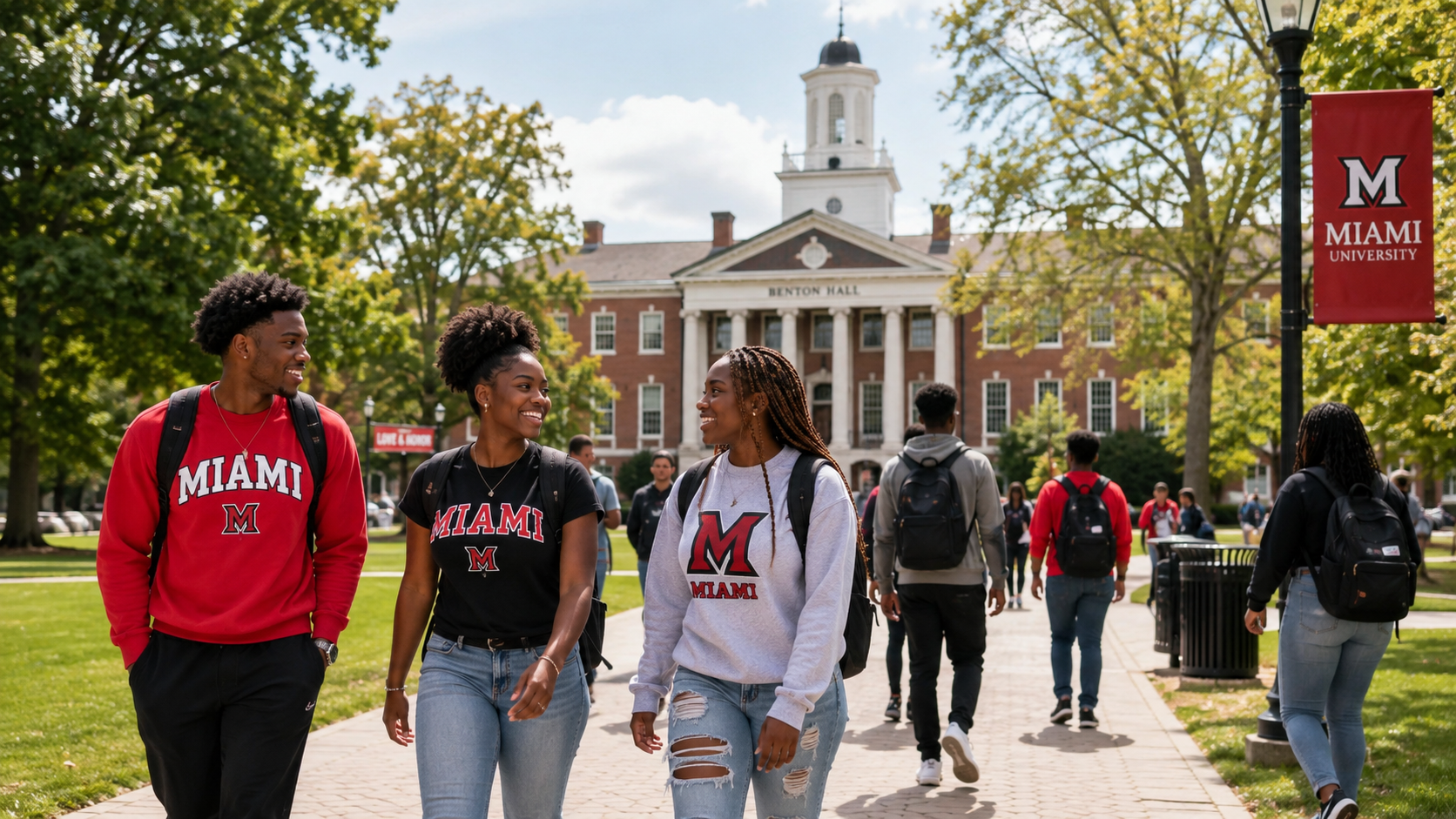
AI curriculum changes at Miami University are set to reach every undergraduate major, turning artificial intelligence from an optional technology topic into a field specific skill students will be expected to carry into their careers. According to Miami University’s August 5 announcement, its new AI in the Majors initiative will place relevant AI competencies directly inside degree programs across the university.
This is not another campus plan to tuck AI into one elective and call the job finished. Miami University, which is based in Oxford, Ohio, wants students studying everything from art and anthropology to accounting and speech pathology to understand how artificial intelligence applies to their chosen professions.
The first phase of the AI curriculum will begin during the 2026 to 2027 academic year. Miami said 13 volunteer departments, representing an estimated 4,925 students, will introduce the program during the fall 2026 semester. Those departments are Accountancy, Anthropology, Art, Chemistry and Biochemistry, Educational Psychology, Electrical and Computer Engineering, Languages, Literatures, and Writing, Mathematics, Physics, Sport Leadership and Management, Speech Pathology and Audiology, Statistics, and Teaching, Curriculum, and Educational Inquiry.
Each participating department selected one major for the initial rollout. Faculty working with those majors will develop learning outcomes and course material that can eventually guide other programs within their departments.
Miami’s current rollout schedule calls for 15 more departments, affecting an estimated 10,949 students, to begin implementation during spring and fall 2027. The final group of 21 departments, representing an estimated 18,982 students, is scheduled to join during the 2027 to 2028 academic year. Those figures come from the university’s latest announcement and reflect a phased rollout rather than one campuswide switch being flipped overnight.
The structure of the AI curriculum may be the most important part of the plan. According to Miami’s 2026 to 2028 completion plan, departments will establish an AI learning outcome for each program, identify the required courses where those skills belong, and create assignments that allow students to use and evaluate AI within their disciplines. The plan is designed to reach every student in a program, not only those who voluntarily sign up for an AI course.
Ellen Yezierski, director of Miami’s Center for Teaching and Learning and a professor of Chemistry and Biochemistry, is leading the initiative. According to the university’s announcement, Yezierski believes higher education cannot separate itself from a technology that students will encounter throughout their personal and professional lives.
“If it’s this embedded in the world, then it needs to be embedded in the learning and in the coursework,” she said. “I trust our faculty to make great decisions on where it fits.”
That faculty control gives the Miami AI curriculum room to look different across majors. An art student may need to examine authorship, creative ownership, and generated imagery, while a future accountant may need to understand automated analysis, accuracy, confidentiality, and professional responsibility. The university has not announced one universal assignment or platform that every student must use.
Yezierski has worked alongside AI provost fellows Heidi McKee, a professor of English, and Dennis Cheatham, an associate professor of Art. Both are faculty affiliates in Miami’s Department of Emerging Technology in Business and Design. Miami said McKee and Cheatham will present their work during the 45th Original Lilly Conference on College Teaching in November 2026 after previously leading sessions at the university’s AI Symposium. Yezierski has also led faculty instruction on using ChatGPT and other generative AI tools to improve teaching.
“Students need critical knowledge,” McKee said.
Speech Pathology and Audiology offers one of the clearest examples of how the AI curriculum could work outside a traditional technology department. Donna Scarborough, professor and chair of the department, said faculty members were already investigating artificial intelligence before the university requested volunteers.
“Our department volunteered to participate in the first cohort because we were already studying AI and how it relates to our major, including both our undergraduate and graduate curriculum.”
According to Miami University’s reporting, the department had spent more than a year examining best practices for AI in teaching, research, and clinical education.
“It was a natural fit for us to volunteer,” Scarborough said.
Rather than receiving identical instructions from a central office, departments will decide how artificial intelligence affects the standards, responsibilities, and risks within their professions.
“I think the way the program was designed allowed for different majors to concentrate on how AI impacted their respective programs without forcing a one size fits all mandate,” Scarborough said.
The Speech Pathology and Audiology program plans to introduce concepts gradually as students move through their courses. That approach could keep the AI curriculum from becoming a single lesson students complete and forget.
“AI/technology competencies will be rolled out in different courses and build throughout the curriculum, both for our academic and research courses as well as our clinical courses,” Scarborough said. “Our goal will be to develop awareness, agency, application and accountability specifically related to ethical issues and use.”
That last word, accountability, matters when AI enters programs connected to patients, clients, children, finances, research, or private information. Scarborough said students in introductory classes will begin with basic awareness, while seniors will face more advanced questions about professional use.
“For example, our introductory course will develop foundational level awareness of digital technology, AI, and future use specifically within communication disorders. In contrast, our senior level clinic course will emphasize the application and accountability of AI use for documentation of patient treatment sessions.”
Miami’s embrace of AI does not mean the university is ignoring cheating, fabricated information, or plagiarism. Its academic integrity guidance warns that AI tools can support productive and creative work, but they can also be used to disguise plagiarism or complete unauthorized assignments. The guidance advises instructors to set clear expectations, test the tools themselves, require citations when appropriate, and remain cautious about AI detection programs that may not be accurate.
The university’s writing and AI resources also encourage instructors to treat generative AI as fallible. Miami faculty materials specifically address fabricated sources, misinformation, bias, and the risk that students could become too dependent on generated answers instead of building confidence in their own thinking. That background makes the AI curriculum less about teaching students to press a button and more about teaching them to question what comes back.
Miami’s strategy also follows a broader shift in education and employment. The World Economic Forum’s Future of Jobs Report 2025 identified AI and big data among the fastest growing skill areas through 2030, while also emphasizing that creative thinking, resilience, curiosity, and lifelong learning will remain important.
At the same time, UNESCO’s AI competency framework for students calls for education systems to prepare students to become responsible users and creators of AI. Its framework covers 12 competencies involving technology, ethics, human agency, and responsible design. Miami’s focus on awareness, application, judgment, and accountability fits within that larger conversation about teaching students to understand both the power and the consequences of AI.
AI in the Majors is not Miami’s first move into artificial intelligence education. The university already offers a Bachelor of Science in Artificial Intelligence that allows students to connect AI studies with areas including emerging technology, cybersecurity, quantum computing, and philosophy.
Miami also offers an AI Fundamentals microlearning program built around short modules introducing core concepts. The university said the five module course is free for students, faculty, and staff, while participants who finish the assessments can earn a digital badge for professional profiles and resumes. These existing options provide general or specialized training, while the new AI curriculum is intended to place relevant competencies inside every major.
Students who have already participated in national AI discussions appear to understand why field specific instruction could matter. Nate Novak, a junior studying Political Science with a Business Leadership co major, attended AI Congress in Washington in May 2026 through his internship with Miami’s Office of ASPIRE.
“Integrating AI literacy into our education at Miami is extremely important now more than ever. AI is continuing to develop at a rapid pace and becoming a fundamental part of nearly every industry. Learning how to use it properly will give Miami students an advantage when it comes time to enter the workforce.”
Novak also pushed back against the idea that students should use artificial intelligence as a replacement for studying.
“AI can be used as a tool to enhance our studies, not something that just spits out answers. Knowing how to use the AI effectively will be an invaluable skill throughout our careers. Having guidance from Miami faculty is essential because they can teach us how to use these tools efficiently and in ways that help us better learn.”
Noah Kruthaupt, a Miami senior studying Marketing with an Entrepreneurship co major, also attended AI Congress. According to the university’s report on the Washington event, the gathering brought together government officials, industry leaders, policymakers, and students to discuss artificial intelligence and other emerging technologies.
“People need more real experience, risk, and accountability related to their education,” Kruthaupt said, adding that students benefit from learning how to ask stronger questions and think across disciplines.
“The more problems people are exposed to the better, which means real world experience and real problems,” he said. “And all of that helps solve the biggest issue with using/integrating AI: being able to build and use judgment at a high level.”
That emphasis on judgment may ultimately define whether Miami’s AI curriculum succeeds. By placing artificial intelligence inside required courses instead of leaving it on the edge of campus life, the university is betting that the graduates who stand out will not simply be the ones who use AI the fastest. They will be the ones who understand when, why, and whether it should be used at all.
