

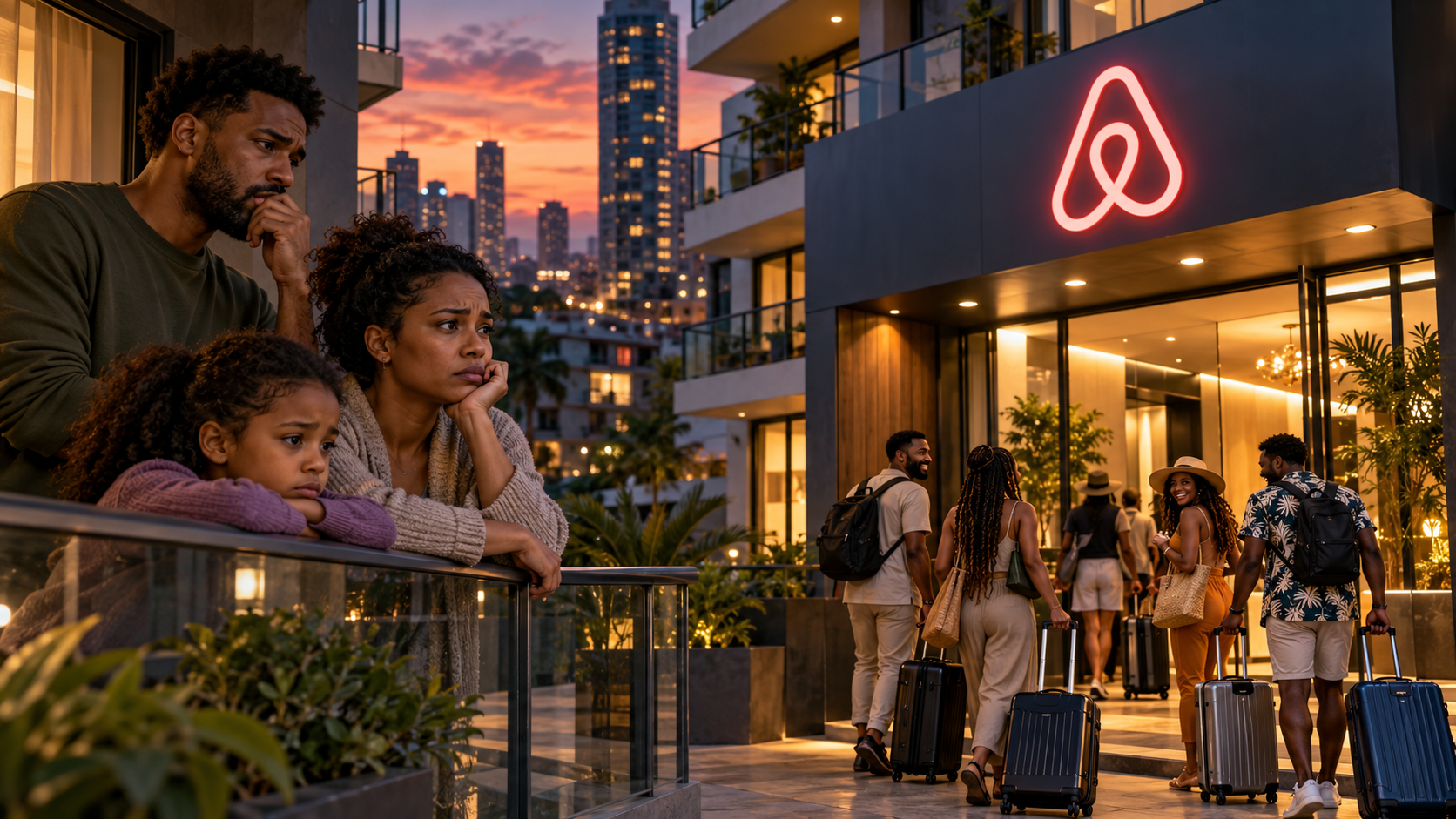
Airbnb did not create America’s apartment crisis, but there is credible evidence that short term rentals have pushed rents and home prices higher in neighborhoods where enough housing was converted from places to live into places for tourists to stay.
A major study published in Marketing Science examined Airbnb listings across the United States and found that a 1 percent increase in Airbnb listings was associated with a 0.018 percent increase in rents and a 0.026 percent increase in house prices in a ZIP code with a typical owner occupancy rate. Using Airbnb growth during the period studied, the researchers estimated an effect equal to roughly $9 more in monthly rent and $1,800 more in home value annually for the median ZIP code in their data.
Those numbers are not large enough to support the claim that Airbnb single-handedly wrecked the apartment market. They are large enough to show that short-term rentals can contribute to rising housing costs.
The reason is supply.
The Marketing Science researchers found that as Airbnb activity increased, the supply of short-term rentals increased while the supply of long-term rental housing decreased. The effect was stronger in places with fewer owner-occupied homes, suggesting the bigger housing concern is not necessarily a homeowner renting a spare bedroom for a weekend. It is housing that could otherwise serve residents being operated as a commercial short-term rental.
Research from other cities points in the same direction.
A 2025 study published in Real Estate Economics examined San Francisco’s registration requirement for short-term rentals. Researchers found that the policy reduced Airbnb availability by roughly 20 to 27 percent and reduced booked nights by 22 to 31 percent compared with surrounding cities that did not receive the same policy treatment. The study also found that long-term housing prices fell after the regulation took effect, with the authors describing the result as evidence of improved housing affordability.
Research in other markets has shown that the type of Airbnb matters too. A 2024 study of Berlin published in Regional Science and Urban Economics found that a regulation that successfully removed commercial Airbnb listings increased the supply of long-term rentals. A later policy change that mainly affected noncommercial hosts did not produce the same housing response.
That difference gets closer to the real fight over Airbnb and apartments.
Someone renting their primary home while they travel is not removing that home from the residential market permanently. An investor buying an apartment, furnishing it, and operating it primarily as a tourist property can. When that happens across hundreds or thousands of units in a housing-constrained neighborhood, residents are competing for fewer available homes.
New York City became one of the biggest tests of what happens when a government aggressively restricts that business model.
The city began enforcing Local Law 18 in September 2023. According to the New York City Office of Special Enforcement, tens of thousands of illegal short-term rental listings disappeared from major booking platforms following the crackdown. The city reported only about 3,000 active short-term rental registrations in its 2025 reporting, compared with more than 38,000 active listings on one major platform at the beginning of 2023.
If Airbnb were the main reason New York rents were so high, removing most short-term listings should have produced a dramatic housing turnaround.
That did not happen.
A 2026 working paper examining New York’s Local Law 18 found that affected Airbnb listings fell approximately 87 percent after enforcement, but estimated the first-year effect on asking rents at roughly negative 0.1 percent, a change the study could not distinguish statistically from zero. The paper also did not find an unusual immediate increase in conventional rental inventory.
That does not prove Airbnb had no effect on New York housing. It shows that removing Airbnb listings does not automatically turn every former short-term rental into an affordable apartment.
The larger apartment problem is considerably deeper.
According to the Harvard Joint Center for Housing Studies, 22.7 million renter households were housing cost-burdened in 2024, meaning they spent more than 30 percent of their income on housing. The center also found that 11 million extremely low-income renter households were competing for only 3.8 million affordable and available units.
Harvard researchers reported that more than 7 million units renting for less than $1,000 per month in inflation-adjusted terms disappeared between 2014 and 2024. Construction costs have also climbed, while new market-rate development frequently enters the market at prices lower-income renters cannot afford.
Airbnb cannot explain that entire gap.
What short-term rental platforms did change was the calculation landlords and investors could make about an individual apartment. A unit no longer had to be worth only what a local renter could pay each month. In a tourist-heavy neighborhood, the same property could potentially generate revenue night by night.
That created a financial incentive to move some homes out of the traditional rental market, and research shows renters in heavily exposed neighborhoods could feel the consequences.
The evidence therefore lands somewhere between the two loudest arguments.
Airbnb did not single-handedly ruin the apartment market. America already had serious problems involving housing supply, zoning, construction costs, disappearing low-rent units, and incomes that failed to keep up with housing expenses.
But Airbnb was not harmless either.
Where investors turned residential units into permanent vacation rentals, short-term rental growth could shrink long-term supply and place additional pressure on rents and property values. The impact appears strongest where housing is already scarce, and tourist demand is high.
The person renting their couch for a weekend was never the whole problem. The bigger question was what happened when an apartment stopped being treated primarily as somebody’s home and started being valued like a hotel room.
