

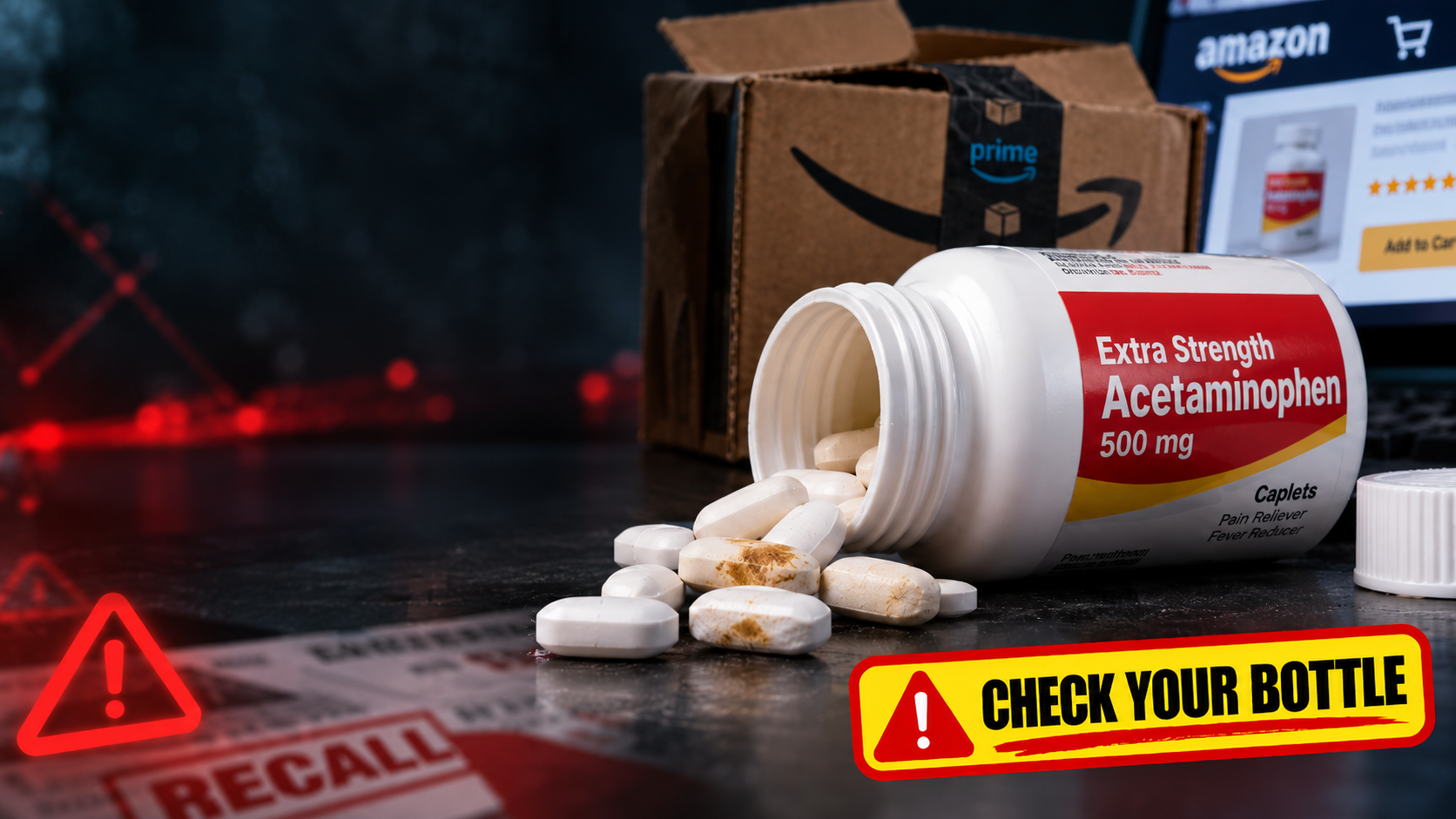
More than 112,000 bottles of a popular pain reliever sold on Amazon are being recalled after customers reported finding discolored pills inside their medication bottles.
According to the U.S. Food and Drug Administration (FDA), the nationwide Amazon acetaminophen recall affects 112,932 bottles of Extra Strength Acetaminophen 500 mg caplets. The medication is commonly used to treat headaches, muscle aches, back pain, menstrual cramps, and fevers.
The voluntary recall began September 18, 2026, and was subsequently published in the FDA’s enforcement reports in October. Aurobindo Pharma USA Inc. initiated the recall after receiving complaints about tablets that appeared discolored.
The issue is particularly concerning because changes in a medication’s appearance can indicate a quality problem, even when the product has not reached its expiration date.
In a statement provided to Nexstar, an Amazon spokesperson confirmed the recall.
“Amazon is voluntarily recalling specific lots of Amazon Basic Care Extra Strength Pain Relief acetaminophen 500mg caplets due to reports of tablet discoloration in the affected lots,” the spokesperson said. “This is a voluntary recall initiated in coordination with the manufacturer, Aurohealth, and the FDA.”
The affected medication was distributed nationwide through Amazon and sold in three bottle sizes. Not every bottle of Amazon acetaminophen is included, making it important for customers to check their specific lot numbers.
According to the FDA’s recall information, the affected products include 14,640 bottles containing 200 caplets, identified by lot number ACD125040A, with an expiration date of September 30, 2027.
Another 90,456 bottles containing 500 caplets are included. The affected lots are ACD124036A and ACD124030A, both expiring September 30, 2027; ACD124042A, expiring October 31, 2027; ACD124048B, expiring November 30, 2027; and ACD125010A, expiring February 29, 2028.
The remaining 7,836 recalled bottles contain 1,000 caplets. Those are identified by lot number ACD124048A, with an expiration date of November 30, 2027.
The FDA has identified consumer complaints about discoloration as the reason for the recall. However, the agency has not publicly established what caused the tablets to change color or assigned a health risk classification to the current recall.
That uncertainty is exactly why consumers should take the warning seriously.
According to MedlinePlus, a service of the National Library of Medicine, medications can deteriorate because of exposure to heat, moisture, air, or light. These conditions may affect their stability and effectiveness.
A pill that changes color, texture, or smell may no longer be in its expected condition. MedlinePlus specifically advises consumers against using damaged medication, even when the printed expiration date has not passed.
Discoloration does not automatically mean a medication is contaminated or toxic. However, it can raise questions about whether the product has remained chemically stable, whether its ingredients have changed, or whether a manufacturing or storage problem has occurred.
Those possibilities have not been confirmed in this Amazon acetaminophen recall. The concern is that consumers cannot determine a pill’s chemical quality simply by looking at it.
The National Library of Medicine’s official labeling for Amazon Basic Care acetaminophen describes the affected formulation’s normal appearance as white to off-white. Unexpected staining or discoloration therefore warrants attention.
Beyond the recall itself, acetaminophen carries an important safety risk that consumers should understand.
According to the FDA’s acetaminophen safety guidance, taking excessive amounts of the medication can cause severe liver damage, potentially leading to liver failure or death.
The liver processes acetaminophen after it enters the body. When someone takes more than their body can safely handle, a toxic byproduct can accumulate and damage liver cells.
The FDA lists 4,000 milligrams as the maximum total daily amount for adults and children ages 12 and older, but individual product labels may recommend a lower limit. In fact, the recalled Amazon Basic Care 500 mg formulation directs adults not to exceed six caplets, or 3,000 milligrams, within 24 hours unless instructed by a doctor.
The danger increases when someone unknowingly takes multiple medications containing acetaminophen.
The FDA explains that the ingredient appears in more than 600 prescription and nonprescription medications, including popular cold and flu treatments. A person taking acetaminophen for a headache while also using a combination cold medicine could accidentally exceed recommended limits.
Symptoms of an acetaminophen overdose may include nausea, vomiting, abdominal pain, confusion, and yellowing of the skin or eyes. However, the FDA warns that some individuals experience no immediate symptoms, and signs of liver injury may take days to develop.
These established dangers of acetaminophen overdose are separate from the discoloration issue. Officials have not reported adverse health effects connected to the currently recalled Amazon tablets, and there is no public finding that the discolored pills contain excessive acetaminophen or dangerous contaminants.
Still, the recall raises additional questions because this is not the first time Amazon acetaminophen produced by Aurobindo has faced concerns about unusual tablet coloring.
According to a 2025 FDA recall record, Aurobindo voluntarily recalled 4,608 bottles of 325 mg acetaminophen tablets sold through Amazon after complaints involving a “brown surface on tablets.”
That earlier recall received a Class II designation, meaning exposure could potentially cause temporary or medically reversible health consequences, while the probability of serious harm was considered remote.
The classification of the 2025 recall does not establish the risk level of the current Amazon acetaminophen recall, which remains unclassified as of October 13, 2026.
For customers who purchased the affected medication, the next step is to check their medicine cabinets and compare the bottle’s lot number and expiration date against the recalled batches.
Consumers with matching bottles should avoid using the affected medication and review any recall notification from Amazon for return or refund instructions. Anyone who has already taken the product and experiences unusual symptoms should speak with a healthcare professional.
The FDA’s drug recall guidance also encourages consumers to consult a pharmacist or doctor when they have questions about recalled medication, particularly when they need a safe alternative.
Anyone who suspects an acetaminophen overdose should seek immediate medical help or contact Poison Control at 1-800-222-1222, even if symptoms have not appeared.
For millions of households that rely on affordable, easily accessible pain medication, the Amazon acetaminophen recall serves as an important reminder that the condition of a pill matters just as much as its expiration date. When a widely used medication begins showing unexpected physical changes, consumers should not have to guess whether it is safe to swallow.
