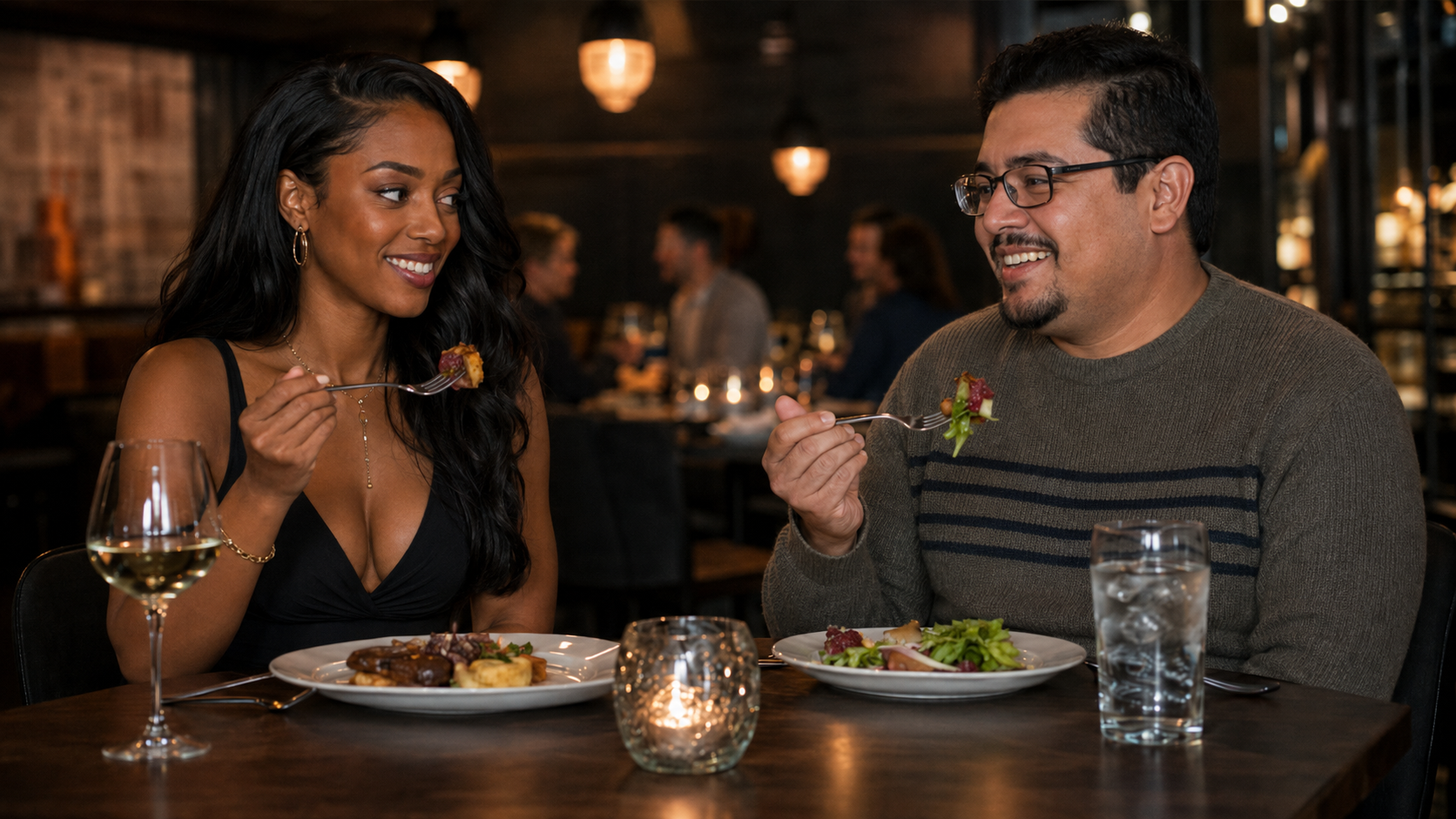
Some people show up to a date looking for chemistry, but new survey data says a big chunk of America is just there for free meal dates and calling it a night. According to a new survey from JG Wentworth, a financial services company that decided to poll the country on romance, 39.9 percent of respondents admitted they have gone on at least one date purely to score a free meal. Another 27.5 percent said they have never actually done it but have thought about it, and only 32.6 percent claim the idea never crossed their mind.
The survey, titled “Love on a Budget: Are Americans Too Broke to Date?,” polled 1,538 adults across the country about the real cost of modern romance and where free meal dates fit into that picture. The average American now spends about $93 on a first date, and 60.1 percent say spending expectations around dating are higher now than they used to be.
That tracks with a broader shift happening in dating culture right now. According to a Wall Street Journal report, people in their twenties are actually reviving the traditional sit-down dinner date, trading quick coffee meetups for full restaurant experiences. Pair that with rising menu prices, and it makes sense that free meal dates have quietly become a budget strategy for some people who still want to get out of the house and meet someone new.
The JG Wentworth numbers are not the only evidence that a free meal can outweigh romantic chemistry. According to a separate DatingAdvice.com study, 30 percent of daters admitted they have accepted a romantic dinner invitation just to get a free meal, with no romantic attraction involved. DatingAdvice describes the practice as a “foodie call.”
That study surveyed 1,016 U.S. adults through an online panel, with an overall margin of error of approximately plus or minus 3.1 percent at a 95 percent confidence level. The findings suggest the behavior is not isolated to one particular generation either. At least 25 percent of every age group surveyed admitted they had gone on a foodie call at least once.
Younger adults did lead the pack. DatingAdvice found that 32 percent of Gen Z and zillennial respondents ages 28 to 33 said they had gone on a date just for a free meal, the highest rate recorded among the age groups surveyed. However, daters 65 and older were not far removed from the trend, with 26 percent admitting they had done the same thing. The numbers challenge the assumption that foodie calls are strictly tied to younger people, dating apps, or swipe culture.
Location appears to matter too. Daters in the Western United States reported the highest rate, with 35 percent saying they had agreed to a date for the free meal. Southern respondents followed at 30 percent, while the North came in at 26 percent and the Midwest at 22 percent. Even in the region with the lowest share, more than one in five respondents admitted to doing it.
DatingAdvice noted that the West is also home to some of the country’s higher housing costs and more expensive urban areas, raising questions about whether affordability pressures could be influencing dating behavior. However, the study stops short of claiming that higher living costs directly cause more people to accept dates for food. Researchers specifically noted that the data cannot formally establish causation.
Money is clearly steering a lot of decisions at the table. Nearly 30 percent of respondents, 29.5 percent to be exact, said they have turned down a date entirely because they could not afford it. An even bigger number, 85.7 percent, admitted to skipping a second date because they felt financially misaligned with the person across from them. Dating has never been cheap, but the current math is pushing people toward blunt, sometimes uncomfortable decisions about who gets their time and their wallet.
Professional development expert Jan Goss described the pattern as a symptom of a culture that celebrates getting something for nothing, and explained that showing up with a hidden agenda damages a relationship before it ever gets the chance to build trust. Goss did not dismiss the economic pressure behind free meal dates either, acknowledging that inflation is real and a lot of people are genuinely struggling right now. Her bottom line was simple. Financial hardship does not excuse compromising your integrity.
Her etiquette rules are just as direct. Whoever extends the invitation is expected to pay, and anyone unsure about the arrangement should just ask upfront instead of guessing. If covering a meal is not realistic that week, Goss suggested simply saying, “It’s not in my budget this week,” which she framed as a complete and acceptable sentence on its own. She also recommended always carrying enough to cover yourself, just in case, so a first date does not turn into an awkward standoff over the check.
Goss’s advice extends past first dates too. When she invites her friend group out, she makes it clear in advance that everyone is covering their own tab, which keeps the outing from turning into confusion once the bill lands on the table. That kind of transparency, she said, is really the throughline for every kind of relationship, romantic, professional, or platonic. Show up honestly, communicate what you can and cannot afford, and treat the other person like an actual human being instead of a free meal opportunity.
What all of this really points to is a dating culture where free meal dates have become both a punchline and a coping mechanism. Nearly four in ten people admitting it in one survey, alongside separate DatingAdvice research finding three in ten daters have accepted a date just for the meal, shows that money is increasingly difficult to separate from modern romance. DatingAdvice’s generational and regional breakdowns make the picture even more striking, with foodie calls showing up among every age group and in every part of the country.
Whether it is inflation, shrinking patience for wasted time, or simply people being more willing to admit their real motives, the numbers suggest Americans are done pretending money is not part of the dating equation. Somewhere between the bread basket and the bill, finding romance has also become a financial decision.