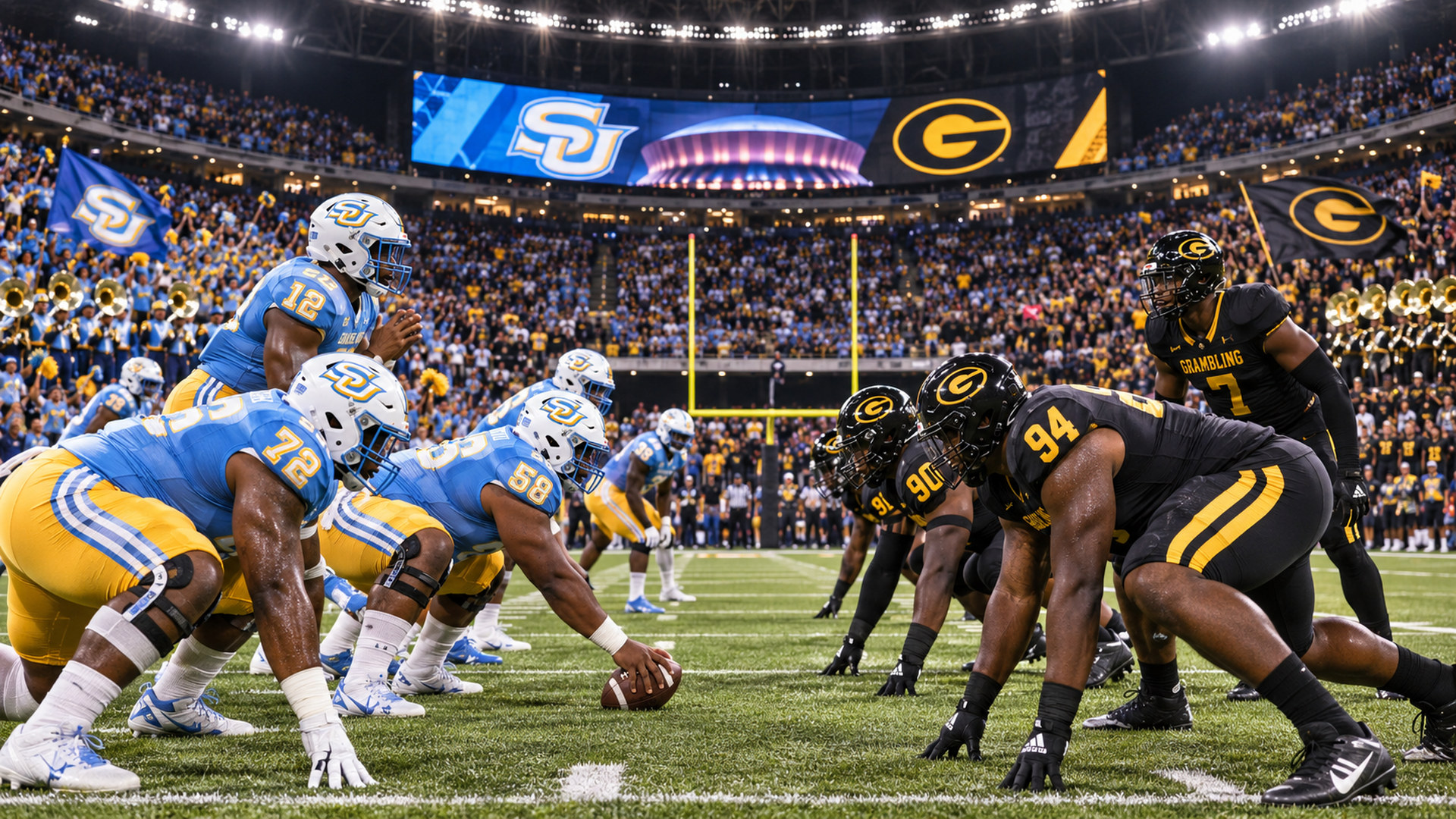
Before either team takes the field Saturday, New Orleans will already be rocking with school colors, marching bands and decades of good-natured trash talk. The 53rd Bayou Classic brings Southern University and Grambling State University back to the Caesars Superdome on November 28, but this Thanksgiving weekend showdown carries a history much bigger than the scoreboard.
The rivalry dates to November 11, 1932, when Southern faced what was then called the Louisiana Negro Normal and Industrial Institute in Monroe. At a time when segregation limited where Black athletes could compete and how much attention their achievements received, schools like Southern and Grambling built football programs that became sources of pride for their communities.
Grambling’s legendary coach Eddie Robinson helped take that pride to a bigger stage. After watching Black college games draw huge crowds elsewhere, Robinson pushed for his Tigers to play in major stadiums. Grambling publicist Collie Nicholson also helped develop the vision, while pioneering Black sports journalist and Southwestern Athletic Conference official R.L. Stockard served on the committee that brought the matchup to New Orleans.
The first game officially called the Bayou Classic arrived at Tulane Stadium on November 23, 1974. More than 76,000 fans filled the stands as a Grambling squad featuring freshman quarterback Doug Williams shut out Southern 21-0. The following year, the event moved to the newly opened Superdome, giving the rivalry a home worthy of its growing reputation.
Robinson understood the significance. As the Sugar Bowl organization later documented, he called it “our Rose Bowl, our Sugar Bowl, our Orange Bowl all wrapped into one.” For Black college football programs that rarely received the same national coverage or resources as major predominantly white schools, the Classic proved they could command a massive audience on their own terms.
The national spotlight grew even brighter in 1991, when NBC began broadcasting the matchup nationwide, making history for HBCU football. That milestone put Southern and Grambling, their students and their school traditions, in living rooms across America. The Classic eventually returned to NBC’s broadcast network after several years on cable, and its television partnership now extends through 2027.
Of course, anybody who knows the Bayou Classic knows the bands don’t play second fiddle to football. Southern’s Human Jukebox and Grambling’s World Famed Tiger Marching Band have turned the Friday night Battle of the Bands and game-day halftime show into attractions of their own. There are booming brass sections, precision dance teams, Greek-letter organizations, and serious bragging rights even before kickoff.


Made to order and shipped to your door.
Southern band director Dr. Kedric Taylor once summed up the importance of building that legacy: “It is important to plant seeds now and watch them grow with you.” The performances have helped generations of students discover HBCU band culture, while the weekend itself has become a reunion for alumni, families and friends.
The tradition has also survived major interruptions. Hurricane Katrina forced the 2005 matchup to Houston before it returned to New Orleans in 2006. The COVID-19 pandemic pushed the 2020 football-season edition into April 2021 in Shreveport. Through it all, the rivalry kept going, carrying memories and rituals from one generation to the next.
There is plenty at stake this year. Southern enters Saturday having won four straight Bayou Classics, including a dramatic 28-27 comeback over Grambling in 2025. The Jaguars also lead the Bayou Classic series 28-24. But records alone have never captured what a victory means. Former Southern coach Pete Richardson once put it simply: “The people’s champion is the winner of the Bayou Classic.”
This year’s celebration has featured a Thanksgiving parade, a Greek Show and Friday’s Battle of the Bands, with a Saturday fan festival scheduled at Champions Square. Kickoff is set for 1 p.m. Central on NBC and Peacock.