

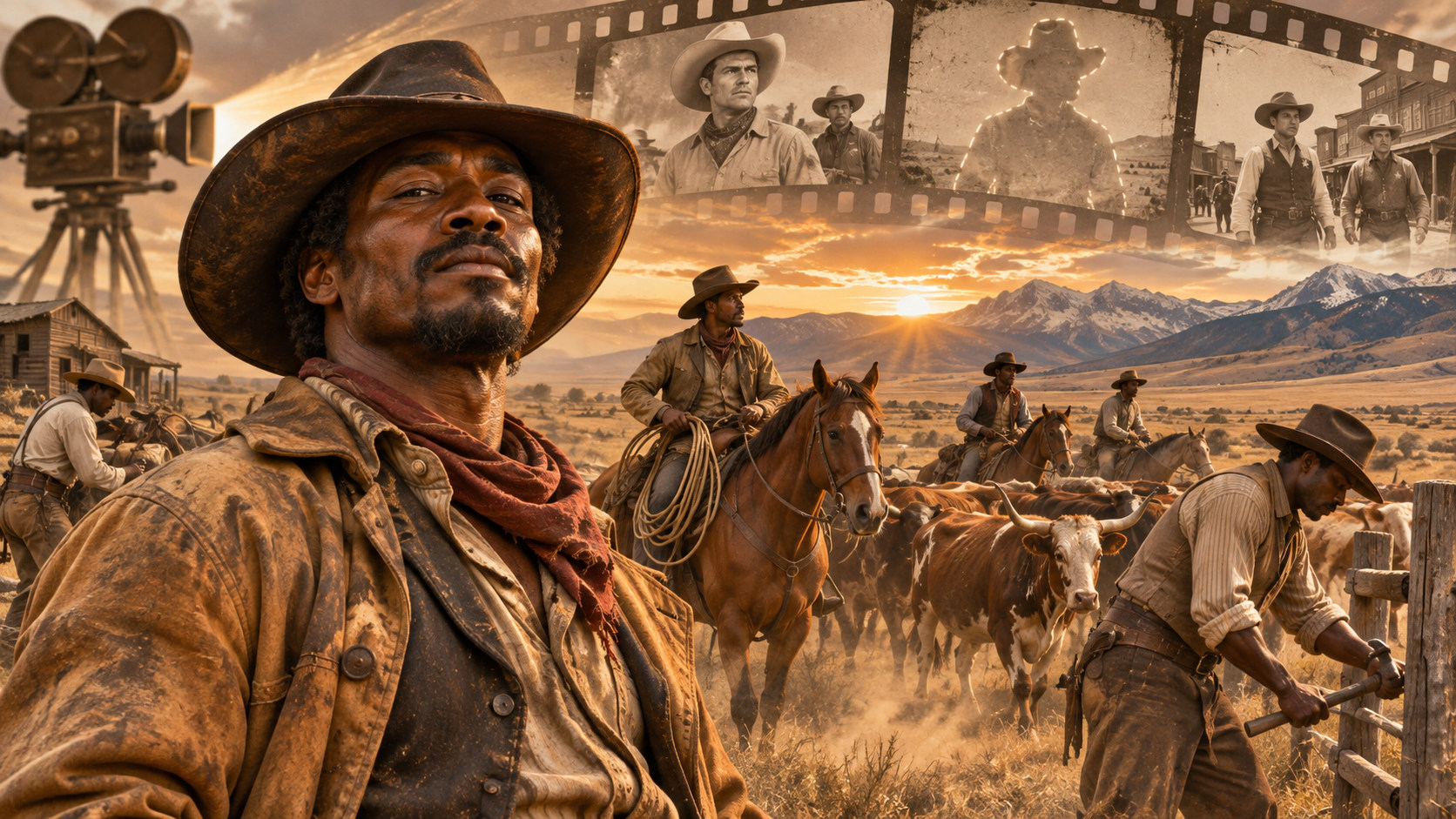
Black folks have been riding horses, roping cattle, and running rodeos long before cowboy boots became everybody’s favorite fashion statement.
The truth is, Black cowboy culture never went anywhere. It has been alive in rodeo arenas, family ranches, riding clubs, and communities across America for generations. Now, more people are finally paying attention to a history that deserves recognition far beyond country music.
According to the Smithsonian, historians estimate that roughly one in four cowboys during the American West’s cattle-driving era were Black. These men worked as ranch hands, cattle drivers, horse trainers, and wranglers, helping build an industry that became central to America’s identity.
Many were formerly enslaved people who used skills learned while working with livestock to find employment after emancipation. Their labor helped move cattle across dangerous trails and sustain ranching operations throughout the West.
Yet Hollywood spent decades selling a different image.
Western movies largely centered white cowboys, leaving Black riders out of the stories they helped create. According to the Library of Congress, historians estimate that approximately 6,000 to 9,000 of the roughly 35,000 cowboys working during that period were Black.
Among the overlooked pioneers was Bill Pickett, a Texas-born cowboy who helped transform rodeo competition. Per the National Cowboy & Western Heritage Museum, Pickett originated the steer-wrestling technique known as bulldogging, which evolved into an established rodeo event. He was inducted into the National Rodeo Hall of Fame in 1972.


Made to order and shipped to your door.
Today, his legacy lives through one of the biggest institutions in Black rodeo.
Founded in 1984 by promoter Lu Vason, the Bill Pickett Invitational Rodeo was created to celebrate Black cowboys and cowgirls after Vason noticed their limited visibility at a major Wyoming rodeo.
More than four decades later, the organization continues touring nationally, putting Black rodeo athletes in front of audiences while educating families about Western history.
Under president and producer Valeria Howard-Cunningham, the rodeo has expanded its cultural reach, connecting Western sports with music, fashion, and community celebrations.
“The rodeo holds a rich history, legacy, and significance within our community,” Howard-Cunningham explained in the organization’s 2026 anniversary statement.
And these events are not simply history lessons.
Black rodeos feature bull riding, barrel racing, steer wrestling, roping competitions, music, food, and generations of families who have grown up around horses. The atmosphere reflects a culture where Western traditions meet Black style, entertainment, and community.
Photographer Ivan McClellan has spent more than a decade documenting that world.
In a 2026 interview with Sugarcane Magazine, McClellan described discovering an entire community of Black riders whose experiences rarely appeared in mainstream Western entertainment.
His photographs capture cowboys wearing gold chains and sneakers, cowgirls competing in elaborate Western outfits, and families gathering around the rodeo arena.
His latest photography book, Eight Seconds: Legacy in Motion, adds 91 images documenting the people keeping Black cowboy traditions alive.
But McClellan is doing more than taking pictures.
Through his Eight Seconds Rodeo, he has created opportunities for Black athletes to compete for larger payouts and gain recognition.
According to his Sugarcane interview, the event provides $75,000 in athlete compensation, including $60,000 in prize money and $500 appearance fees for competitors.
That financial investment matters because rodeo is an expensive sport. Horses require training, transportation, equipment, veterinary care, and ongoing maintenance. Athletes also face travel costs and financial uncertainty while competing.
McClellan told Euronews that he had seen Black competitors earn only hundreds of dollars for events where athletes elsewhere could win substantially more.
His goal is to give talented riders a bigger platform and make their work financially worthwhile.
The next generation is already making noise.
Texas barrel racer Kortnee Solomon is among the young athletes receiving attention through McClellan’s photography. Her appearance in his latest book highlights a generation of Black cowgirls determined to compete at higher levels while representing their communities.
And Black cowboy culture isn’t limited to rural ranches.
In California, the Compton Cowboys are proving that horseback riding belongs in urban communities, too.
The collective grew out of the Compton Jr. Posse, an equestrian youth program established by Mayisha Akbar in 1988. Its successor, Compton Junior Equestrians, uses horseback riding, mentorship, and educational programming to provide opportunities for underserved young people.
The group’s founder, Randy Savvy, explained the importance of protecting that history in a Los Angeles Times interview.
“It’s not just a trend. It’s real,” he said.
That distinction matters as Black Western culture becomes more visible in mainstream entertainment.
Beyoncé’s “Cowboy Carter” album and subsequent stadium tour introduced wider audiences to Black country music history, Western fashion, and the artists who helped shape the genre.
Films including The Harder They Fall and Concrete Cowboy have also brought Black Western stories to audiences who rarely saw them represented in traditional cowboy movies.
However, the popularity of cowboy hats, denim, boots, and country-inspired music should not overshadow the actual riders maintaining the culture.
People like Larry Callies, founder of the Black Cowboy Museum in Rosenberg, Texas, have spent years preserving that history. His museum highlights Black ranchers, rodeo competitors, and Western pioneers whose contributions were often overlooked.
The broader conversation is about more than fashion or entertainment. It is about ownership, opportunity, historical recognition, and whether Black riders will benefit from the growing attention surrounding their culture.
Because Black cowboys are not some newly discovered trend. They have been competing, raising families, preserving traditions, and passing down skills for generations.
The rest of the country is simply catching up.
And while cowboy boots might be having their moment, Black rodeo culture deserves something much bigger than a fashion cycle.
