

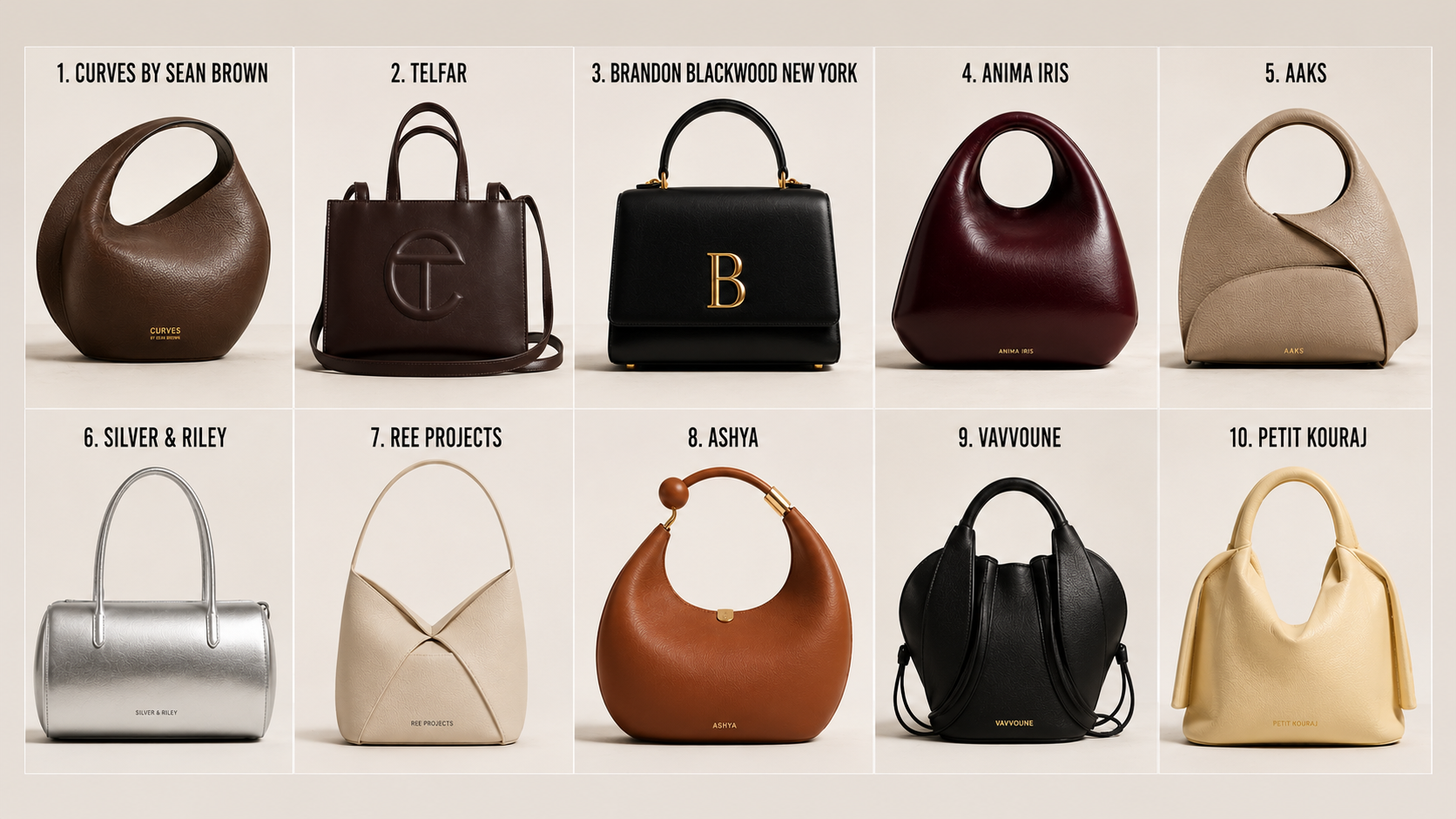
Black-owned handbag brands are competing across luxury, everyday totes, handcrafted leather, travel accessories and statement design without following one formula. Some have become social media obsessions. Others rely on generations of craftsmanship, distinctive materials or cultural references that make their work immediately recognizable.
Curves by Sean Brown deserves all the recognition because its tote has become one of the most talked about Black-owned bags of 2026. Canadian designer Sean Brown built Curves as a broader design world spanning home goods, art, apparel and everyday objects before the brand’s oversized knit tote became a fashion obsession.
The tote is especially recognizable because the Curves name stretches across the front and back of the bag while the sides curve outward. Curves originated as his 2018 solo art exhibition before becoming a consumer design brand during the pandemic. His work has long pulled from music, visual culture and everyday objects, which gives the tote more in common with a design collectible than a conventional logo bag.
View this post on Instagram
Telfar helped prove that a culturally dominant handbag did not need to come from a traditional European luxury house. Founded by Telfar Clemens in New York in 2005, the unisex label is best known for its Shopping Bag. According to Telfar, the line now comes in numerous colors and sizes. The classic versions use faux leather, an embossed logo, handles and crossbody straps, giving the bag a recognizable shape without relying on old luxury codes.
View this post on Instagram
Brandon Blackwood New York has built an entirely different handbag universe. According to the Council of Fashion Designers of America, the Brooklyn born designer launched his company in 2015 after creating the Portmore backpack. His Jamaican and Chinese heritage influences his work, and many of his bags are named for friends, relatives and places connected to his life. The brand has since expanded beyond handbags into categories including footwear, eyewear and outerwear.
View this post on Instagram
Anima Iris places African manufacturing directly at the center of its luxury identity. Founder Wilglory Tanjong named the company after her mother, Iris Tsamoh, and childhood friend Sarah Yaa Anima Amoyaw. Its bags are handcrafted by professionals in Dakar, Senegal, using limited quantities of leather and a zero waste production model. Its sculptural shapes and saturated colors offer a deliberate alternative to the neutral palettes associated with many established luxury labels.
View this post on Instagram
AAKS makes Ghanaian weaving central to the product rather than treating African craft as decoration. Founder Akosua Afriyie Kumi created the label to bring greater attention to traditional weaving techniques practiced by women in Ghana. Its handbags are handcrafted in Ghana using ecologically harvested raffia, with many pieces taking approximately ten days to complete. The bags combine traditional methods with bold colors and contemporary shapes.
View this post on Instagram
Silver & Riley focuses on leather goods that work as hard as they look polished. Founder Lola Banjo built the company around a desire for luxury travel products that combined function with quality. Banjo faced 136 rejections while searching for manufacturing partners before launching the company in 2019. Its products are handcrafted in Tuscany, positioning the brand within the same Italian leather tradition used by many established luxury houses.
View this post on Instagram
Ree Projects represents the quieter side of Black owned luxury. Founder Desiree Kleinen launched the Amsterdam based label in 2016 after approximately two decades working in fashion. Its handbags are handcrafted in Italy using Italian leather and are built around sculptural construction, folded details and functional shapes. The company identifies itself as a woman of color owned business and centers understated design rather than prominent logos.
View this post on Instagram
ASHYA rethinks the handbag around movement. Cofounders Ashley Cimone and Moya Annece created the label as a bridge between design and travel. Its gender neutral leather goods are designed around mobility and produced in Italy and the United States. The result includes compact carrying systems and travel focused accessories that move away from the conventional idea of what a handbag has to be.
View this post on Instagram
Vavvoune keeps much of its production close to home in New York. Designer Valerie Blaise founded the Brooklyn based leather goods company, whose name comes from a nickname connected to her childhood in Haiti. Designs are developed in its studio and produced with artisans in New York City’s garment district. The company also uses premium leather discarded by luxury brands as part of its material sourcing.
View this post on Instagram
Petit Kouraj turns movement and texture into the center of its handbag identity. Founder Nasrin Jean Baptiste, who was born in London to Haitian immigrants, created the brand after visiting Haiti in 2018. The company was developed as an ode to Haitian culture and became known for luxury bags built around expressive fringe. The company previously produced with artisan organizations in Port au Prince before temporarily moving production because of safety conditions in Haiti.
What makes these Black owned handbag brands worth watching is how little they resemble one another. Curves has transformed an oversized knit tote into an object people chase during restocks. Telfar built an accessible fashion symbol. Brandon Blackwood created a colorful handbag universe around personal storytelling. AAKS and Anima Iris put African production at the center of their identities. Silver & Riley and Ree Projects compete directly in Italian made leather luxury, while ASHYA, Vavvoune, Brother Vellies and Petit Kouraj each approach craftsmanship from a different direction.
The real shift is not that Black designers are finally making luxury handbags. They have been doing that. It is that more consumers are beginning to recognize that the next bag worth obsessing over does not need an old European fashion house stamped across the front.
