

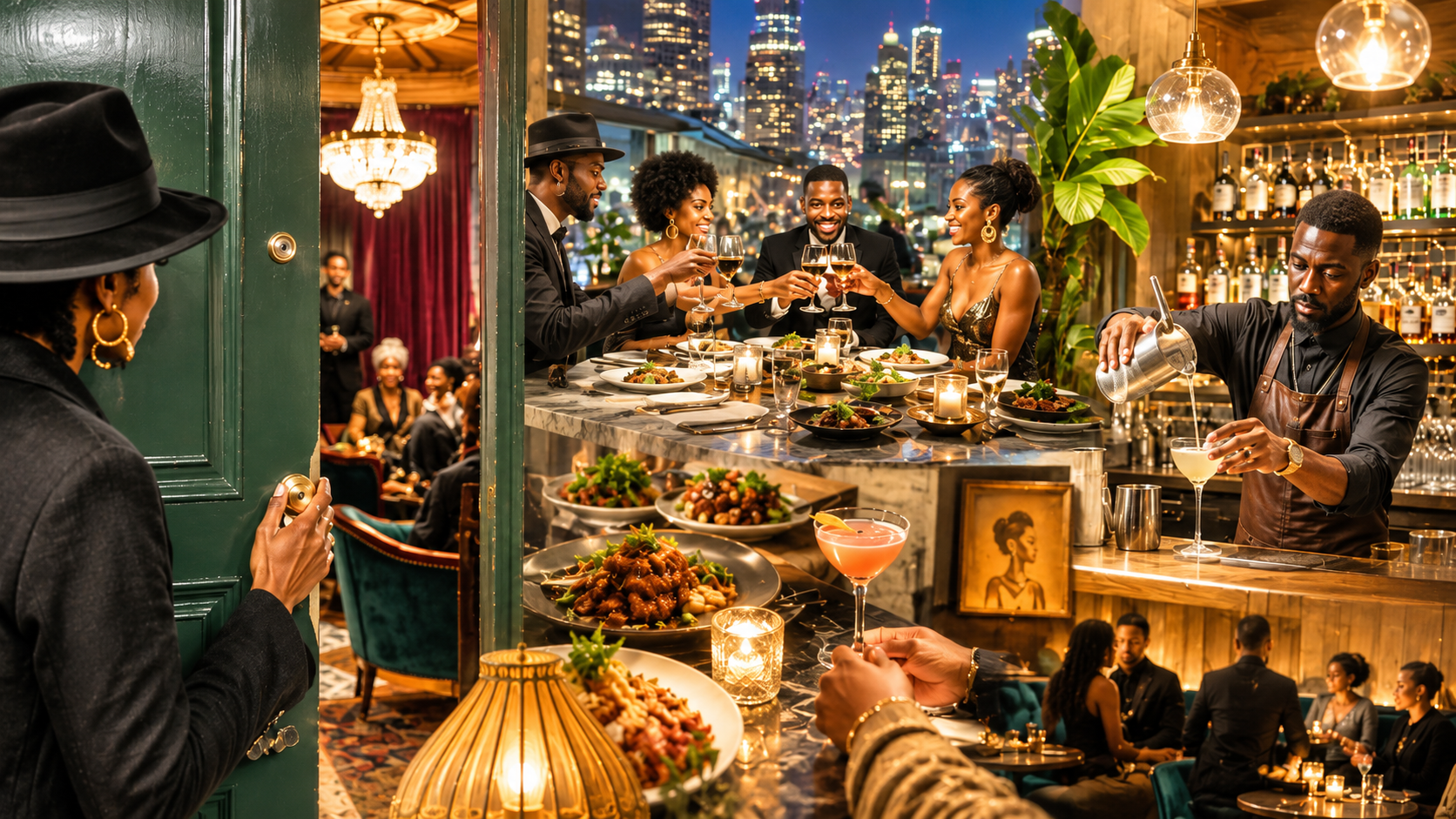
There is something happening in cities across the country that feels less like a passing trend and more like a full circle moment. Black-owned speakeasies and supper clubs are popping up from Boston to Charlotte to Detroit, and they are pulling from a tradition that has existed in Black communities for close to a century, even if most people are only now discovering it. These spaces are not just about the drinks or the food. They are about creating rooms where community, culture, and a little bit of exclusivity all live under the same roof.
The speakeasy concept itself is not new, but its roots run deeper in Black history than most people realize. During Prohibition, cities like Detroit became hotbeds for underground drinking culture, and Black entrepreneurs were right in the middle of it. Close to seventy five percent of the alcohol illegally supplied during that era reportedly moved through Detroit, thanks in large part to its proximity to Toledo and a heavy smuggling route running through the Detroit River. Out of that underground economy came what locals called blind pigs, low key speakeasies that operated in the shadows and quietly built their own legacy. Cafe D’Mongo’s, now one of Detroit’s most beloved Black owned speakeasies, traces its lineage directly back to that era, with owner Larry Mongo coming from a family of Prohibition era booze runners before eventually opening his own spot after being turned away from a white owned disco club. What started as an act of exclusion turned into an institution that has hosted celebrities, politicians, and generations of Detroit natives ever since.
View this post on Instagram
That same energy is showing up in new cities right now, just with a modern twist. In Charlotte, chef Gregory Collier and his wife Subrina, the culinary duo behind BayHaven Restaurant Group, are bringing a speakeasy called The Abyss into Camp North End, a historically Black neighborhood currently facing rapid gentrification. Their mission has never been subtle. They have been vocal about the fact that Black entrepreneurs succeed at the same rate as anyone else when they actually receive the capital investment that white owned businesses are routinely given, and their growing footprint in Camp North End is proof of exactly that.
Boston is seeing its own wave too. Restaurateur Nia Grace, already known locally for Darryl’s Corner Bar and Kitchen, has opened Grace by Nia, a modern supper club set inside a former movie theater space, in partnership with entertainment group Big Night. The project is part of a broader push bringing multiple Black owned nightlife concepts into the city’s Seaport district, an area that has not historically had much Black owned presence at all. Alongside her opening, a New York based bar operator is also bringing his own speakeasy concept into the neighborhood, signaling that this movement is not confined to one city or one type of space.
View this post on Instagram
The supper club side of this movement looks a little different, and it is carving out something increasingly rare, dedicated space for connection. In Austin, a dining community called Kinory has been hosting intimate dinners specifically for Black women since mid-2025, gathering strangers around a table for a night built entirely around conversation, reflection, and community. Guests introduce themselves without mentioning their jobs, share a home cooked meal, and work through thoughtful prompts pulled from a custom card deck. The concept has already expanded beyond Austin into Washington DC and Houston, with a similar effort called the Black Women Dinner Society running its own version of these gatherings across Central Florida. These are not loud nightlife spaces. They are quiet, deliberate rooms built around the idea that Black women in particular need more spaces designed specifically for their peace and their joy.
What ties all of these spaces together, whether it is a hidden bar behind an unmarked door or a private dinner built around meaningful conversation, is intention. None of these concepts happened by accident. They are being built by Black entrepreneurs who understand exactly what kind of room they wanted to walk into and did not see enough of, so they built it themselves. In cities where gentrification is reshaping entire neighborhoods and access to capital has historically been harder to come by, these speakeasies and supper clubs represent something bigger than a night out. They represent ownership, in every sense of the word.
As more of these spaces continue to open, the appeal is becoming impossible to ignore. There is a hunger for exclusivity that feels personal rather than performative, for nightlife and dining experiences built by and for the culture instead of borrowed from it. Whether it is a century old blind pig legacy in Detroit or a brand new supper club series built around Black women’s wellness, this movement is proving that the demand for these spaces has always existed. It just needed the right people to finally build the room.
