

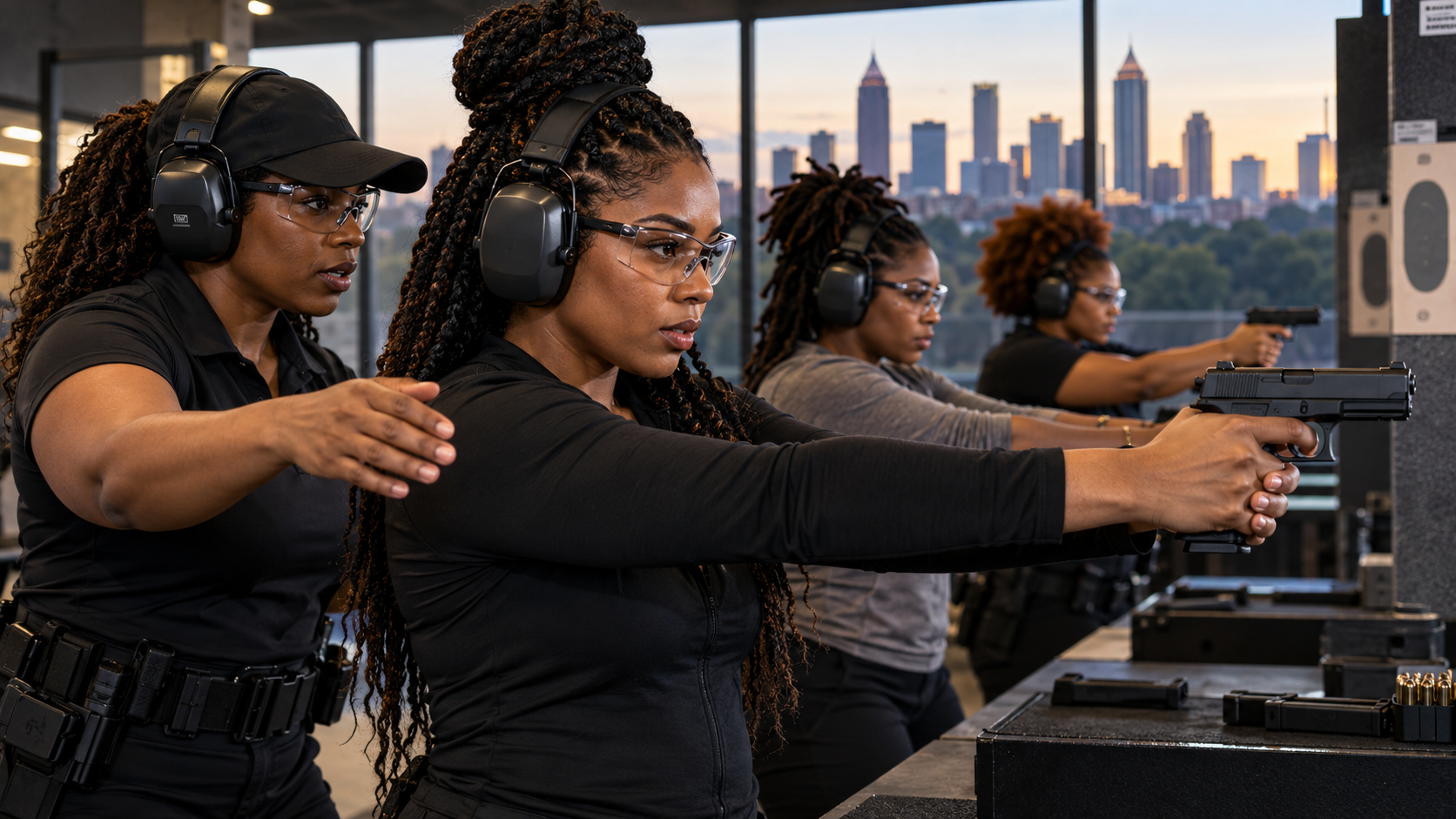
A growing number of Black women in Atlanta are heading to the shooting range with personal safety on their minds, turning gun clubs into spaces for firearms training, community and preparedness.
According to Capital B Atlanta, multiple firearms organizations across metro Atlanta have seen increased interest since 2024, with Black women making up a significant share of newcomers. The trend is bringing new attention to Black gun ownership at a time when concerns about violence, personal security, and the national political climate are converging.
Larry Brown, president of the Bass Reeves Gun Club, told Capital B Atlanta that the organization has roughly 700 active members. Brown said its Facebook community has expanded from about 200 to 300 members when he joined in 2017 to roughly 1,400 people today. He also said the club began noticing another increase in interest last year, with Black women disproportionately represented among new members.
“I think it’s just the political climate. Uncertainty with where the country is going,” Brown told the outlet.
That interest is also showing up at A Girl & A Gun’s Atlanta chapter. Chapter leader Daphne Enmon said the majority-Black organization has tripled in size over the past two years and is nearing 200 members.
“Women join every week, predominantly Black women,” Enmon said.
The broader crime picture in Atlanta is more complicated than a simple citywide surge. According to WSB TV, citing Atlanta Police Department statistics, homicides were down in a July 2026 public safety update, but aggravated assaults were up 20 percent compared with 2025. Crimes against people were collectively up 19 percent, while reported sexual assaults were unchanged at 55 for the comparable period.
Domestic violence data provides another layer of concern for women. The City of Atlanta’s Atlanta Says NO MORE initiative reported that the city experienced a spike in domestic violence incidents during 2024. By week 35 of that year, the city recorded 1,517 incidents and 17 homicides classified as domestic in nature, with 29 more incidents than during the same period a year earlier.
Statewide numbers show an even clearer increase. According to the Georgia Commission on Family Violence, Georgia recorded 42,184 reported family violence incidents in 2024, a 12 percent increase from 2023. Women accounted for 70 percent of reported victims, and the state documented 159 known domestic violence fatalities across 113 fatal incidents. The commission also reported that domestic violence fatalities increased by nearly 4 percent from 2020 through 2024 and that firearms were involved in roughly four out of five domestic violence-related fatalities during that period.
For Black women, the disparities extend beyond Georgia. A September 2026 analysis from the Violence Policy Center, using 2024 FBI homicide data, found that 704 Black women and girls were killed by men in incidents involving one victim and one offender. Their homicide rate was 2.9 per 100,000, compared with 1.2 per 100,000 among white women. Black females represented 14.1 percent of the female population but 30.3 percent of female victims killed by males in the study.
The same analysis found that nearly 90 percent of those Black female victims knew the man who killed them. When the weapon was identified, 76.5 percent were killed with a firearm. That percentage has risen substantially since 2011, according to the organization’s analysis.
Georgia data also reflects a sharp racial divide in gun violence. According to the Johns Hopkins Center for Gun Violence Solutions, Black females in Georgia were more than four times as likely as white females to die by gun homicide in 2024. That statistic does not establish that crimes against Black women are rising specifically within Atlanta, but it underscores why conversations about Black gun ownership and personal protection are resonating across the state.
The growth of Black gun ownership also extends to recreational shooting. Capital B Atlanta reported that a 2024 analysis from the National Shooting Sports Foundation, a firearms industry trade association, found Black Americans represented 32 percent of new target shooters. The outlet reported that metro Atlanta organizations have seen renewed interest following a slowdown after the pandemic-era surge in firearm purchases and training.
Georgia’s laws have also shifted alongside that interest. According to the Georgia House Budget and Research Office, Senate Bill 319 took effect in April 2022 and removed the weapons carry license requirement for people otherwise legally eligible to carry firearms. The law did not eliminate restrictions on firearm possession or prohibited locations.
For Atlanta’s growing community of Black women gun owners, however, club leaders are emphasizing more than simply purchasing a weapon. Atlanta reported that groups such as Bass Reeves focus on regular instruction, gun safety, and developing competent firearm owners, while other organizations are expanding into hunting and broader survival skills. The rise of Black women in these spaces reflects a larger conversation about safety, self-reliance, and what preparedness looks like when the statistics show that violence does not affect every community equally.
