

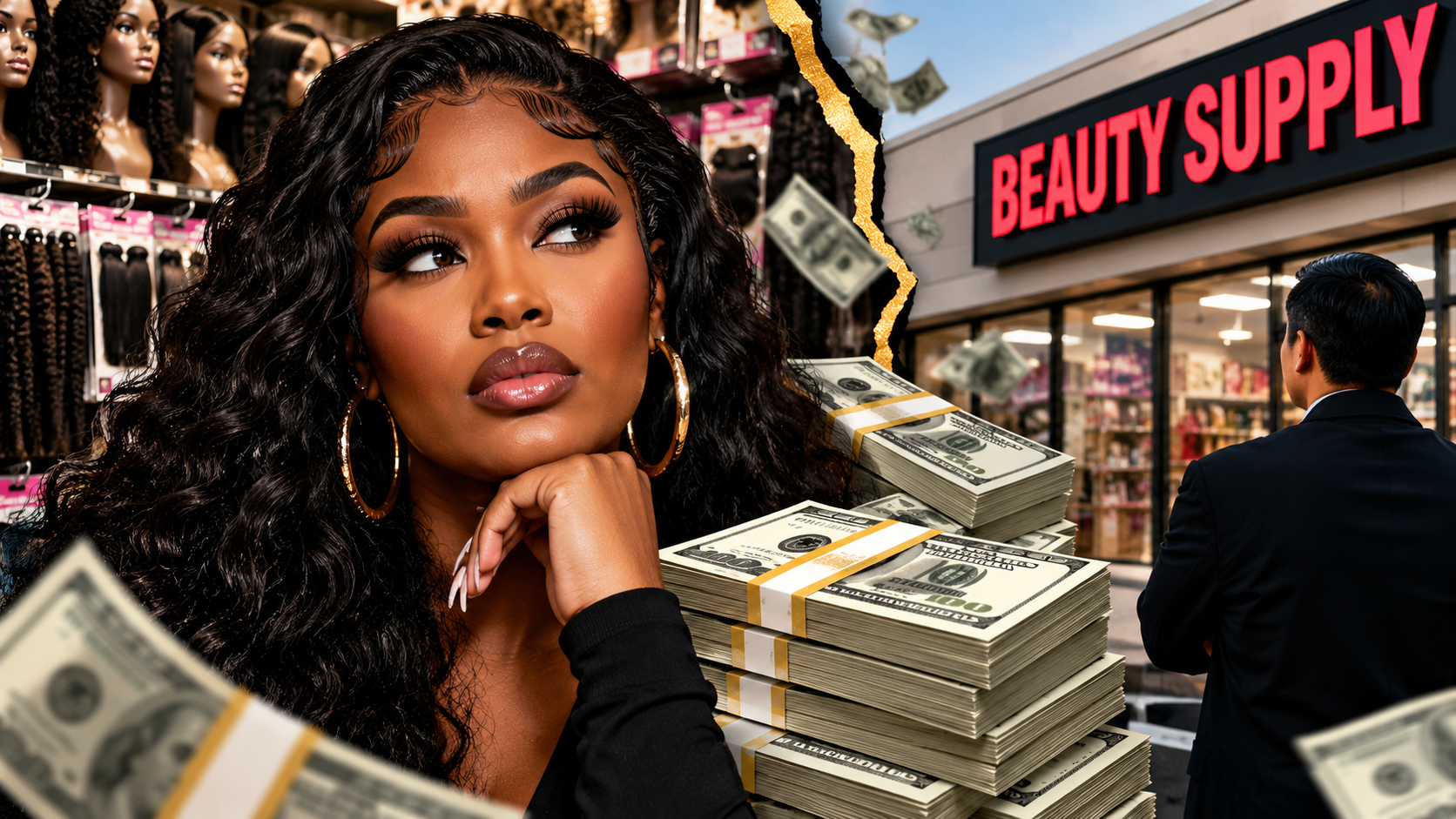
Black women can walk into almost any beauty supply store and find aisles stocked with products made specifically for their hair, from bundles and braiding hair to edge control, bonnets, wigs, and scalp treatments. Their dollars keep these businesses moving, their hairstyles influence global beauty trends, and their loyalty has helped turn Black hair care into a multibillion-dollar industry. Yet there’s an uncomfortable reality behind those packed shelves: many of the businesses profiting from Black women’s hair are not owned by Black women.
This disconnect is especially striking because Black women were instrumental in creating the modern American hair care industry. Long before beauty supply stores became neighborhood staples, entrepreneurs like Annie Turnbo Malone and Madam C.J. Walker were manufacturing products, developing hair care systems, and building distribution networks. Malone established her Poro business in the early 1900s, while Walker launched her own company in 1906. Both created employment opportunities for thousands of Black women during segregation, proving that hair care could become a pathway to financial independence.
Their influence went far beyond selling products. Black-owned salons became community gathering spaces, beauty schools trained generations of entrepreneurs, and women who were excluded from traditional employment opportunities found ways to establish their own businesses.
More than a century later, the demand those pioneers helped develop remains enormous. NielsenIQ reported that Black consumers spent $9.4 billion on beauty products in 2023, with spending growth outpacing the broader U.S. market in several categories, including hair care. That figure covers beauty products overall, not hair alone, but it demonstrates the purchasing power supporting the industry.
Historically, Korean American entrepreneurs became major players in beauty supply retail during the expansion of the wig and hair extension business in the 1970s and subsequent decades. Their businesses developed strong relationships with manufacturers, importers, and wholesalers, helping establish an interconnected network that influenced which products reached neighborhood stores. By 2018, public radio reporting estimated that Korean Americans owned nearly three-quarters of U.S. beauty supply stores, although that historical estimate should not be treated as today’s ownership percentage.
The issue extends beyond who owns the storefront. Access to the supply chain can determine whether a business survives. A retailer may have the money to rent a location but still struggle to obtain popular hair brands, competitive wholesale prices, or favorable payment arrangements.
Felix B. Chang, a law professor, examined these dynamics in a 2022 Indiana Law Journal study titled Ethnically Segmented Markets: Korean-Owned Black Hair Stores. His research argues that exclusionary business relationships have helped maintain market dominance. However, some distributors have denied discriminating, maintaining that their decisions are based on competition and economic considerations.
For Black entrepreneurs, these obstacles can be devastating. Minnesota businesswoman Karen Coffey, who opened Bella Beauty and Hair in 2017, reported difficulty getting merchandise from wholesalers even as a competing store carried products she couldn’t access. Her experience highlighted a problem that customers rarely see: two stores can sell to the same community while operating under vastly different purchasing conditions.
Lia Dias, founder of The Girl Cave Los Angeles, described similar challenges. In a 2020 interview with Glamour, she revealed that distributors refused to extend favorable purchasing terms and required upfront payments. Despite those setbacks, Dias expanded her business by building relationships with customers who wanted to support Black ownership.
Unfortunately, accessing financing is another hurdle. The Federal Reserve’s 2025 Small Business Credit Survey report found that just 35% of Black-owned employer firms seeking loans, credit lines, or cash advances received the full amount requested, compared with 56% of white-owned firms. These figures cover businesses across industries and are not adjusted for differences in financial characteristics, but they demonstrate the broader funding gap Black entrepreneurs navigate.
The imbalance is also visible beyond storefront ownership. McKinsey’s 2022 research found that Black-founded or Black-owned beauty brands captured only 2.5% of industry revenue, despite Black consumers accounting for 11.1% of beauty spending. That distinction matters because owning a popular product line doesn’t automatically mean controlling its manufacturing, distribution, or retail placement.
Still, the industry is changing. Independent Black-owned beauty suppliers, online retailers, and entrepreneurs developing their own hair products are creating alternative paths into the market. Organizations such as the Black Owned Beauty Supply Association are also working to help entrepreneurs establish businesses and acquire existing stores.
But supporting Black-owned businesses cannot fall entirely on Black women already spending their money in the industry. Meaningful progress requires fair wholesale access, financing opportunities, stronger distribution partnerships, and retailers willing to stock emerging Black-owned brands.
Black women have spent generations making the hair industry profitable. The next chapter should be about having greater power over where those profits go.
