


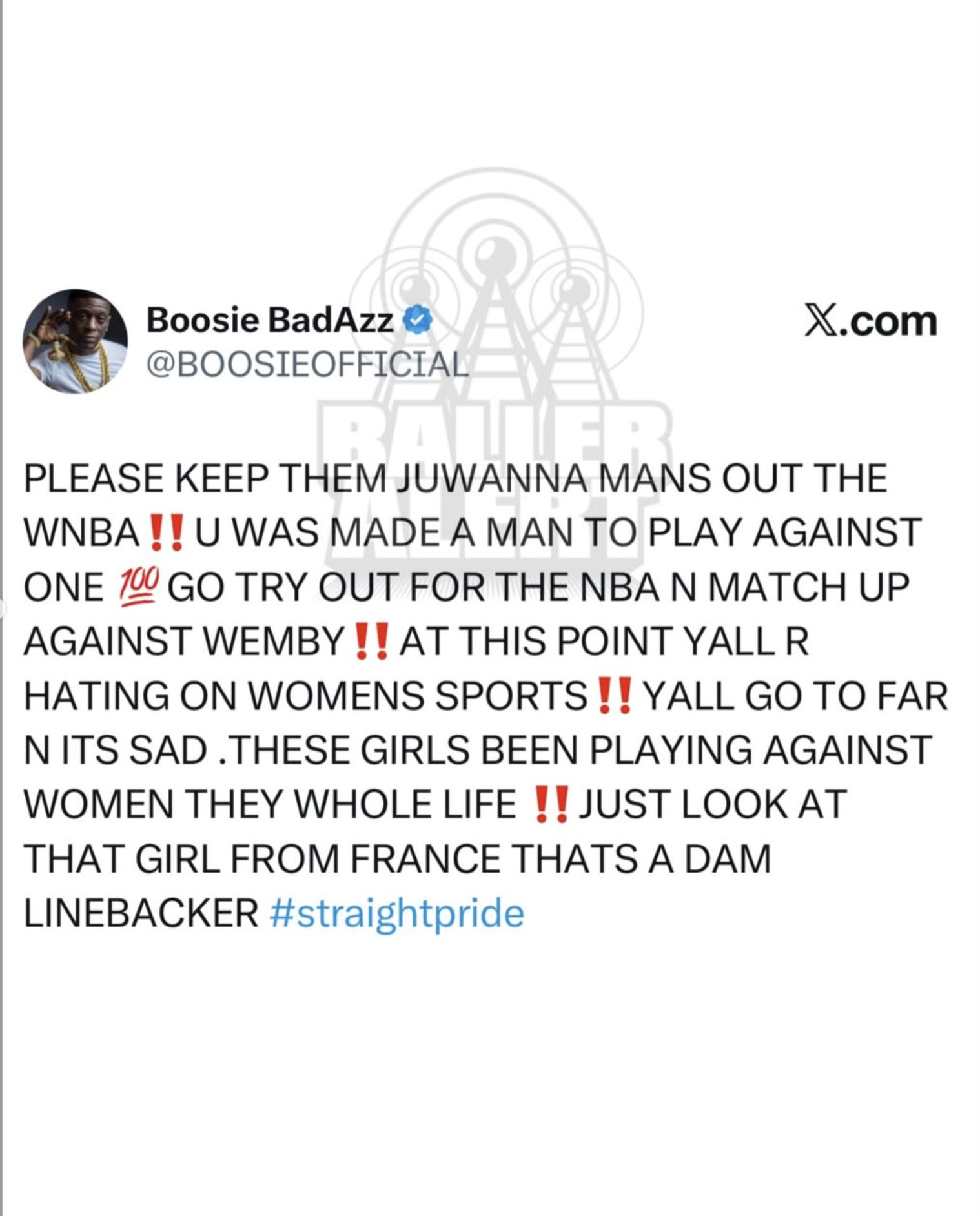
Boosie’s WNBA comments have pushed the rapper into another online culture war after he used a movie reference to argue that trans women should not compete in the league. According to Boosie’s post on X, he wrote, “keep them Juwanna mans out the WNBA,” before telling trans women to “go try out for the NBA and match up against Wemby.” He also insisted that people raising concerns about physical differences were not “hating on women’s sports.”
The reference comes from the 2002 sports comedy “Juwanna Mann.” The film follows a disgraced male basketball player who presents himself as a woman to continue his career in a women’s league. Boosie used that fictional act of deception as shorthand for transgender participation, but the comparison immediately changes the conversation from athletic regulations to an accusation that trans women are simply pretending.
Boosie did not identify the athlete from France mentioned in his post. However, the timing of the Boosie WNBA comments appears connected to the attention surrounding French basketball player Julie Tétart. Tétart is a 6-foot-3 center who plays for Monaco Basket Association in France’s second tier league. She averaged 21.2 points and 20.2 rebounds during the 2025 to 2026 season.
Tétart has not announced a WNBA deal, tryout, or formal offer. During an Instagram exchange, she said, “If they contact me, I won’t say no.” She also acknowledged that she is older than most prospects and that stronger players remain ahead of her. Those details matter because Boosie’s post presented the issue as an immediate competitive crisis without addressing Tétart’s age, league level, eligibility, scouting evaluation, or actual chances of reaching a WNBA roster.
The larger debate was already surrounding the WNBA before Boosie entered it. Indiana Fever guard Sophie Cunningham faced both support and criticism after speaking against transgender participation in women’s sports. Small rallies supporting her appeared outside Fever games, while opposing fans displayed transgender pride flags and booed her during games. The controversy also became a league disciplinary matter after a Seattle Storm co-owner was fined and suspended following an exchange with Cunningham supporters.
The Boosie WNBA comments also overlook the league’s more complicated history with gender identity. An official Golden State Valkyries announcement described former All-Star Layshia Clarendon as the WNBA’s first openly transgender and nonbinary player. Clarendon completed an 11 year playing career before moving into broadcasting. That history shows why using “Juwanna Mann” as a blanket description is misleading. A fictional man secretly entering a women’s league is not interchangeable with every athlete who identifies as transgender or nonbinary.
The strongest criticism of the Boosie WNBA comments is not that competitive fairness must remain off limits. Professional leagues routinely create eligibility standards, medical requirements, and roster rules. Those policies can be examined without reducing an entire group of people to a punchline. Boosie skipped that distinction and framed transgender identity as fraud before any WNBA team had even expressed interest in the athlete he appeared to reference.
Boosie’s post may generate clicks because the “Juwanna Mann” comparison is instantly recognizable. It does little, however, to explain how the WNBA currently evaluates athletes, whether Tétart would qualify, or what evidence should guide future rules. A serious sports debate requires more than a movie joke and an imagined matchup with Victor Wembanyama.
