

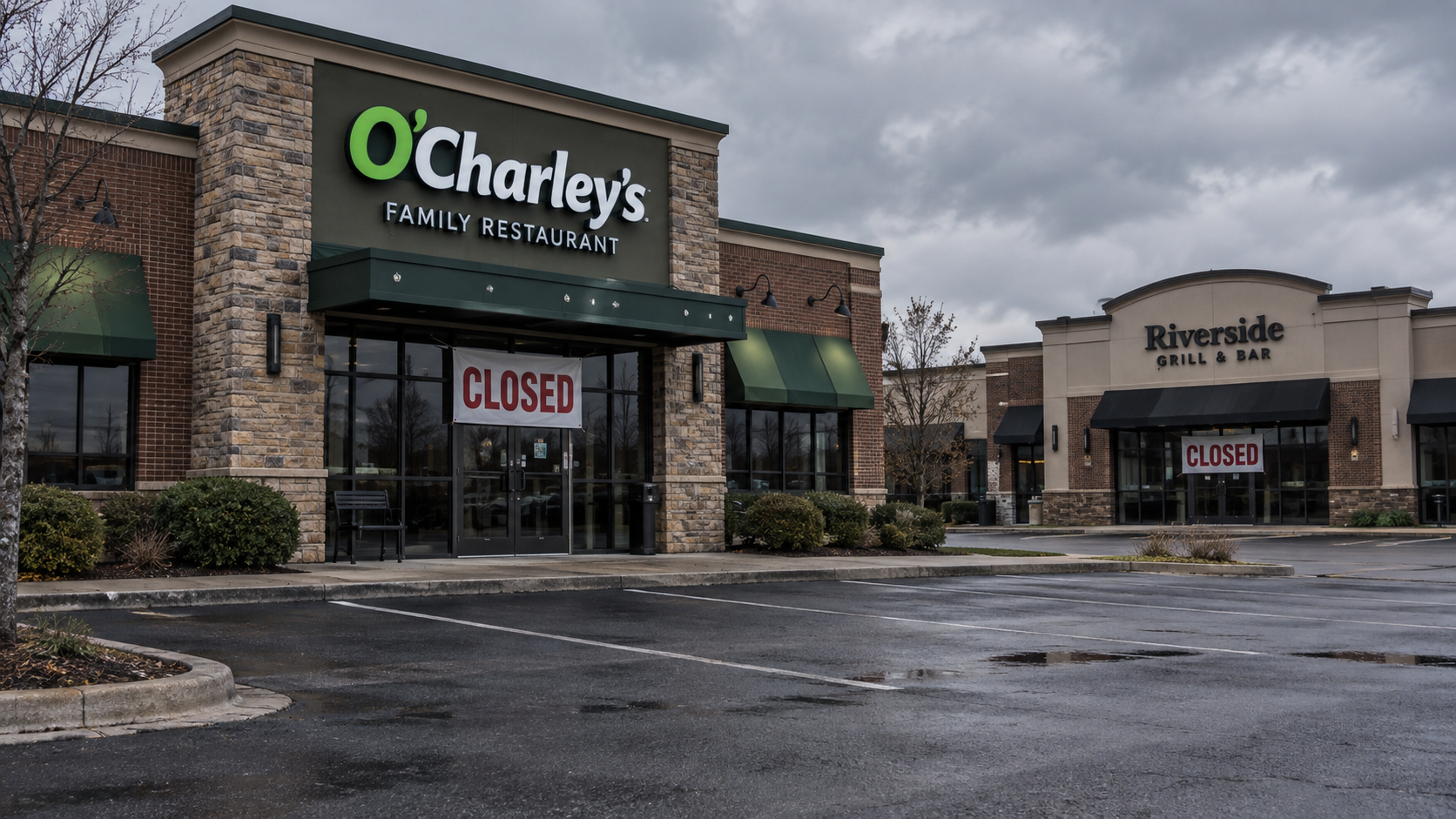
O’Charley’s sudden shutdown may be more than the end of another familiar restaurant chain. It could be a warning about what is coming next for a part of the restaurant industry already fighting shrinking traffic, stubborn operating costs, and customers becoming much more selective about where they spend their money.
O’Charley’s abruptly closed all of its company-owned restaurants on September 9, 2026, while a small number of franchised locations continued operating temporarily. The Nashville-based chain once operated nearly 250 restaurants at its peak in the 2000s but has been steadily closing locations since 2016. By July 2026, its portfolio had fallen to 47 restaurants as same-store sales dropped by double digits.
Sadly, the company had been showing signs of financial stress long before its final restaurants went dark. O’Charley’s closed dozens of restaurants in 2023 as management attempted to protect cash flow and deal with inflationary pressure. Then CEO Craig Barber described the strategy as necessary pruning. Barber also acknowledged how difficult the post-pandemic economy had become for restaurants.
“For our industry in general, and for our brands, it was very challenging to understand how to best maneuver that,” he said.
For employees, the eventual collapse carried a more personal cost.
“It was just really a bummer,” former employee Leslie Bolin told WKRN. “Like, I have friends who have said that they’ve been crying, they can’t sleep because so many memories built there over the years, and it’s, it’s hard to see it go.”
What makes O’Charley’s more significant is that it is hardly alone.
In 2024, Red Lobster closed 93 restaurants before filing for Chapter 11 bankruptcy protection. The seafood chain had about $300 million in debt and pointed to high inflation, unsustainable rent expenses, and costly business decisions among the problems that pushed it into restructuring. The company later emerged from bankruptcy under new ownership, showing that restaurant closures do not necessarily mean a brand completely disappears.
TGI Fridays faced its own reckoning that same year. Its United States restaurant operator filed for Chapter 11 bankruptcy in November 2024 after years of financial pressure. Executive chairman Rohit Manocha pointed to the pandemic and the company’s capital structure as major contributors to the distress.
Then came Hooters. More than 30 company-owned locations abruptly closed in June 2025, roughly two months after its parent company entered Chapter 11 bankruptcy protection. That followed approximately 40 restaurant closures the previous year.
Those casual dining closures are increasingly difficult to dismiss as unrelated events.
Data reported by Nation’s Restaurant News from Black Box Intelligence found that 9 percent of full-service restaurant locations were considered at risk of closure in 2026 after losing at least 30 percent of their peak sales. Another 3 percent had lost more than half of their peak sales.
At the same time, the National Restaurant Association reported that total expenses for the average restaurant had increased 36 percent compared with pre-pandemic levels. Food and labor remain two of the largest expenses, while rent, utilities, supplies, and other operating costs continue squeezing already thin restaurant margins.
Restaurants also cannot simply raise prices forever.
The National Restaurant Association said its 2026 outlook showed lower- and middle-income households becoming increasingly stretched as restaurants deal with uneven traffic and elevated operating expenses. Even when customers continue dining out, they are paying closer attention to value and making more deliberate choices about where to eat.
That may be the real threat to older casual dining brands. Many of them operate large dining rooms, require significant staffing, and occupy expensive real estate. If fewer customers walk through the doors, those fixed costs do not disappear.
But there is a twist to the casual dining crisis. Some chains are thriving.
According to Restaurant Business, sales among major casual dining chains increased in 2025, but nearly all of the dollar growth came from Chili’s, Texas Roadhouse, and Olive Garden. Chili’s alone added nearly $1 billion in sales during the year.
By August 2026, Nation’s Restaurant News reported that Chili’s had recorded 21 consecutive quarters of same-store sales growth, powered by menu changes, stronger operations, value-focused marketing and improved traffic. Texas Roadhouse has also continued posting positive traffic, with same-store sales rising 7.1 percent during the first quarter of 2026, according to Nation’s Restaurant News.
That suggests the future of casual dining may not be extinction. It may be a major shakeout.
Customers are still willing to sit down for dinner, but increasingly, a familiar logo alone is not enough. Chains that deliver strong value, memorable food, efficient service, and an experience worth leaving home for may continue growing. Restaurants that fail to give consumers a convincing reason to spend could keep losing traffic until closing locations becomes the only option left.
O’Charley’s may be one of the latest recognizable names to reach that point, but with thousands of full-service restaurants facing declining sales and operating costs still elevated, it may not be the last.
