

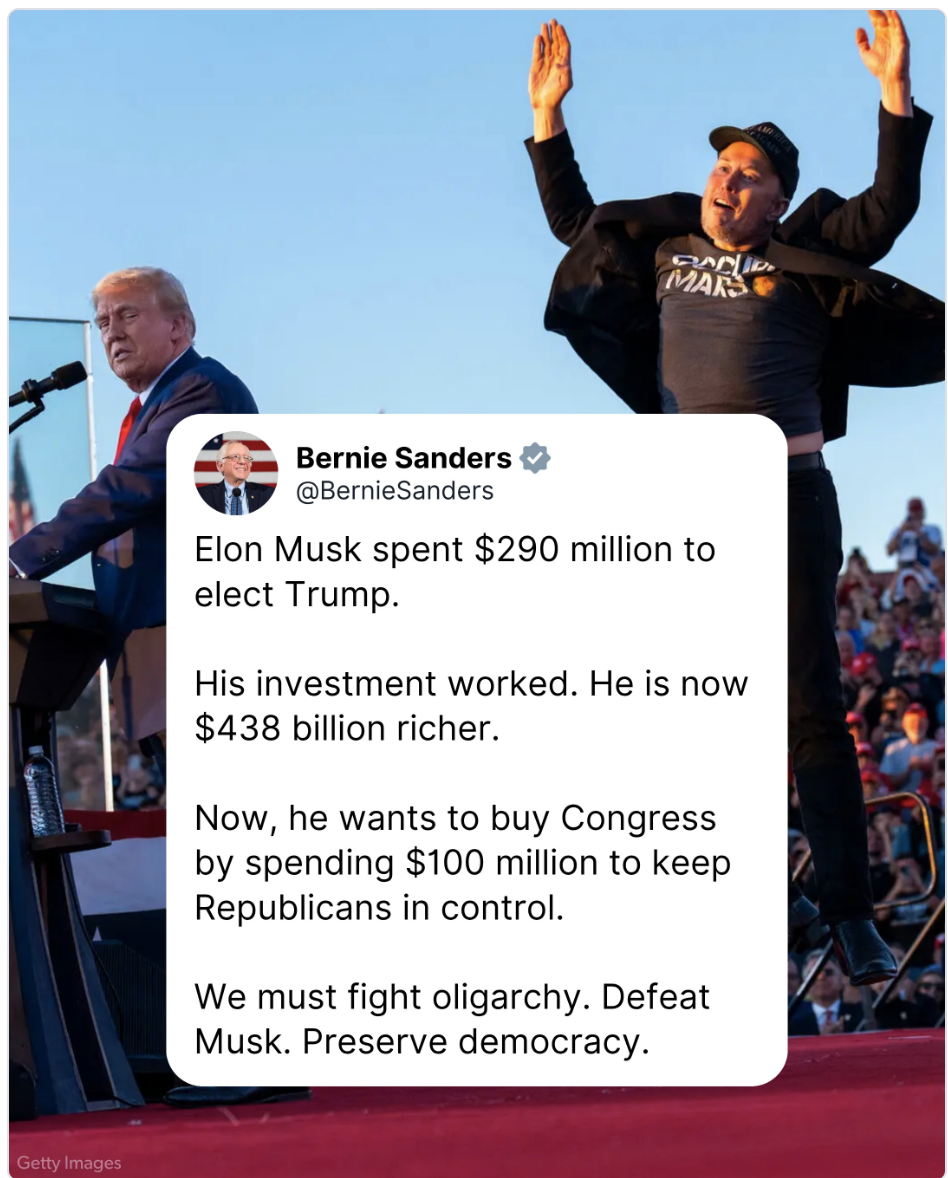
Elon Musk is putting up to $120 million behind America PAC to help Republicans hold Congress in November, and the plan became public one day after the Space Force awarded his rocket company a $1.6 billion contract. Both stories broke inside the same twenty four hours, from different rooms, with no formal connection between them.
Start with the money from the government. On Wednesday, July 29, Space Systems Command announced it had given SpaceX two task orders worth a combined $1.6 billion. A task order is not a new contract so much as a purchase made under a contract that already exists. The military sets up a large master agreement with a ceiling, pre-approves a handful of companies to bid, and then buys individual jobs off that agreement as it needs them. In this case the jobs are 18 Falcon 9 launches carrying Space Based Sensing and Targeting satellites, which are designed to spot and follow airborne threats from orbit. Every launch will lift off from Vandenberg Space Force Base in California, and all 18 are supposed to be finished by the end of 2027.
The agreement they came from is the National Security Space Launch program, Phase 3, Lane 1. Lane 1 is the part reserved for the less demanding missions, meaning lighter payloads going to orbits that are easier to reach, where the military is comfortable buying launches the way a commercial customer would. On July 17, the Space Force raised the spending ceiling on that agreement by $11.4 billion, taking it to $17 billion. The SpaceX award was the first thing bought under the expanded ceiling.Now the political money. Axios reported Wednesday evening that Musk was reactivating America PAC for the midterms, and the New York Times reported Thursday that he had authorized somewhere between $100 million and $120 million for a new field program across eight states. Midterms are the congressional elections that happen halfway through a presidential term, and turnout in them is always lower, which is exactly the problem this operation is built to solve. The plan is door to door canvassing, direct mail and digital advertising aimed at conservative voters who show up for presidential races and skip everything else. Musk’s longtime political adviser Chris Young is running it, and the group is expected to coordinate with other Republican organizations rather than duplicate their work.
America PAC is a super PAC, which means it can raise and spend unlimited amounts to support candidates as long as it does not formally coordinate with the campaigns themselves. In 2024 it spent more than $260 million backing Trump’s return, and that spending made Musk the largest individual political donor in a single election cycle in American history. James Blair, Trump’s senior political adviser, told Axios the group had been an essential partner in the 2024 turnout operation and called its return a boost for Republicans nationally.
The timing is awkward for one reason Musk created himself. He told The Economist last week that he thinks he got a little too involved in politics. That statement is now roughly a week old. It also arrives after a genuinely hostile stretch between the two men. Musk ran the Department of Government Efficiency during the first months of the administration, that arrangement ended in mid 2025, and he spent the following weeks publicly attacking a spending bill that undercut the cost cutting he had been brought in to do. At one point he floated starting his own party. Since then he has donated to Republican committees, put $10 million behind a Kentucky Senate candidate who later withdrew to take an administration job, and now this.
The $1.6 billion is also not the year’s whole picture. SpaceX has taken at least $7 billion in Pentagon awards in 2026, including a $4.16 billion order in late May to accelerate a space based targeting program and $2.29 billion for a military data relay network. That concentration in a single commercial provider has started drawing questions on Capitol Hill.There is a straightforward explanation for the concentration that has nothing to do with politics, and any honest account of this has to include it. Falcon 9 is currently the only American rocket flying national security payloads at high volume. United Launch Alliance and Blue Origin are both pre-qualified to compete for the same Lane 1 task orders, but Blue Origin’s only New Glenn launch pad was destroyed in a static fire explosion in May and the rocket is not expected to fly again until the end of 2026 at the earliest. SpaceX also runs Falcon 9 for its own Starlink satellites off the same production line, which spreads its fixed costs across a launch schedule nobody else matches and lets it price below competitors. Those are procurement facts, and they were true before this week.
What is also true is that a company competing for billions in federal contracts is simultaneously funding the turnout operation for the party that controls the agencies awarding them. No reporting has connected the two, no evidence suggests the contract was awarded for political reasons, and the award moved through a competitive process. The proximity is the story, not a causal claim.
One more piece of context. SpaceX went public in June under the ticker SPCX, its shares have fallen since the IPO, and the contract landed days before its first earnings report as a publicly traded company.
The next hard numbers come from Federal Election Commission filings, which will eventually show exactly what America PAC spent and where. Until then, the $100 million to $120 million figure comes from people briefed on the plans, and Musk has not confirmed an amount himself.
Short Link: https://balleralert.com/ckpk