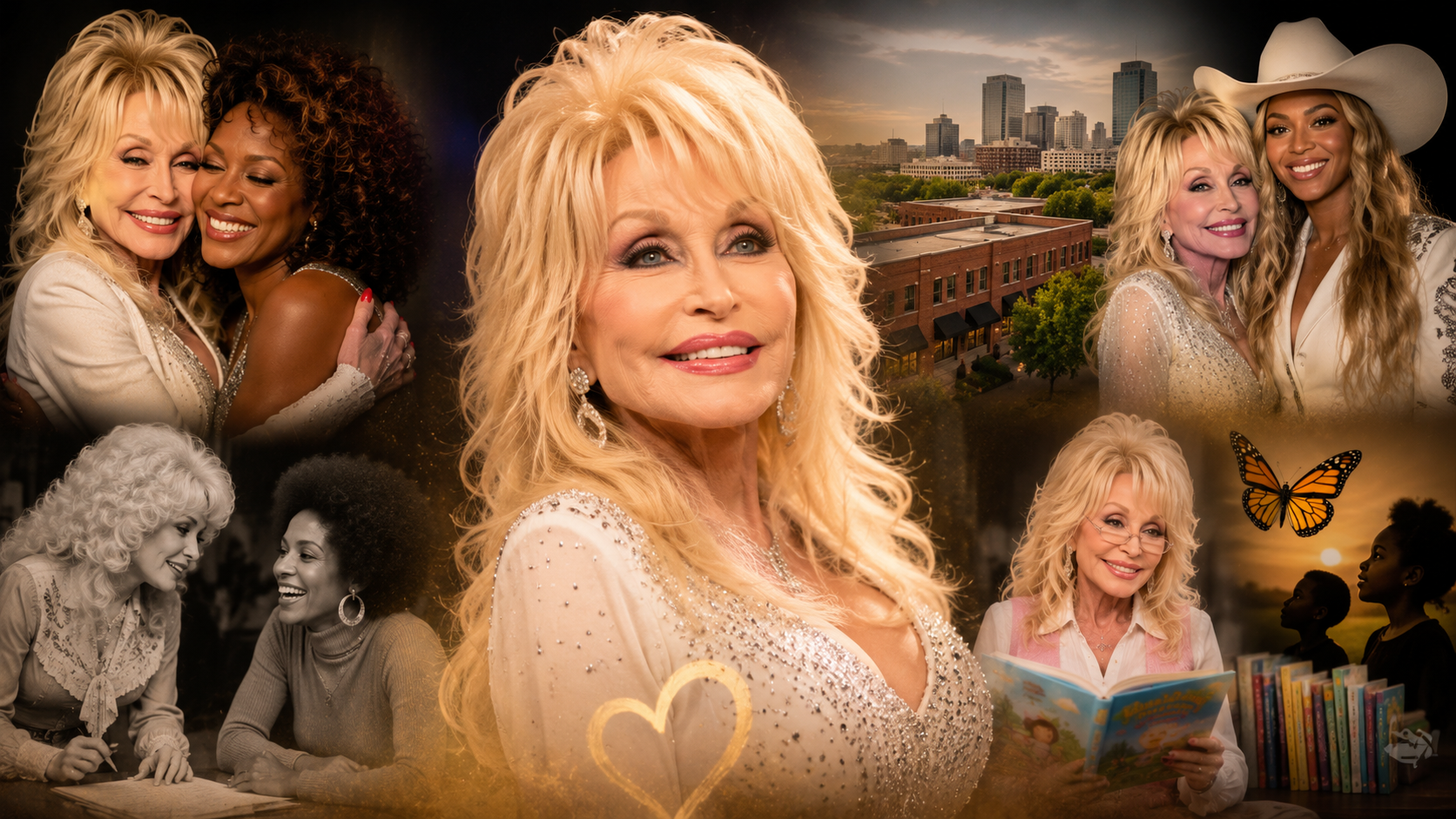
Dolly Parton has died at the age of 80, leaving behind a seven-decade career built on timeless music, prolific songwriting, and a warmth that made fans across every background feel like family. Parton’s catalog needs little introduction, from “9 to 5” to “Jolene” to the ballad most people know as Whitney Houston’s signature moment, “I Will Always Love You.” But while her chart success and business empire, from Dollywood to her Imagination Library literacy program, will rightfully dominate most retrospectives, Parton’s relationship with the Black community deserves its own spotlight, because it went far deeper than most casual fans realize.
The Whitney Houston connection alone tells a meaningful story. When Houston’s cover of “I Will Always Love You” became one of the best-selling singles of all time off “The Bodyguard” soundtrack, Parton earned a massive windfall in songwriting royalties. Rather than simply pocketing the money, she used those royalties to purchase an office building in a predominantly Black neighborhood in Nashville. Reflecting on the decision years later on “Watch What Happens Live,” Parton explained her reasoning simply. “I thought this is the perfect place for me to be, considering it was Whitney, so I just felt, ‘This is great, I’m just going to be down here with her people, who are my people as well.'” It was a quiet but meaningful gesture, tying her own financial success directly back to the Black artist who had helped create it.
Decades later, Beyoncé gave Parton’s catalog another major moment when she reimagined “Jolene” for her 2024 album “Cowboy Carter,” reworking the lyrics and delivering her own commanding spin on the classic. Parton publicly embraced the reinterpretation, expressing pride in seeing her song carried forward by one of the biggest artists in the world and folded into a project that pushed back against the country genre’s historically narrow gatekeeping around Black artists.
Parton’s relationship with the Black community was not limited to music collaborations. In 2018, she made the decision to rename her popular Pigeon Forge dinner show from Dolly Parton’s Dixie Stampede to simply Dolly Parton’s Stampede, removing the word “Dixie” because of its ties to the Confederacy. The move predated similar rebrands from groups like the Dixie Chicks and Lady Antebellum by two years. When Billboard asked her about the decision in 2020, Parton did not dodge the question or downplay her own past blind spots.
“There’s such a thing as innocent ignorance, and so many of us are guilty of that,” she said. “As soon as you realize that something is a problem, you should fix it. Don’t be a dumba**. That’s where my heart is. I would never dream of hurting anybody on purpose.” In that same interview, conducted during the nationwide protests following the murder of George Floyd, Parton gave one of the clearest political statements of her career, telling Billboard plainly, “And of course Black lives matter. Do we think our little white asses are the only ones that matter? No!”
Parton’s generosity toward Black communities also extended into spaces she rarely publicized herself. Writer Michael Harriot confirmed that Parton financially supported choir and band programs at predominantly Black high schools for years without ever turning those donations into a press moment, a detail that only came to wider public attention when others began sharing their own stories of her quiet generosity. That pattern fits the broader legacy of her Imagination Library, the free book mailing program she founded that has reached millions of children across the country, including countless kids in underserved and predominantly Black communities who otherwise would not have had regular access to books at home.
None of this erases the complexity of Parton’s position as a white country music icon whose early career existed within an industry that has long marginalized Black artists and Black contributions to the genre’s roots. But Parton’s willingness to acknowledge her own blind spots, correct them publicly, and put real resources behind Black communities and Black artists set her apart from many of her peers, and it is part of why so many Black fans, artists, and commentators have spoken warmly of her over the years, well beyond just enjoying her music.
As tributes continue pouring in following news of her death, Parton’s catalog will rightfully be celebrated for its scope and songwriting brilliance. But her legacy within the Black community, built through royalty checks reinvested into Black neighborhoods, a willingness to publicly admit and correct her own mistakes, and quiet support for Black students and institutions, is just as much a part of the full picture of who Dolly Parton was.