

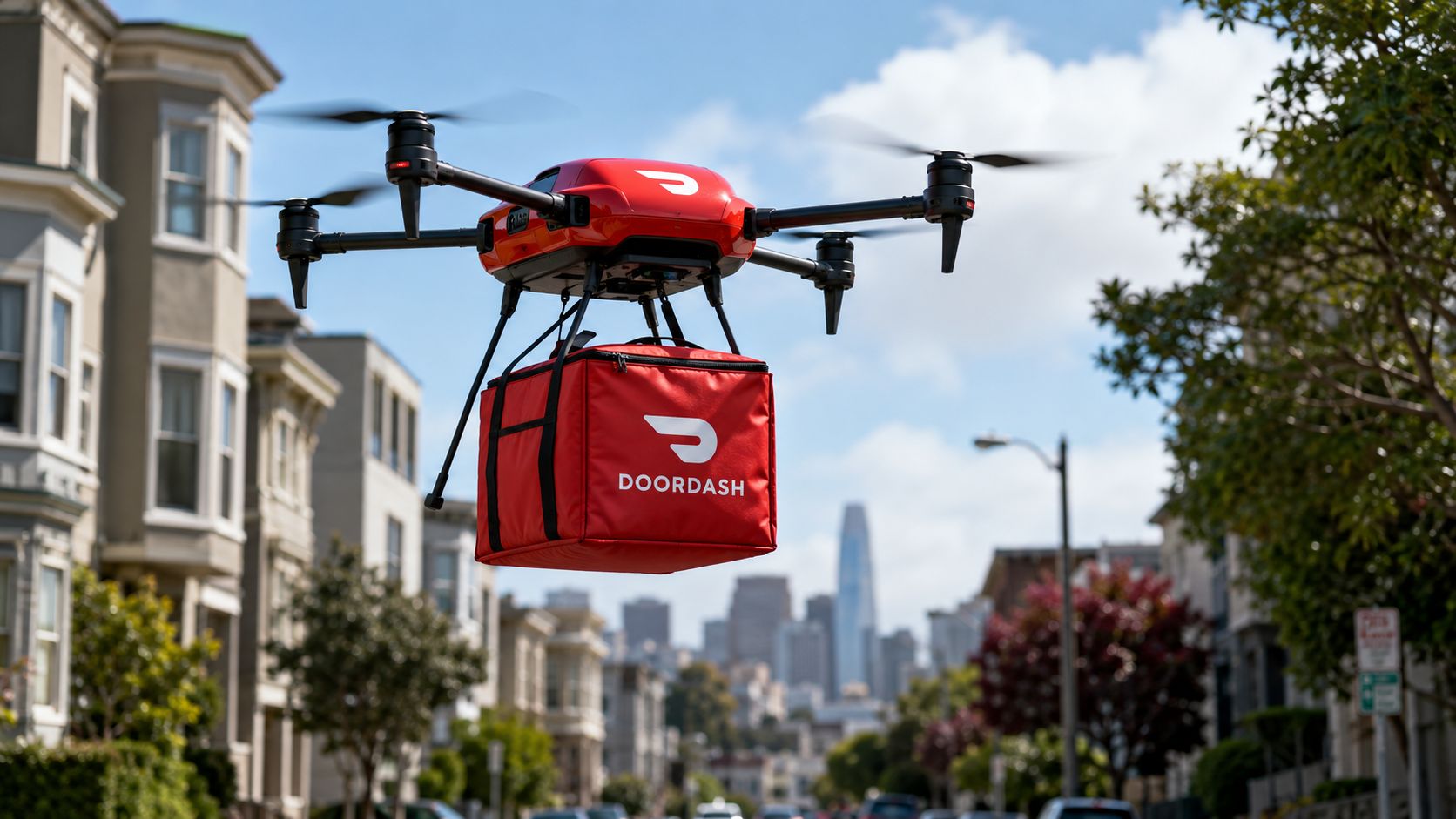
DoorDash Air is bringing the food delivery race into a new era as DoorDash moves from simply partnering with drone companies to becoming a federally certified air carrier capable of operating its own commercial drone delivery service. According to a July 29 announcement from DoorDash, its DoorDash Labs division earned Federal Aviation Administration Part 135 air carrier certification, clearing a major regulatory hurdle for the company’s growing autonomous delivery business.
That certification matters because this is bigger than testing a drone with somebody’s lunch attached. According to the FAA, companies that want to transport packages by small drone for compensation beyond a pilot’s visual line of sight must operate through the Part 135 certification framework and secure the necessary federal approvals. The FAA says applicants go through a five-phase certification process that examines operations, safety procedures, personnel, aircraft, and other requirements before commercial service can begin.
DoorDash said becoming a certified air carrier now allows the company to operate its own drone delivery service rather than relying entirely on outside operators. The company also said DoorDash Air is being developed internally through DoorDash Labs, with the team designing both the aircraft and the infrastructure needed to connect drones with merchants, customers, and DoorDash’s existing marketplace.
The company is not new to putting food in the sky. According to DoorDash, it first teamed with Alphabet-owned Wing on drone delivery in Australia in 2022 before bringing that partnership to Christiansburg, Virginia, in March 2024. During the Virginia rollout, eligible customers ordering qualifying Wendy’s items through DoorDash could choose drone delivery at checkout, with Wing handling flights that DoorDash said typically arrived in 30 minutes or less.
DoorDash and Wing expanded further in May 2025, when the companies introduced drone delivery to eligible customers around Charlotte, North Carolina. DoorDash said that service included restaurants and DashMart items, while its partnership with Wing had already expanded into parts of Southwest Virginia and the Dallas-Fort Worth area.
DoorDash also added another drone partner that summer. According to the company, a June 2025 partnership with Flytrex opened drone delivery to customers in parts of Little Elm and Frisco, Texas, serving more than 30,000 households and over 100,000 residents at launch. Eligible customers could order from participating restaurants through the DoorDash app and select drone delivery when their order qualified.
Now, DoorDash Air gives the company a first-party operation to place alongside those partnerships. DoorDash said it had already been involved in tens of thousands of drone deliveries before announcing the new program. Based on the company’s own 2025 estimates, drone deliveries averaged about 25 minutes, while participating locations in some drone partner pilots experienced roughly 30 percent DoorDash order volume growth that continued across the nine weeks after launch. Those figures come from DoorDash and have not been independently established as results that every merchant or market should expect.
DoorDash Air also fits into a much broader automation strategy that is already moving on sidewalks and streets. In September 2025, DoorDash introduced Dot, an electric autonomous delivery robot developed by DoorDash Labs. According to the company, Dot was designed to travel on sidewalks, bike lanes, roads, and driveways at speeds of up to 20 miles per hour. DoorDash also unveiled an Autonomous Delivery Platform designed to choose between different fulfillment options, including a Dasher, drone, sidewalk robot, or Dot, depending on factors such as location, speed, cost, and the type of order.
DoorDash says human drivers remain central to that system. In its DoorDash Air announcement, the company said Dashers still handle the vast majority of its millions of daily deliveries, particularly jobs that autonomous systems cannot easily complete, including navigating apartment buildings or carrying larger orders. DoorDash argues that drones could instead absorb certain midrange trips and allow Dashers to concentrate on shorter deliveries.
That explanation arrives as public concern around drone delivery remains significant. A 2024 survey from the Vanderbilt Policy Accelerator asked 1,031 American adults about commercial drone delivery and found that 70 percent said they were concerned that large numbers of drones could disturb their neighborhoods and may be unsafe. The poll was conducted by SSRS from June 7 through June 10, 2024, with a reported margin of error of plus or minus 3.5 percentage points.
Safety was not the only issue respondents raised. According to the same Vanderbilt Policy Accelerator report, 66 percent opposed drone delivery companies taking videos or images of their homes, while 74 percent said they were concerned about traditional delivery workers losing jobs because of drone delivery. Another 77 percent said state and local governments should be permitted to adopt stricter drone delivery rules on top of federal regulations.
Those concerns help explain why federal certification does not mean drones can simply start flying anywhere DoorDash chooses. According to the FAA, package delivery operators must comply with applicable federal requirements, obtain airspace authorization, establish delivery infrastructure, address environmental review requirements, and follow state and local obligations. The agency says delivery drones generally operate below 400 feet, while operations beyond a pilot’s direct line of sight require additional regulatory authority.
DoorDash Air enters a market where major companies have already spent years trying to make airborne delivery practical. The FAA identifies Amazon Prime Air among certified drone package operators and says Amazon began commercial Part 135 operations in 2020. The agency also lists operators connected to Zipline, Flytrex service through Causey Aviation Unmanned, DroneUp, and Drone Express as part of the expanding commercial drone delivery landscape.
For DoorDash, the timing also comes during continued growth in its core marketplace. According to the company’s first quarter 2026 financial results, total orders increased 27 percent from the prior year to 933 million. DoorDash said continued consumer demand and platform engagement helped drive its performance while the company kept investing in new technology and services.
DoorDash has not publicly detailed every market where its own aircraft will operate or provided a complete deployment schedule for DoorDash Air. In its July 29 announcement, the company said more information about the aircraft and how the program will operate alongside Dashers, Dot, and outside partners would be shared later in 2026.
The bigger question is no longer whether DoorDash sees drones as part of delivery’s future. The company has spent years building toward that future through Wing, Flytrex, robots, artificial intelligence, and now its own federal air carrier certification. The question DoorDash Air will have to answer next is whether Americans are ready for that future to start landing in their neighborhoods.
