

Drake is questioning whether the music industry’s scoreboard can still be trusted following another major shakeup in how its biggest hits are determined. As Billboard prepares to give free streams more weight and welcome YouTube back into its rankings, the rapper’s reaction is raising a bigger question about what a No. 1 record actually means.
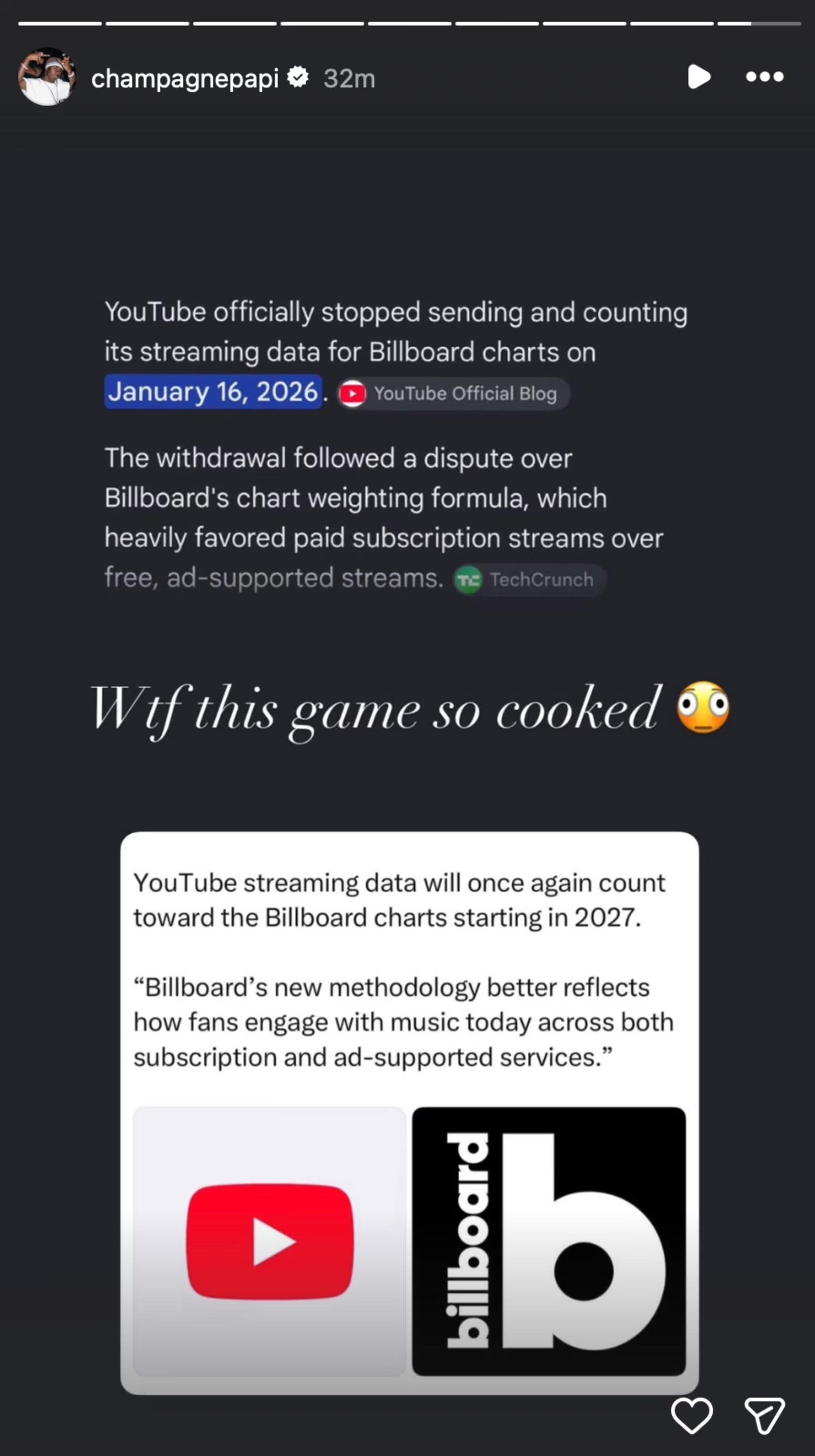
“Wtf this game so cooked,” Drake wrote on Instagram while sharing news of YouTube’s return to Billboard in 2027. He did not accuse anyone of rigging the rankings. Still, his comment comes as artists compete in an industry where the formula for success keeps changing.
On November 9, 2026, Billboard announced that it would increase the value of ad-supported music streams on the Billboard 200 and related album charts. Under the 2026 rules, 2,500 qualifying free streams of songs from an album equal one album unit. Beginning with the charts dated January 16, 2027, it will take just 1,500. Paid-subscription streams will still require 1,000 plays per unit.
That is a substantial shift. An album generating three million qualifying ad-supported streams would earn 2,000 album units under the new formula, compared with 1,200 under the outgoing rules. Traditional album sales and track downloads won’t be recalculated. Importantly, these are chart measurements, not changes to the royalty rates artists receive from streaming services.
Billboard says the adjustment follows a review of streaming revenue with data company Luminate. It also clears the way for YouTube to rejoin the rankings after a dispute that took its listening data out of Billboard’s U.S. charts earlier this year.
YouTube had argued that free listeners were being undervalued. Its global head of music, Lyor Cohen, said in announcing the company’s return, “We are returning to the Billboard charts starting in 2027. Billboard’s new methodology better reflects how fans engage with music today across both subscription and ad-supported services.”


Made to order and shipped to your door.
YouTube stopped sending data in January 2026 over that disagreement. Its return is important for artists whose fans watch music videos and listen through ad-supported services instead of paying for monthly subscriptions. Hip-hop and Latin artists with especially strong video audiences could benefit.
Audiomack executive Brian Zisook welcomed the adjustment: “With this change, ad-supported consumption on DSPs will carry significantly more weight, leading to greater representation for hip-hop and Latin on the Billboard charts. Long overdue!”
But Drake’s frustration raises a different question: If the same song can earn dramatically different chart credit without gaining a single additional listener, how much faith should fans place in rankings as proof of popularity? Changing how those numbers are interpreted can reshape what success looks like. That uncertainty has consequences well beyond bragging rights.
There’s also the pressure to manufacture attention. Music promotion already revolves around playlists, viral clips, fan campaigns, and streaming milestones. Giving ad-supported activity more influence could make video strategy even more central to release plans. That might help independent acts reach larger audiences, but it also puts another premium on securing attention at scale.
The larger industry already has a documented problem with fake listening. In October 2026, the U.S. Copyright Office opened an inquiry into music streaming fraud, identifying tactics including bots, click farms, and manipulated playlists. Such schemes can divert royalties and distort the audience data used for promotion and touring decisions. The new rules do not authorize fake streams, and Drake did not mention fraud.
For stars with massive catalogs, chart adjustments can change how new releases compete with older hits and how fans compare accomplishments across eras. Drake has complained before. After “What Did I Miss?” debuted at No. 2 on the Hot 100 in July 2025, he wrote, “Suppressor on the 1 spot. I’m taking that soon don’t worry one song or another. Rule changes and all.”
The coming system isn’t an outright win for free listening, either. A paid stream will still carry more chart weight than an ad-supported one. Billboard’s Hot 100 also considers radio airplay and song sales, so the album-unit conversion cannot simply be applied to every singles-chart position.
That leaves the music business facing an uncomfortable balancing act. Charts need to reflect where people actually listen, but they also need stable rules and safeguards against artificial traffic. YouTube’s return could make Billboard more representative. Drake’s “cooked” reaction, meanwhile, captures the distrust that grows when artists and fans suspect the scoreboard keeps moving.
