

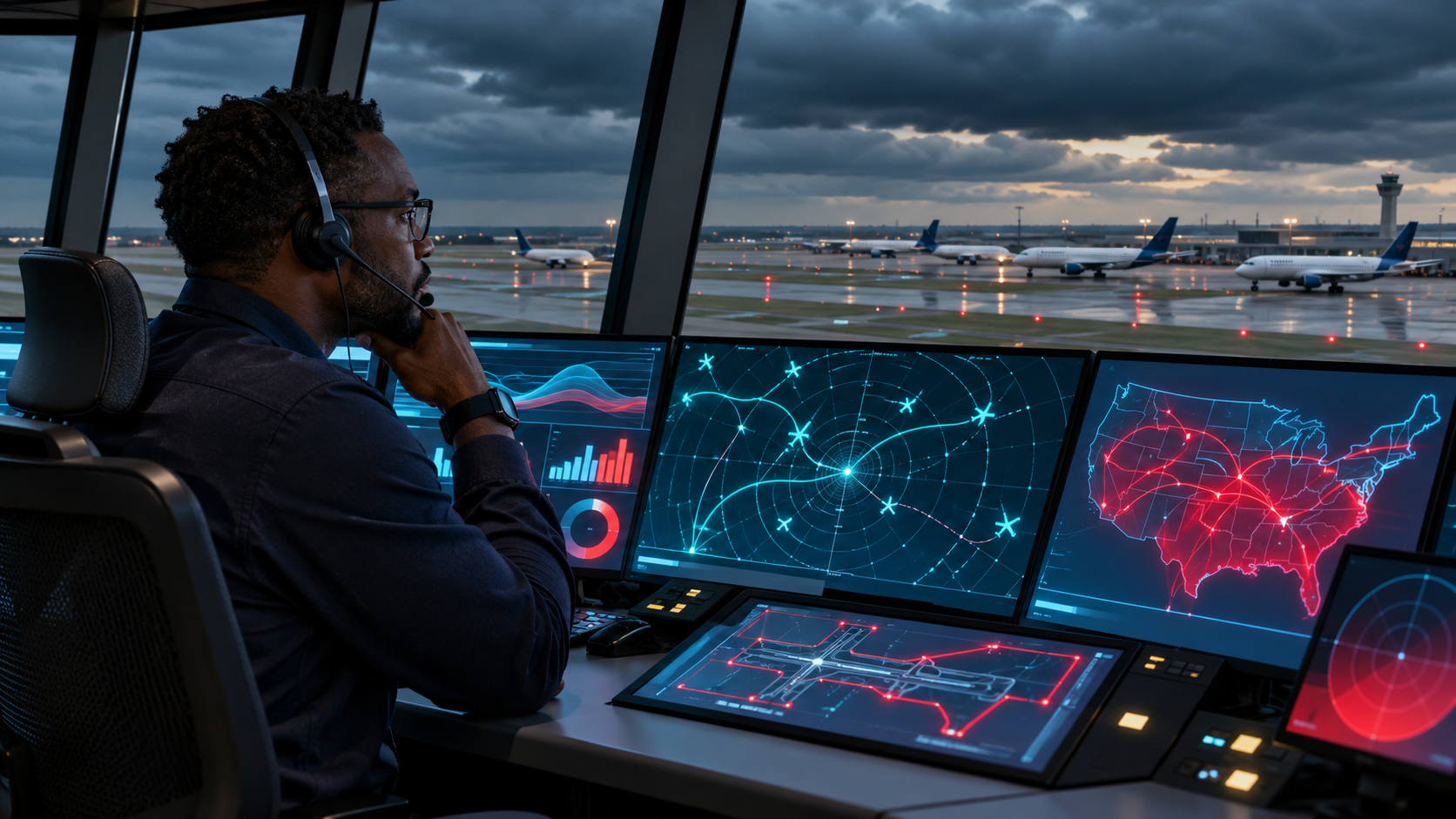
The FAA AI tool known as SMART went live at every high altitude air traffic control center in the country this week, and three days later the Federal Aviation Administration grounded every departing flight in America. No official has connected the two, but the timing has put the brand new system at the center of the conversation.
The ground stop hit Friday afternoon, November 13, just before 4 p.m. Eastern. A ground stop means planes are held at their gates and are not allowed to take off. The FAA ordered it for every airport in the country “due to extraordinary circumstances and for reasons of safety.” Flights already in the air were allowed to keep going, and international flights headed to the US were handled case by case. The FAA’s advisory now runs until 11:30 p.m. Eastern, but the agency told airlines that departures stay grounded until further notice, so it could end earlier or run later.
Transportation Secretary Sean Duffy said the stop followed a communication issue affecting all of the country’s Air Route Traffic Control Centers. There are 22 of those centers. They handle planes cruising above 18,000 feet, which covers most of a flight between two cities. The FAA later described the problem as a “temporary telecommunications outage.” Earlier in the afternoon, both of Chicago’s major airports, O’Hare and Midway, had already been put on a ground stop because of an equipment outage.
The new FAA AI tool is called SMART, short for Strategic Management of Airspace, Routes and Trajectories. The FAA says it pulls about 200 streams of information onto one platform, including flight paths, airline schedules, weather, airport capacity and how many controllers are on staff. The goal is to predict traffic jams in the sky hours, days or even weeks ahead, then recommend early route or schedule changes so planes avoid bad weather and congestion. The FAA has pitched it as a way to cut delays and save fuel.
SMART was first tested in the airspace around Reagan National, Dulles and Baltimore/Washington airports. The FAA says it expanded the system to all 22 centers three days before Friday’s ground stop. It was built under a $875 million, 12-year contract the FAA awarded to Air Space Intelligence in June. SMART does not fly planes or talk to pilots. FAA specialists in Washington review its suggestions and pass them to the agency’s command center in Warrenton, Virginia, and local managers at each facility decide whether to use them. Controllers on the ground are still responsible for keeping planes safely apart.
CNN aviation analyst Mary Schiavo, a former inspector general for the Department of Transportation, said on air that it was “just too much of a coincidence” that the FAA rolled out the FAA AI tool right before a nationwide communications outage. Her concern is that air traffic control still runs on a patchwork of old equipment, some of it relying on radios, telephones and floppy disks, and that new computer systems have a long history of struggling to work with the older ones.
Neither the FAA nor Duffy has linked SMART to the ground stop. Homeland Security Secretary Markwayne Mullin said there was “no indication as of yet” that anything “nefarious” was behind it and called it a telecommunications outage “as of now.” Mullin also said the administration is “not ruling out anything at this point,” that Trump has been briefed, and that Thursday’s global Microsoft outage is not connected. He said passengers already in the air have no reason for concern, and aviation experts noted that pilots are trained to fly through communication outages using backup procedures.


Made to order and shipped to your door.
This is only the third time the FAA has grounded the entire country. The first was after the September 11, 2001 attacks. The second was in January 2023, when the system that sends pilots safety alerts before takeoff went down overnight. That shutdown was traced to a contractor’s mistake that corrupted a file, and it caused more than 10,000 delays and over 1,300 cancellations nationwide. The 2023 problem came from a computer system. Friday’s came from a breakdown in the communications that connect air traffic controllers across the country, and FAA technicians are still working to find out what caused it.
Travelers with flights tonight should expect delays and cancellations to keep piling up after departures resume, because planes and crews will be out of position at airports across the country.
