

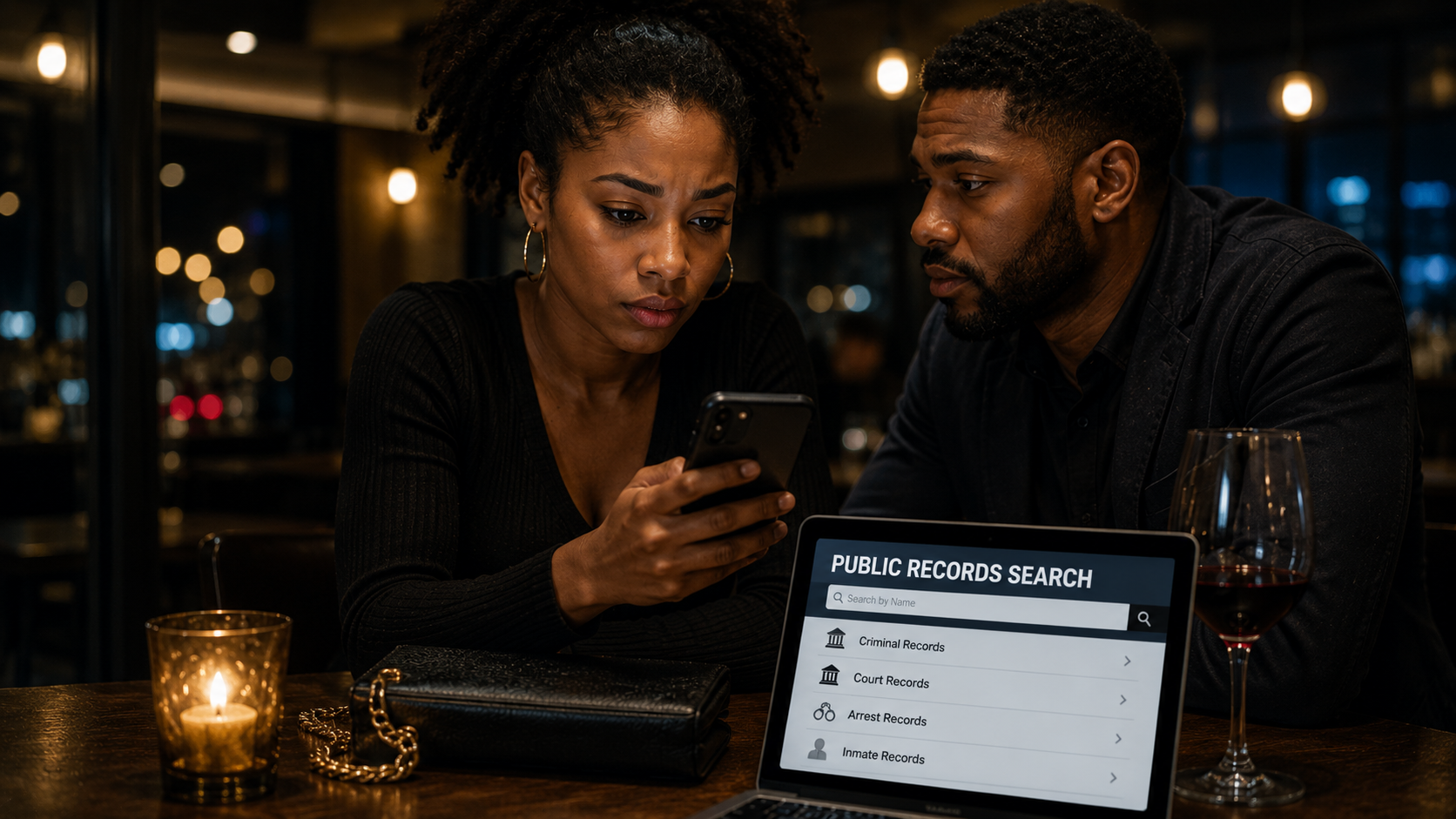
Going on a first date used to mean checking the outfit, confirming the reservation, and maybe sending a screenshot of the person to the group chat. Now, for millions of Americans, first date violence is part of the calculation, and criminal-record searches are increasingly becoming part of the pre-date routine. A new DatingAdvice.com survey of 1,016 U.S. adults found that 40% have researched a potential date’s criminal records before meeting them. Men and women reported doing it at nearly the same rate, 36% and 38%, respectively, while younger daters were even more likely to investigate before showing up. Forty-six percent of adults ages 18 to 24 said they had conducted a background check on a date, followed by 42% of people ages 25 to 34.
The survey also found that the digging sometimes changes what happens next. Among people who searched a date’s background, roughly 1 in 12, or 8.5%, said what they discovered caused them to cancel the date. Regionally, 41% of Midwestern respondents said they had researched a date’s court records, followed by 39% in the Northeast, 36% in the South and 34% in the West.
Those numbers do not prove that violent first-date cases are causing more people to search court databases. However, the safety concerns behind the behavior are not happening in a vacuum.
Pew Research Center previously found that women under 50 who have used online dating report substantial levels of unwanted behavior. Fifty-six percent said they had received unwanted sexually explicit content, 43% had been contacted after saying they were not interested, and 11% said someone threatened them with physical harm through a dating site or app. Overall, 66% experienced at least one of the unwanted behaviors Pew measured.
Then there are the cases where an ordinary-looking first meeting became a homicide investigation.
In April 2024, 19-year-old Milwaukee college student Sade Robinson went on a first date with Maxwell Anderson. Prosecutors said the two went to dinner before Robinson was killed and dismembered. Her remains were later recovered from multiple locations, and her burned vehicle became part of the investigation. Anderson was convicted of first-degree intentional homicide, mutilating a corpse, and arson in June 2025. He was later sentenced to life in prison without parole. The sentencing judge described the killing as “unconscionable.”
Robinson’s case was horrific, but it was not isolated.
In California, 32-year-old Priscilla Castro traveled to Vacaville on August 16, 2020, for what police described as a first date with Victor Serriteno, a man she had met through a dating app. She never came home. Investigators later determined Serriteno killed Castro and then started the Markley Fire while attempting to conceal the crime. The fire killed two additional people, Douglas Mai and Leon Bone. In May 2025, Serriteno pleaded no contest and was found guilty of three murders and arson charges. Three months later, he received a sentence of 73 years to life.
The danger remains painfully current.
In July 2026, 21-year-old Arizona mother Arianna Bailey Jones met Domonic Rodolico in person after connecting with him online. Authorities say the pair went to a movie on July 5, the first time they had met face-to-face. Days later, investigators found Jones’ remains in a shallow grave near Lake Pleasant. Rodolico was arrested and indicted on a murder charge. He has pleaded not guilty, and his trial is scheduled for March 2027. Investigators have said the motive remains unclear.
Family friend Vivian Lopez Jr. remembered Jones as “a very great mother; she loved her little boy.” Jones left behind a 2-year-old son.
Another high-profile case exposed an even more disturbing concern: sometimes a violent history exists before the first date ever happens.
Queens nurse Samantha Stewart met Danueal Drayton through Tinder in 2018. Prosecutors allege the pair went on a date before returning to Stewart’s home, where Drayton beat and strangled the 29-year-old. He was later indicted on murder and other charges. Queens District Attorney Melinda Katz called it “a brutal crime that makes every person using a dating app fearful.” Drayton is presumed innocent unless proven guilty, and recent public reporting has not confirmed a conviction in Stewart’s case.
Drayton had also previously been arrested after another woman accused him of choking her. That history adds weight to the basic premise behind pre-date court searches: sometimes the information people are looking for is actually there.
The shift does not mean every online match is dangerous, nor does the DatingAdvice survey establish that first-date murders are statistically rising. There is no comprehensive national database specifically tracking murders committed during first dates, making sweeping claims about an increase impossible to support.
What the available evidence does show is a dating culture increasingly shaped by verification. Dating apps made it easier to meet someone outside your social circle. That same convenience also removed some of the informal vetting that once came through shared friends, coworkers, or communities. DatingAdvice researchers explicitly noted that public records are now filling part of that gap.
And when headlines repeatedly show how quickly a first meeting can turn fatal, searching a name before sharing a table starts looking less like paranoia and more like another layer of preparation.
The first date may still begin with chemistry. Increasingly, though, somebody is checking the court docket first.
