

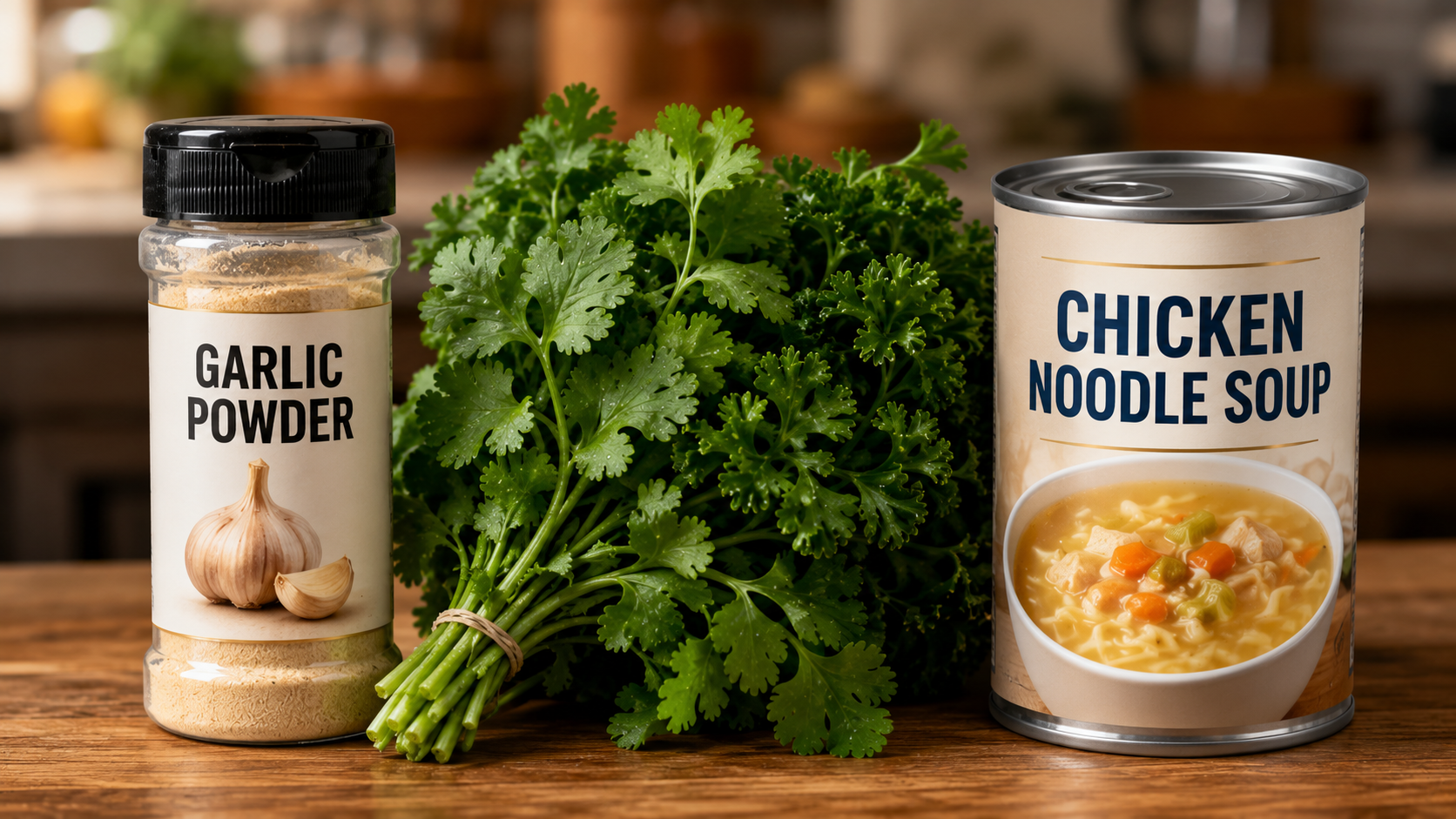
The grocery list is looking a little suspicious after three separate food safety developments put garlic powder, fresh herbs and canned chicken noodle soup under the microscope.
First, Canadian officials recalled Heavenly Spices Garlic Powder sold through Dollarama stores over possible Bacillus cereus contamination. Meanwhile, North Carolina health officials are investigating a sharp rise in Cyclospora infections involving commonly reported foods such as parsley, cilantro and lettuce. In a separate action, BCI Foods, Inc. recalled thousands of pounds of canned chicken noodle soup imported into the United States without required federal reinspection.
The Dollarama garlic powder recall was announced by the Canadian Food Inspection Agency on July 15. It covers Heavenly Spices Garlic Powder sold in 70-gram containers with UPC 6 67888 50634 7 and package code “BB: 2029 JAN 30 GP 30ZV PIT.”
The CFIA classified the action as a Class 2 recall, indicating that exposure could cause temporary or non-life-threatening health effects.
Officials say the product may contain Bacillus cereus, a bacterium that can cause nausea, vomiting, abdominal cramps and watery diarrhea. Symptoms typically last between 24 and 48 hours, although severe or prolonged illness may require medical attention.
The affected garlic powder was distributed across Canada in physical Dollarama stores and online. No distribution in the United States has been reported.
The CFIA advised consumers not to “use, sell, serve, or distribute” the product. Dollarama has also advised customers to discard it instead of attempting to kill the bacteria through cooking. Customers may contact the retailer for a $2 e-gift card replacement.
However, garlic powder is not the only ingredient drawing concern.
North Carolina has reported a major increase in cyclosporiasis, an intestinal illness caused by consuming food or water contaminated with the microscopic Cyclospora parasite.
From May 1 through July 14, state officials documented 307 cases and 13 hospitalizations, with most cases reported in Wake County. By July 17, the North Carolina Department of Health and Human Services said additional infections had pushed the state beyond the number of cases recorded in both 2024 and 2025.
Parsley, cilantro and lettuce were among the foods commonly reported by people who became sick. However, officials stressed that the information does not prove any of those ingredients caused the infections.
The North Carolina cases also did not appear to be connected to a separate multistate outbreak involving lettuce served at Taco Bell locations.
Cyclospora typically causes frequent watery diarrhea. Other symptoms may include appetite loss, weight loss, stomach cramps, bloating, gas, nausea, fatigue and flu-like symptoms. Symptoms generally begin about one week after exposure and may continue or return without treatment.
“If you are experiencing severe or persistent diarrhea, you should reach out to your health care provider,” State Epidemiologist Dr. Zack Moore said. “It is also important for everyone to follow routine safety practices like washing your hands with soap and water before and after handling or preparing food and washing all fresh produce under clean running water.”
Tracing the source can be difficult because herbs may be mixed into meals without customers noticing every ingredient.
“Many individuals may not even realize they have consumed the ingredient that is making them sick, which makes tracing the source of contamination more difficult,” State Public Health Veterinarian Dr. Carl Williams said. “For example, someone may recall that they had pico de gallo with their dinner, but not that it included cilantro.”
North Carolina officials warned that rinsing produce may remove some of the parasite but cannot guarantee its complete removal. Cooking food to 165 degrees Fahrenheit can prevent many foodborne illnesses, although parsley, cilantro and lettuce are frequently served raw.
Then there is the soup recall.
On July 23, the U.S. Department of Agriculture’s Food Safety and Inspection Service announced that BCI Foods, Inc. was recalling approximately 4,300 pounds of canned chicken noodle soup imported from Canada without the benefit of required import reinspection.
BCI Foods is based in Saint-Hyacinthe, Quebec, and served as the importer of record. According to the federal notice, the recalled cans bear Canadian establishment number “EST. 142.”
The product was distributed to food banks and food pantry locations in Oklahoma, adding another layer to the recall since customers may have received the cans through community assistance programs instead of purchasing them at a traditional store.
The company notified FSIS after determining that the shipment had entered the country without being presented for federal import reinspection.
There have been no confirmed reports of illness or injury connected to the soup. Still, consumers should not eat recalled products. Federal guidance generally directs people to discard affected items or return them to the location where they were received.
The three situations are not connected, and they involve different concerns. The garlic powder recall centers on possible bacterial contamination. The North Carolina investigation involves a parasite with no confirmed single source. The chicken soup recall involves a missed federal inspection rather than a confirmed contaminant.
Still, the timing puts a spotlight on how quickly routine foods can become part of a safety investigation. That bottle behind the paprika, the cilantro sitting in the produce drawer and the donated soup can in the cabinet may all deserve a closer look before the next meal.
