

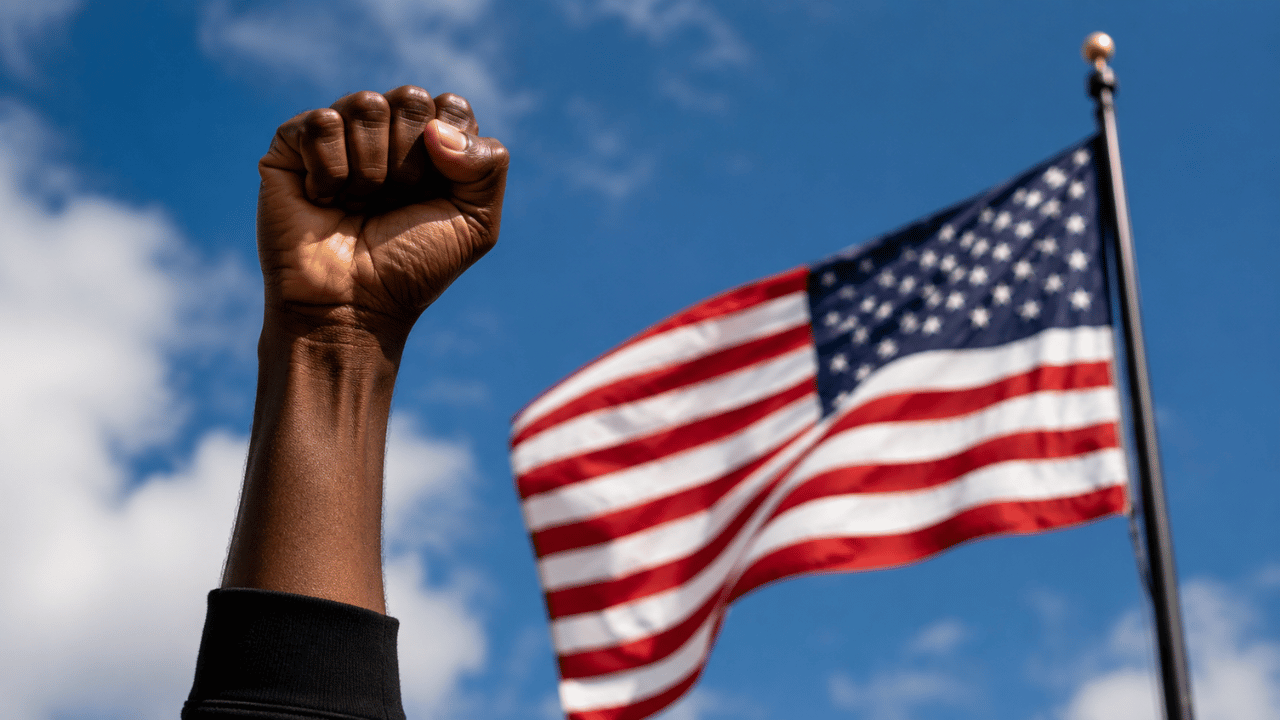
Fourth of July conversations in Black America always seem to arrive right on time. The grill is getting cleaned. The red cups are coming out. Somebody is already arguing over who made the potato salad. Then the bigger question slides into the group chat like clockwork: Is this really our holiday?
The answer depends on who you ask, and both sides have more than enough history to stand on.
According to the National Archives, the Continental Congress adopted the Declaration of Independence on July 4, 1776, after the colonies moved to separate from British rule. According to the U.S. Department of State Office of the Historian, the declaration formally severed the political ties between the thirteen colonies and Great Britain. The National Archives’ transcript of the Declaration of Independence also shows the language that America would build its identity around, including the promise that “all men are created equal” and the right to “Life, Liberty and the pursuit of Happiness.”
That is the version of the Fourth of July that shows up in school programs, parade speeches, flag displays, and fireworks shows. It is the story of freedom, independence, and a nation announcing itself to the world. But for Black Americans, the story has always required another paragraph.
According to the American Battlefield Trust, about 500,000 African Americans lived in the colonies at the start of the War for Independence, and roughly 450,000 of them were enslaved. That means the freedom being celebrated in 1776 did not include most Black people living in the colonies. They were not treated as citizens enjoying a new nation’s promise. They were treated as property inside a country declaring liberty for itself.
That contradiction gets even harder to ignore when looking at the men behind the founding language. According to Monticello, Thomas Jefferson owned more than 600 enslaved people during his lifetime. Jefferson helped write the words that became America’s freedom scripture, but his own wealth and household were tied to the labor of people who had no legal freedom under the system he helped preserve.
That is why the Fourth of July has never landed cleanly for many Black Americans. It is not about refusing joy. It is about knowing that the country’s birthday was built on a promise that Black people had to fight generations to claim.
Frederick Douglass made that tension plain in 1852. According to the Library of Congress, Douglass delivered his famous address on July 5, 1852, while millions of Black Americans remained enslaved. The Library of Congress notes that Douglass viewed the Independence Day celebration amid slavery as hypocrisy. According to the National Constitution Center, the speech challenged the gap between America’s founding principles and the institution of slavery.
That speech still echoes because the question still cuts. What does the Fourth of July mean to people whose ancestors were excluded from the freedom being celebrated? What does it mean to wave a flag for a country that had to be forced, challenged, sued, marched on, and legislated into recognizing Black humanity?
Abraham Lincoln issued the Emancipation Proclamation on January 1, 1863, declaring that enslaved people held in rebellious states “are, and henceforward shall be free.” The same source explains that the proclamation applied to areas in rebellion, which means freedom did not arrive everywhere at once. U.S. Major General Gordon Granger issued General Order No. 3 in Texas on June 19, 1865, informing people there that enslaved people were free. That day became known as Juneteenth.
That timeline matters. The Fourth of July marked independence for the nation in 1776, but Juneteenth marked a freedom announcement for enslaved people in Texas nearly ninety years later. That is why some Black Americans connect more deeply with Juneteenth than the Fourth of July. One holiday celebrates the country’s birth. The other speaks directly to the delayed, denied, and hard fought freedom of Black people.
The tension is not only historical. According to the Federal Reserve, the median wealth gap between White families and Black families grew between 2019 and 2022, reaching more than $220,000. According to the CDC, Black women had a maternal mortality rate of 50.3 deaths per 100,000 live births in 2023, significantly higher than the rates for White, Hispanic, and Asian women. Those realities are part of why the Fourth of July can feel complicated. Freedom is not just a historic word. It has to show up in health, safety, opportunity, wealth, and dignity.
Still, there is another side of the conversation that deserves just as much honesty.
For many Black families, the Fourth of July is not really about founding fathers, colonial politics, or speeches from 1776. It is about a day off work. It is about somebody’s auntie making ribs the same way she has made them for twenty years. It is about kids running through the yard, cousins pulling up from out of town, card tables opening, dominoes slamming, and the playlist moving from Frankie Beverly to Future without warning.
Black people have a long record of taking spaces and dates that were not made with us in mind and turning them into something rooted in community. The Fourth of July cookout is often less about celebrating America’s origin story and more about celebrating each other. It becomes a family reunion, a neighborhood check in, a chance to breathe, eat, laugh, dance, and remember that joy is also a form of resistance.
That does not erase the history. It does not soften slavery, excuse hypocrisy, or make the founding contradiction disappear. But it does show how Black culture can transform a day. For some people, refusing the Fourth of July is a political choice. For others, gathering on that day is not an endorsement of America’s past. It is a commitment to Black presence, Black family, and Black joy in the present.
Both positions can be true.
You can understand why some Black Americans skip the Fourth of July completely. You can also understand why others pull up to the cookout with a folding chair, a foil pan, and no interest in debating the Declaration of Independence over a plate. One response is rooted in historical memory. The other is rooted in cultural survival. Neither one needs to be flattened into a talking point.
The real issue is whether we are willing to tell the whole truth. The Fourth of July is a national celebration built on freedom language that did not originally include enslaved Black people. It is also a day that many Black families have reshaped into something warmer, louder, and more communal than the holiday’s official script. The contradiction is the point.
So whether you are waving a flag, skipping the fireworks, honoring Juneteenth more deeply, or showing up strictly for the ribs and the Spades table, the history deserves to be known. The Fourth of July can be a celebration, a critique, a cookout, a contradiction, or all of that at once.
For Black America, freedom has never been handed over neatly. It has been fought for, redefined, protected, and sometimes celebrated over a paper plate while somebody’s uncle argues about the grill.
