

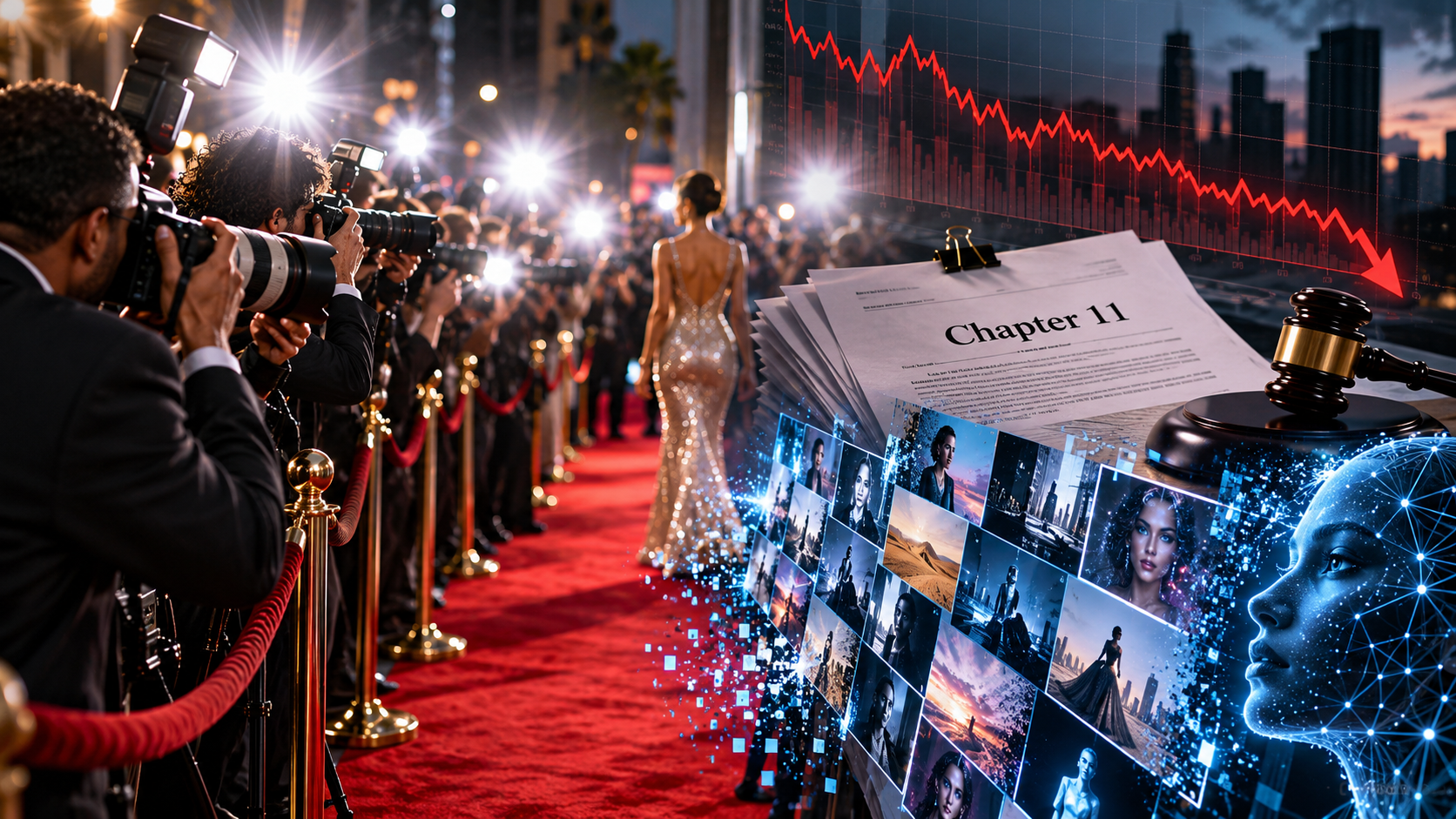
One of the biggest companies behind Hollywood red carpet photos, celebrity images, and breaking news photography is preparing to file for bankruptcy as artificial intelligence transforms the business of selling pictures. Getty Images, a major supplier of professional photography worldwide, announced plans to restructure its finances and become privately owned following a failed multibillion dollar merger with Shutterstock.
The Getty Images bankruptcy plan comes during a challenging period for the photography industry, where artificial intelligence is making it easier for businesses to create images without purchasing traditional stock photography.
According to Getty Images’ October 12 announcement, affiliates of the Getty family and Koch Equity Development, the investment division associated with billionaire Charles Koch, have committed up to $533 million in new equity. The agreement also includes retiring $270 million in unsecured debt and reducing interest expenses.
Getty plans to enter an expedited Chapter 11 bankruptcy process in the coming weeks and complete its restructuring before the end of 2026. The company maintains that everyday operations will continue without disruption. Employees, photographers, content contributors, customers, and business partners are not expected to be affected.
The financial problems intensified after Getty abandoned its proposed $3.7 billion merger with Shutterstock. According to the United Kingdom’s Competition and Markets Authority, regulators required Shutterstock to sell its editorial photography business before approving the transaction. Getty ultimately rejected that condition, ending the merger in July.
The failed deal also came with substantial expenses. As reported by The Hollywood Reporter, Getty CEO Craig Peters said the company spent “more than $100 million across professional fees and financing costs in pursuit of what we believe will be a strategic transaction.”
However, the failed merger is only part of the story. Artificial intelligence has introduced another major challenge for Getty’s traditional business model.
During the company’s August 2026 earnings call, Peters acknowledged that generative AI was affecting the stock photography market, especially customers who prioritize affordability over premium image quality. Businesses can now generate advertising concepts, backgrounds, lifestyle images, and other promotional visuals using AI software rather than purchasing existing photographs.
Getty also disclosed that its iStock online marketplace was experiencing “declining agency demand and disruption,” according to The Hollywood Reporter.
The impact goes beyond AI-generated photographs. Getty executives said search engines increasingly provide AI-generated answers directly to users, reducing the number of people clicking through to websites like iStock. That decline in referral traffic makes it harder for the company to attract new subscribers.
Company financial results reveal the pressure. Getty reported approximately 240,000 active annual subscribers in its second quarter of 2026, compared with 321,000 during the corresponding period the previous year.
Chief Financial Officer Jennifer Leyden attributed the decline partly to a “deliberate strategy to deemphasize lower-value acquisition channels, including the discontinuation of our iStock free trial program.”
Although the subscriber decline cannot be blamed entirely on artificial intelligence, Getty’s management has directly identified AI competition and changes in search traffic as significant business challenges.
Despite these setbacks, the company’s editorial photography operation remains a source of strength. According to Getty’s second-quarter financial report, editorial revenue increased 9.2% compared with the previous year, reaching $96.5 million.
That growth highlights a crucial distinction. Artificial intelligence can generate a convincing fictional red carpet scene, but it cannot independently document which celebrity actually attended an event, capture a real championship moment, or verify what happened during breaking news.
Getty’s extensive archive and network of professional photographers provide something businesses and media organizations increasingly need in an era of synthetic imagery: authentic, licensed visual documentation.
Interestingly, Getty is also investing in the technology disrupting its industry. The company has introduced AI image generation and editing tools, including services developed with NVIDIA technology, allowing customers to create visuals using models trained on licensed content.
Getty also announced a multiyear partnership with OpenAI in June 2026, allowing licensed images from its collection to appear within ChatGPT search and discovery experiences. That arrangement demonstrates how Getty is attempting to generate new business opportunities from AI rather than relying exclusively on traditional photo licensing.
Still, artificial intelligence is not the sole explanation for the Getty Images bankruptcy plan. The abandoned Shutterstock merger, substantial debt obligations, financing expenses, and other financial pressures have also contributed to the company’s restructuring.
Mark Getty, the company’s co-founder and board chairman, expressed confidence in its future.
“This transformational transaction is underpinned by the strength of the business and the significant growth potential we see ahead,” Getty said. “I am pleased to continue our strong partnership with Koch Equity Development and the lender groups to provide capital structure improvements that will enable us to build on our solid foundation and seize new growth opportunities.”
CEO Craig Peters also emphasized what makes the company valuable beyond technology.
“Core pillars of our success are the longstanding commitment of our customers and partners, the deep expertise and creativity of our team and content contributors, and the uniqueness of our archive.”
Mike Harris, senior managing director and co-head at Koch Equity Development, expressed similar optimism.
“We remain confident in the company’s future and fully support this transaction alongside the Getty family. This equity investment will provide Getty Images with a firm financial foundation and greater flexibility to continue investing in its employees, customers, contributors, and future growth.”
For photographers, publishers, entertainment outlets, and digital creators, the Getty Images bankruptcy plan reflects a larger transformation across the visual content industry. AI is making generic imagery easier to produce, while the value of original photography increasingly rests on authenticity, exclusivity, and trust.
Getty’s next chapter will test whether its historic archive, professional photographers, and technology partnerships can help the company remain profitable in a market where generating an image is easier than ever, but proving that an image captures something real may be more valuable than ever.
