

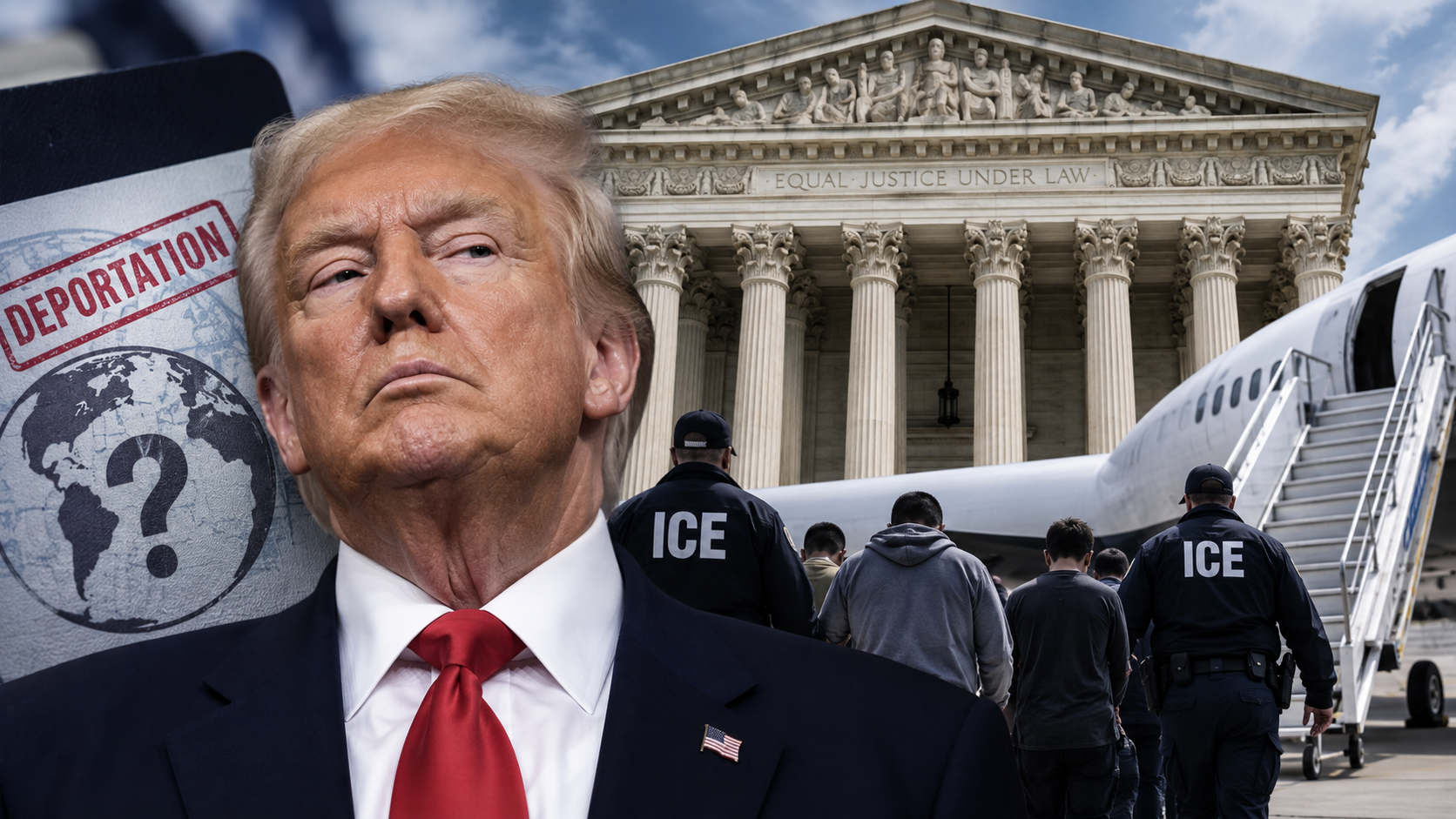
Donald Trump’s administration asked the Supreme Court on Thursday, September 24, to let third country deportations keep going without first giving immigrants a chance to object.
A third country deportation sends a person to a nation that is not their homeland, often a place where they have never lived and have no family or connections. The administration says it uses these removals for people who already have final deportation orders when their home countries will not take them back or they cannot be sent there.
The emergency filing asks the justices to put on hold a ruling by U.S. District Judge Brian Murphy in Boston. Murphy found that the Department of Homeland Security’s policy for these removals is unlawful. His ruling does not ban the practice. It requires the government to give people a real opportunity to argue that they face danger in the country they are being sent to before they are put on a plane.
Murphy’s ruling had been on pause while the government appealed. On September 18, the 1st U.S. Circuit Court of Appeals upheld most of it. On Wednesday night, lawyers for the immigrants told the appeals court they had heard from multiple sources that a flight was set to leave Alexandria, Louisiana, the next day for Burundi, Rwanda and the Central African Republic. Within hours, the court lifted the pause and put Murphy’s ruling into effect.
The administration says that order came down minutes before midnight. It says the order forced it to cancel a flight carrying 70 people to three countries, which it did not name. The government also told the justices the cancellation means reopening diplomatic talks with each of those countries. It argues the ruling would cause long delays for anyone who says they fear persecution and would force it to rework agreements with foreign governments.
Attorney General Todd Blanche blasted the appeals court for acting “in the dark of night.” He claimed the order took away a legal tool the administration uses to slow illegal immigration. DHS general counsel James Percival said 25,000 people living in the U.S. illegally have been removed through third country deportations. He called the removals “an essential public safety tool.” A tally by human rights groups puts the number at more than 25,000 people sent to 29 countries, with most going to Mexico.
The immigrants’ lawyers and Murphy say the policy has also swept up people who had been granted legal protection from being returned to their home countries. According to court filings from the plaintiffs, some deportees were handed off by third countries right back to the homelands U.S. courts had protected them from. Others were abused, detained or disappeared.
This month, lawyers for two men deported to Equatorial Guinea said police beat the men and held them at gunpoint in a hotel turned detention center. They said the police covered the men’s heads with bags.
This is not the first time third country deportations have reached the Supreme Court. Last year, a divided court let the flights continue while the case played out. The three liberal justices dissented. That decision came through the court’s emergency docket, where the justices rule quickly on urgent requests, usually without full arguments and often without explaining their reasoning. The majority gave no explanation at the time.
