

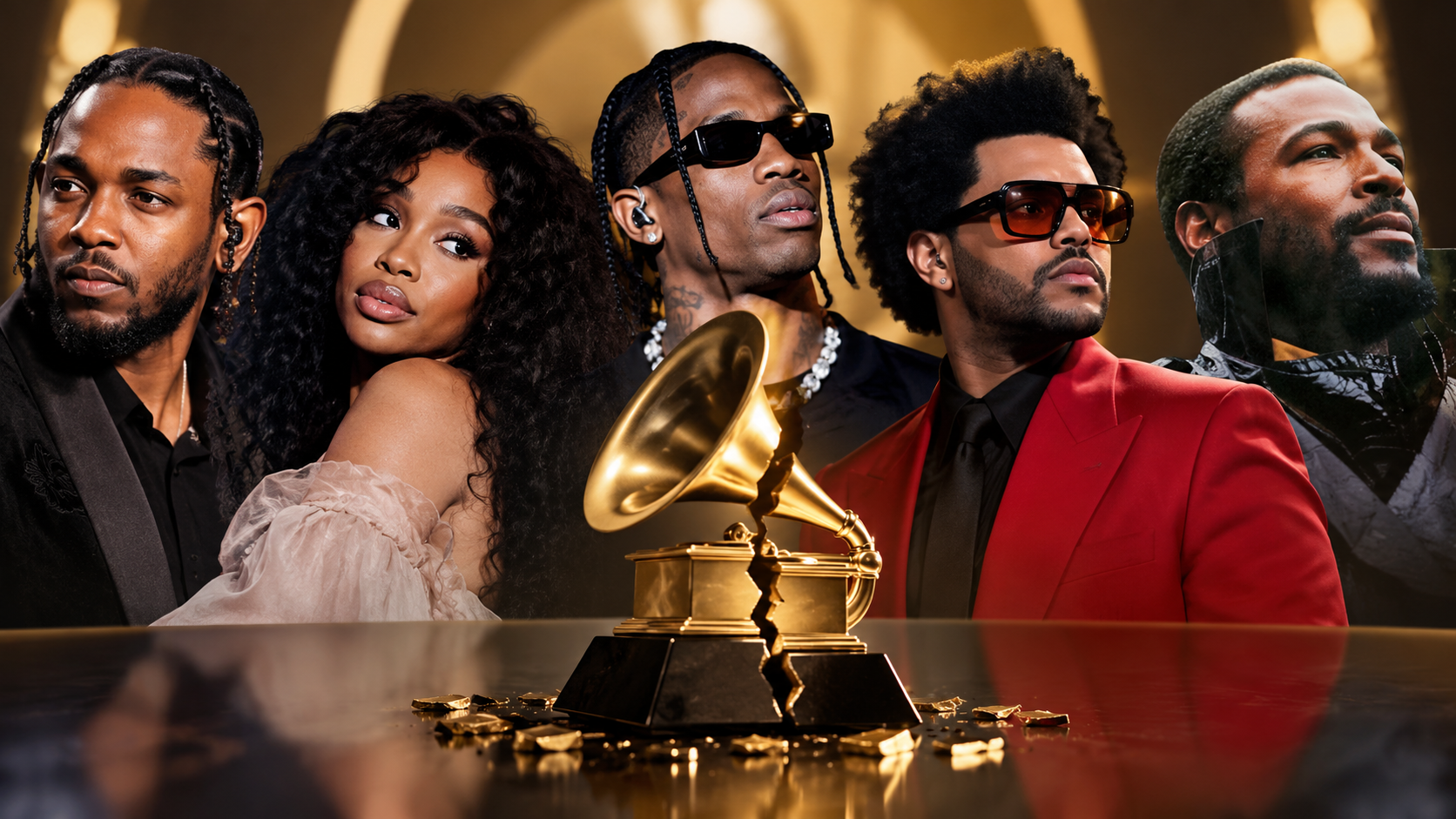
Everybody remembers the night Beyoncé’s “Lemonade” lost Album of the Year to Adele’s “25.” And everybody remembers Adele standing on that stage in 2017, practically saying the trophy belonged to Beyoncé. Even the Recording Academy later revisited the moment, acknowledging how Adele praised the album she had just beaten. But “Lemonade” still went home with Best Urban Contemporary Album. Unlike that iconic piece, these five albums never got such consolation. Some lost controversial races, one received no nominations whatsoever, and another was overlooked decades before the conversation about Grammy snubs became a yearly tradition.
What makes these Grammy album snubs so interesting is that the music never needed an award to prove its worth. Years later, these projects still influence artists, dominate conversations, and remind listeners that winning a Grammy and creating a classic are two very different accomplishments.
Kendrick Lamar’s “good kid, m.A.A.d city” might be one of hip hop’s most infamous Grammy losses. Released in October 2012, the album introduced millions of listeners to Kendrick’s cinematic storytelling through a deeply personal portrait of growing up in Compton. Songs like “Money Trees,” “Swimming Pools (Drank),” “m.A.A.d city,” and “Sing About Me, I’m Dying of Thirst” helped turn his major label debut into something bigger than a collection of hit records. It played like a film, with family conversations, neighborhood experiences, and consequences connecting the music.
By the 2014 Grammys, Kendrick had earned seven nominations, including Album of the Year and Best Rap Album. He left without a single win. Daft Punk’s “Random Access Memories” won Album of the Year, while Macklemore and Ryan Lewis took Best Rap Album for “The Heist.”
The backlash became even more memorable when Macklemore acknowledged the controversy himself. He later posted a screenshot of a text message he sent Kendrick after the ceremony that began, “You got robbed. I wanted you to win. You should have.”
That admission turned an already controversial decision into a defining Grammy moment. Kendrick would eventually become one of the most decorated rappers in the awards show’s history, but “good kid, m.A.A.d city,” the project that helped establish his reputation as one of hip hop’s greatest storytellers, remains without a Grammy.
Travis Scott experienced his own disappointment with “Astroworld,” the sprawling 2018 album that helped push his psychedelic trap sound into the mainstream. Inspired by Houston’s former amusement park of the same name, the project created an immersive musical universe built around unpredictable beat switches, atmospheric production, and high-profile collaborations.
The album delivered fan favorites including “STARGAZING,” “STOP TRYING TO BE GOD,” and “SICKO MODE,” the Drake collaboration that became Travis’s first No. 1 hit on the Billboard Hot 100.
The Grammys recognized “Astroworld” with a Best Rap Album nomination in 2019, while “SICKO MODE” earned nominations for Best Rap Song and Best Rap Performance. Travis lost all three. According to the Recording Academy, Cardi B’s “Invasion of Privacy” won Best Rap Album over a field that also included Mac Miller’s Swimming, Nipsey Hussle’s Victory Lap and Pusha T’s Daytona.
Cardi’s win was a significant achievement for her career, but Travis’s loss still fuels debate about the category. “Astroworld” was not simply successful because of one hit single. Its sound, sequencing, and ambitious production helped define an era of mainstream rap. The fact that none of its three nominations produced a trophy remains a striking part of its history.
SZA’s “Ctrl” represents another kind of Grammy disappointment. When the singer released her debut studio album in June 2017, she helped reshape what contemporary R&B could sound like. Her writing was conversational, vulnerable, and sometimes uncomfortably honest. She explored jealousy, insecurity, complicated relationships, and the pressure of trying to figure yourself out while growing older.
Tracks like “Love Galore,” “The Weekend,” “Drew Barrymore” and “20 Something” connected with listeners who recognized themselves in the experiences she described. Rather than presenting herself as someone who had everything figured out, SZA made uncertainty part of the album’s appeal.
The Recording Academy nominated SZA for five awards at the 2018 Grammys, including Best New Artist, Best R&B Performance, Best R&B Song, Best Rap/Sung Performance, and Best Urban Contemporary Album for “Ctrl.” She won none of them. The Weeknd’s “Starboy” defeated “Ctrl” in the album category, while Alessia Cara took Best New Artist.
SZA later opened up about the disappointment in a February 2018 interview with GQ. She admitted, “Aw, I was mad as hell for a little while, girl. Don’t trip!”
Still, she refused to make Alessia Cara the villain of the situation, praising her talent and saying she deserved her recognition. SZA also explained that she never created “Ctrl” with Grammy trophies in mind.
That perspective makes the album’s legacy even more meaningful. SZA eventually won Grammys for later work, but “Ctrl” remains the breakthrough record that introduced her distinctive songwriting to a wider audience without earning a single award of its own.
The Weeknd’s “After Hours” might be the most baffling omission on this list because the Recording Academy did not even nominate it. Released in March 2020, the album arrived with a fully developed visual identity, a dark cinematic storyline and a collection of songs that blended pop, electronic music and R&B.
With records like “Blinding Lights,” “Heartless,” “In Your Eyes,” and “Save Your Tears,” The Weeknd created one of the defining musical eras of 2020. The album debuted at No. 1 on the Billboard 200, and “Blinding Lights” became a historic chart success. In 2025, Billboard ranked the song No. 1 on its chart of the top Hot 100 songs of the 21st century through 2024.
Yet when nominations for the 2021 Grammys were announced, “After Hours” and its singles were completely absent.
The Weeknd publicly challenged the Recording Academy over the decision. He announced in March 2021 that he would stop submitting his music for Grammy consideration, specifically criticizing the secret committees involved in the nomination process.
The boycott did not last forever. The Weeknd made a surprise return to the Grammy stage in February 2025, with the Recording Academy confirming his performance and acknowledging his previous concerns about fairness and transparency.
Still, that reconciliation did nothing to change the fate of “After Hours.” Of all the Grammy album snubs in recent memory, leaving a project of that commercial reach and cultural visibility completely off the ballot remains one of the hardest decisions to explain.
Then there is Marvin Gaye’s “What’s Going On,” an album whose significance reaches far beyond the recording industry.
Released in May 1971, the Motown masterpiece addressed war, poverty, environmental destruction, addiction, and the struggles facing Black communities. Rather than avoiding uncomfortable subjects, Gaye centered them in an album that blended soul music with spiritual reflection and social commentary.
According to the Recording Academy’s retrospective on the project, Gaye drew inspiration from the unrest of the era, the Vietnam War, and the experiences of his brother Frankie, who served in Vietnam. The project marked a major creative shift for a singer who had already established himself through Motown hits.
Songs such as “What’s Going On,” “Mercy Mercy Me (The Ecology)” and “Inner City Blues (Make Me Wanna Holler)” challenged listeners to confront what was happening around them. More than five decades later, their themes remain painfully relevant.
Despite that impact, the album itself failed to earn a nomination for Album of the Year at the 1972 Grammys. The distinction is important because “Inner City Blues” did receive a nomination for Best R&B Vocal Performance, Male, but it did not win. “What’s Going On” received no competitive Grammy award.
The Recording Academy eventually inducted the album into its Grammy Hall of Fame in 1998, recognizing its historical importance. And in its influential ranking of the 500 greatest albums of all time, Rolling Stone placed “What’s Going On” at No. 1.
That contrast might be the clearest example of how an album’s legacy can exceed its original awards recognition. A record now celebrated as one of the greatest ever made could not secure an Album of the Year nomination when it was eligible.
Together, these five albums expose one of the Grammys’ most persistent contradictions. The Recording Academy recognizes music within a particular awards season, but listeners decide what survives long after that season ends. Kendrick delivered a landmark coming-of-age story, Travis built an immersive hip hop experience, SZA helped redefine modern R&B, The Weeknd created an era of chart dominance, and Marvin Gaye made a timeless statement about the world around him.
None of those albums needed a Grammy to become culturally significant, but their omissions remain part of the awards show’s history. The trophies went elsewhere, while the music kept making its case.
