

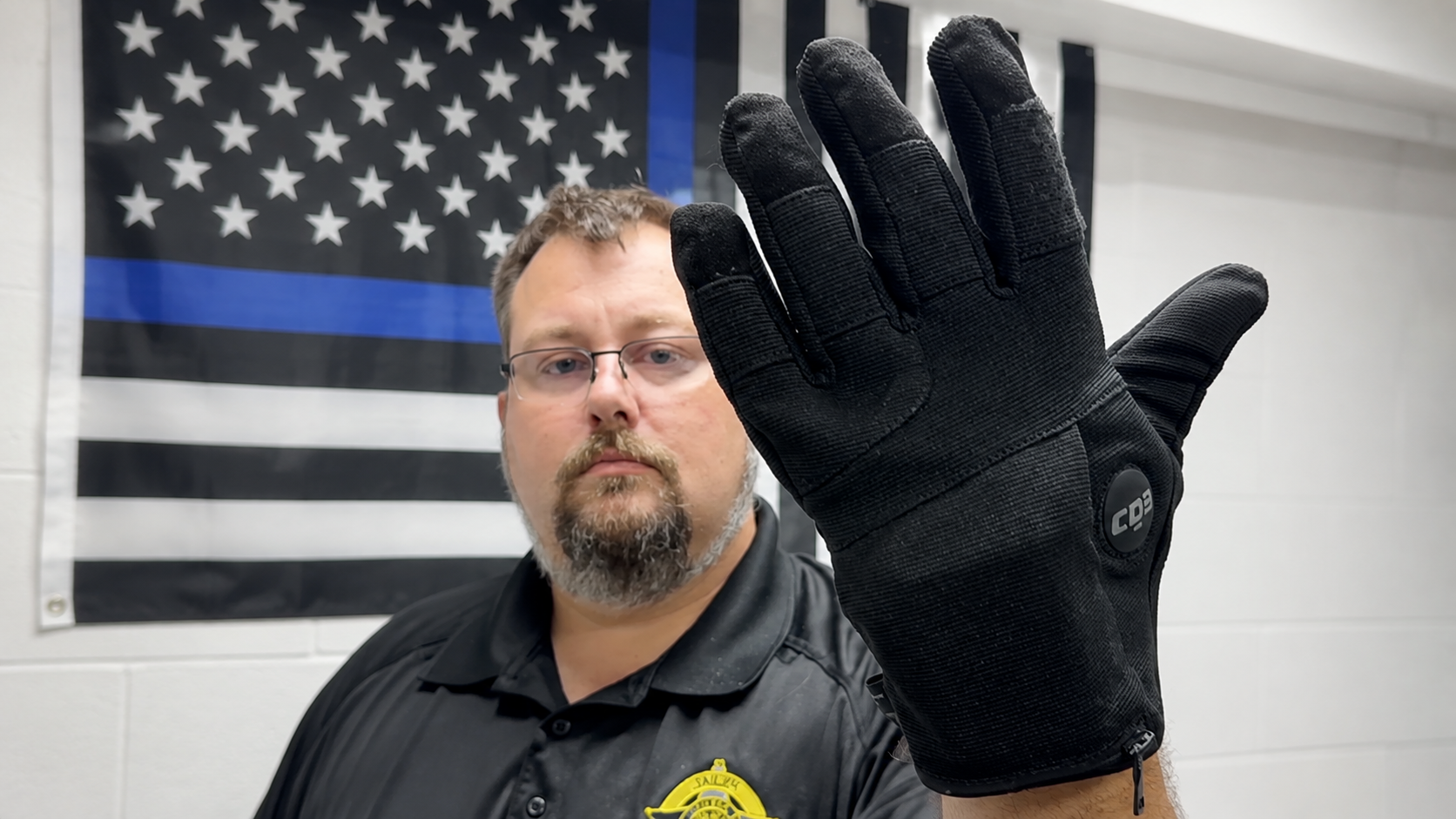
ICE is planning to outfit its officers with electric shock gloves, according to a Department of Homeland Security procurement notice posted this month, and the agency could spend as much as $20 million on them. The devices go to Homeland Security Investigations and Enforcement and Removal Operations, the two arms of ICE that run investigations and carry out arrests and deportations, with delivery expected by March 2027. The Associated Press first reported the plan.
Video
The product is called the G.L.O.V.E., which stands for Generated Low Output Voltage Emitter. It is made by Compliant Technologies, a veteran-owned company based in Kentucky. A small button sits on the wrist of the glove. When an officer presses it, the glove delivers an electric shock the moment it touches skin. It works like a taser in that it uses electricity to incapacitate someone, but a taser fires prongs that pierce the skin from a distance. This does not. An officer simply has to have a hand on you. The company says it emits up to 380 volts on skin contact, that the charge will not penetrate clothing, and that it does not interfere with pacemakers or defibrillators.What it feels like is not in dispute. Kenneth Corey, who spent more than three decades at the New York City Police Department and now leads the Policing Leadership Academy at the University of Chicago Crime Lab, told NPR he has had it used on him. He described someone simply grabbing his wrist while wearing the glove. Corey is six foot three and around 250 pounds. He said it made his knees buckle. Compliant Technologies fills its own Instagram page with demonstration footage, and in most of those clips, the officers being shocked grimace or yell and end up on the ground. In one video introduced by company founder Jeff Niklaus, a deputy with the Oklahoma County Sheriff’s Department screamed and dropped when the glove touched him. He described the sensation afterward as having no control.
Now, the number that should stop you. The certification course Compliant Technologies requires before someone can carry the device runs about three and a half hours total, including lectures, demonstrations, and breaks, and ends with a multiple-choice test. That is the full training to carry a weapon that drops a 250-pound man to his knees. Context matters here because of who is receiving them. ICE has hired more than 12,000 officers in under a year, an expansion so fast that policing experts have publicly questioned the vetting. Naureen Shah, director of policy and government affairs for immigration at the ACLU, put the objection plainly: her question was why you would hand novel, dangerous technology that is difficult to train people on to personnel with a documented track record of abuse. She called it reckless and surprising to arm agents who have limited training and a recent history of using force too readily.
Shah authored a report released weeks before the procurement notice documenting widespread use of force by federal immigration agents during the administration’s first year, including tasers deployed hundreds of times. Separate reporting counted 412 instances of misuse of force against people at immigration protests inside a single year. Federal immigration officers have also fatally shot multiple people, including two last month. DHS pushes back on the framing. A spokesperson said ICE constantly assesses what its officers need to safely arrest and remove people from the country, that every decision is reviewed for consistency with law enforcement policy, and that officers are highly trained in de-escalation and receive ongoing use-of-force training. The agency says nearly 70 percent of its arrests involve people charged with or convicted of a crime in the United States, and that its officers are facing a 1,300 percent increase in assaults, a 3,300 percent increase in vehicle attacks and an 8,000 percent increase in death threats. Those figures come from the agency itself and have not been independently verified.
Corey, the former NYPD chief, does not think the glove is inherently the problem. He describes use of force as a ladder where each rung offers a more intense option, and says there are situations where an electric shock is the appropriate rung. His concern is the same one he would raise about any new tool. Whatever the agency, he says, you need strong policies governing when it can be used, and you need people held accountable for following those policies. Without those guardrails, he says, plenty of tools become ripe for abuse.
There is one more feature of this particular device worth naming. A taser leaves prong marks. Pepper spray leaves residue. Physical force leaves bruises. A shock delivered through a glove leaves nothing, which means an officer can inflict significant pain on someone in the middle of a crowd and a bystander filming it would have no visual evidence that anything happened at all. In a moment when phone footage is often the only accountability mechanism available, that matters.
The gloves are already circulating well beyond immigration enforcement. The technology is less than a decade old, and NPR reviewed a buyer list at a school safety conference last year that included more than 50 police departments across roughly 20 states, along with prisons, jails and several hospitals. The company markets the device to healthcare settings as a way to manage agitated or combative patients. Omaha, Nebraska purchased them for its public schools, though it is not clear whether they are actively being used.
Compliant Technologies declined to comment. Its website states there have been no documented injuries from the glove.
