
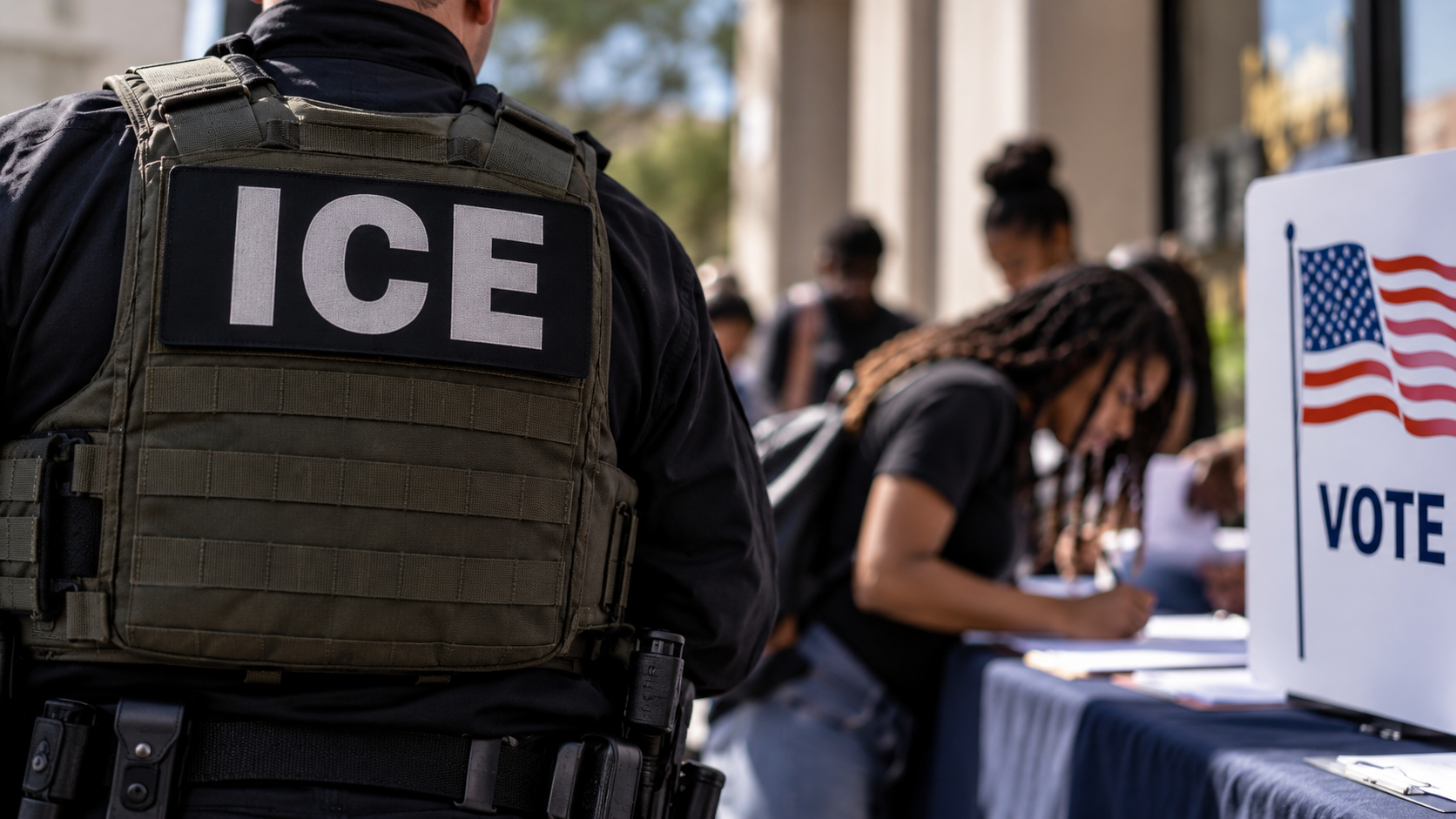
Federal immigration investigators quietly pushed far beyond individual voter fraud cases, examining hundreds of voter registration organizations as part of a nationwide election probe ahead of the 2026 midterms. According to Democracy Docket, newly released government records show Homeland Security Investigations, the investigative arm of U.S. Immigration and Customs Enforcement, scrutinized nonprofits and other organizations involved in voter registration across multiple states.
The ICE voter investigation included discussions about sending undercover agents into organizations suspected by investigators of helping noncitizens register. The records, obtained through a Freedom of Information Act request by Democracy Forward, contain one internal document stating, “Future [undercover]-related operations may involve utilizing [undercover agents] to target identified organizations and engage in communications with these entities to substantiate recruitment methods and activities related to illegal alien voter registration.”
That same document said any covert work “will support broader investigative and enforcement actions, leveraging [undercover] findings to initiate prosecutions and dismantle illicit facilitation networks.” According to Democracy Docket, the records do not establish that HSI actually carried out the proposed undercover operations.
The scale of the ICE voter investigation extended well beyond surveillance of organizations. According to Democracy Forward, a June HSI report said investigators obtained 50.6 million voter roll records from a Justice Department data set. The agency also received another 48.4 million records linked to Heather Honey, a senior adviser within ICE and DHS, from what the documents described as “independent sources of information.” Democracy Forward said the government records do not identify those outside sources. The organization also reported that HSI obtained 26,235 records derived from U.S. Citizenship and Immigration Services.
According to Democracy Docket, Pennsylvania became one of the major areas of scrutiny. HSI reviewed at least 82 nonprofits there, including the Pennsylvania chapter of the Council on American Islamic Relations. Investigators also examined retailer Zumiez and marked both CAIR and Zumiez for “further investigation.” The records said investigators initially used nonprofit search tools to identify organizations before looking through other databases for “derogatory information.”
New Jersey produced a different result. Democracy Docket reported that HSI included at least 41 organizations in its review there, but an internal document said: “no derogatory information was found on any of the [nongovernmental organizations].” Democracy Forward separately said New Jersey and Pennsylvania were identified as priority locations as investigators considered possible undercover activity.
The ICE voter investigation also crossed into Ohio, where federal scrutiny of voter registration groups had already become public. According to Democracy Docket, HSI and the FBI examined Black Fork Strategies, a voter engagement company founded by Kirk Noden. An internal document stated, “HSI Cleveland and FBI have identified seven companies that serve as consolidation centers associated with [Black Fork Strategies] for data obtained by canvassers throughout Ohio.” It continued, “HSI and FBI are solidifying investigative plans related to these companies.”
Black Fork has ties to the Ohio Organizing Collaborative, another organization founded by Noden. In June, the Associated Press reported that FBI agents searched the collaborative’s Cleveland office, seized documents and computer files, and questioned staff while investigating potential fraud violations. The AP reported that federal agents also contacted people who had worked with the organization. The Justice Department declined to comment on that investigation at the time.
The newly released records show HSI was also watching elections themselves. According to Democracy Docket, the agency monitored state primaries in an effort it described as an attempt to “determine if any notable trends or vulnerabilities in upholding election integrity.” Democracy Forward said HSI also coordinated with the U.S. Postal Inspection Service on suspected voter fraud cases and listed states including Texas, Pennsylvania, California, New Jersey, Minnesota, Michigan, Arizona, Florida, Georgia and Ohio as priorities for different data sets.
Those efforts come as independent research continues to show that voting by noncitizens is rare. An Associated Press review published October 1 found that the administration’s extensive campaign against noncitizen voting had produced only a small number of cases compared with the millions of ballots examined. The AP reported fewer than 100 identified fraud cases nationally from the 2024 election despite more than 152 million votes being cast.
Research collected by the Brennan Center for Justice has similarly found noncitizen voting to be extremely rare. In one nationwide study covering jurisdictions responsible for 23.5 million votes in 2016, election officials referred roughly 30 suspected incidents of noncitizen voting for further investigation or prosecution, representing about 0.0001 percent of ballots cast in those jurisdictions.
The ICE voter investigation also unfolded alongside other federal moves affecting voter registration organizations. According to an August federal court ruling, USCIS had barred nongovernmental organizations from offering voter registration assistance at administrative naturalization ceremonies. U.S. District Judge Adam B. Abelson blocked the policy while the case proceeds, finding that challengers were likely to succeed on several claims, including an allegation that the ban was motivated by intentional discrimination.
Together, the newly disclosed records show that the federal search for noncitizen voting expanded into voter databases, nonprofit organizations, state election activity and potential undercover operations. Democracy Forward said the documents came from a 166-page production obtained after its April 2026 Freedom of Information Act request seeking records about ICE involvement in elections and voting ahead of the midterms.