

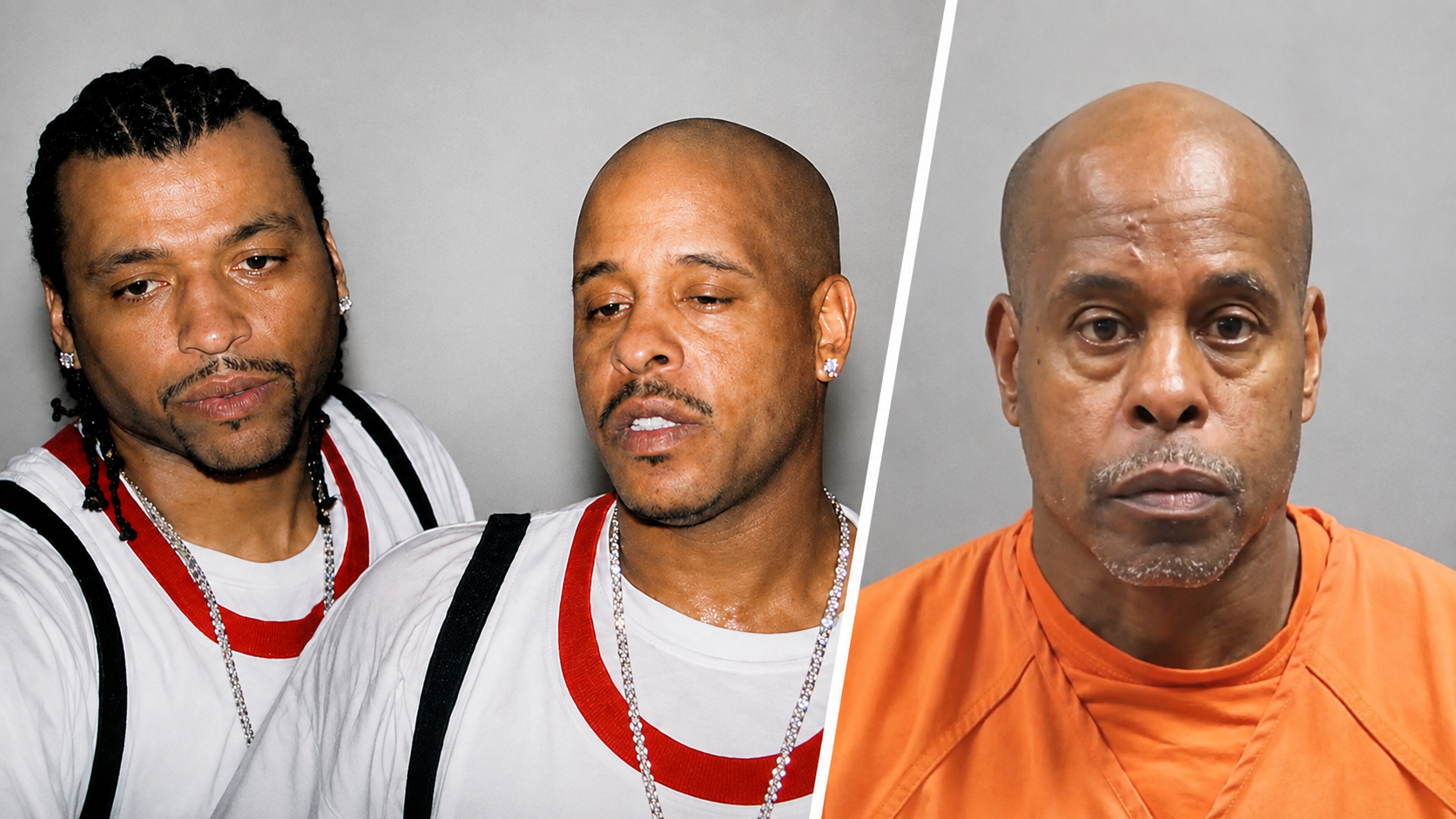
Former BMF figure Chad “J Bo” Brown is back in federal court after authorities say a search of a St. Louis County residence turned up approximately 53 kilograms of cocaine and two firearms, reviving his history with the infamous Black Mafia Family.
Video
According to the U.S. Attorney’s Office for the Eastern District of Missouri, J Bo, 54, was charged by criminal complaint on August 14 with one count of possession with intent to distribute more than 10 kilograms of cocaine. Although authorities say two firearms were recovered, the Justice Department’s announcement did not list a separate gun charge against J Bo.Federal prosecutors said the DEA learned on August 13 that a cocaine shipment had arrived in the St. Louis area and began focusing on J Bo and a St. Louis County home that investigators suspected was being used to store drugs. According to the U.S. Attorney’s Office, agents executed a court-authorized search the next day and allegedly discovered about 49 kilograms of cocaine inside duffel bags in a bedroom closet, along with another four kilograms in the kitchen. Two firearms were allegedly found in a bedroom.
J Bo has not been convicted in the new case. The Justice Department emphasized that a criminal complaint is an accusation and that J Bi is presumed innocent unless proven guilty.
What makes the J Bo arrest travel far beyond a standard federal drug case is the name attached to it. Brown has spent years occupying a complicated position in BMF history. He has commonly been described in hip-hop media as an underboss or one of Demetrius “Big Meech” Flenory’s closest associates, while older reporting identified him as chief operating officer of BMF Entertainment, the music company that helped push BMF from street legend into rap mythology. J Bo appeared in promotional material alongside Meech and at a 2006 federal hearing, Assistant U.S. Attorney Michael Leibson described Brown as “one of the higher-ranking members of the organization.”
Even the title most often attached to Brown deserves context. Brown has said that J Bo means “Junior Boss,” and the Justice Department noted during a separate 2023 prosecution that Brown called himself the “Junior Boss” of BMF. But federal records show the hierarchy was more complicated than the popular underboss label suggests.
In a 2013 federal habeas case, court records state that J Bo challenged the Bureau of Prisons for classifying him as an organizer or leader of BMF. Brown argued that he should instead have been classified as a lieutenant or manager. Federal court records show that Brown pleaded guilty on April 2, 2007, to conspiracy to distribute at least five kilograms of cocaine and conspiracy to launder money. On November 15, 2007, he was sentenced to 188 months in federal prison. That equals 15 years and eight months.
Brown did not serve the full 188 months behind prison walls. Brown served about 11 years following the BMF prosecution before being released to a halfway house, before he fully returned home. In a separate VladTV interview about his sentencing, Brown described receiving roughly 15 years and discussed a Bureau of Prisons error that temporarily made his projected time significantly longer before it was corrected.
That prison stretch is also where the J Bo story crossed directly into recorded hip-hop history. Jeezy released a song titled “J Bo” on his 2015 album “Church in These Streets.” Brown later told VladTV that he heard the record while incarcerated and said, “I was honored.”
The relationship between J Bo, Jeezy, and the broader BMF orbit has been discussed for years. The street boss himself told the blogger that he was an early supporter of Jeezy and recalled encouraging the rapper’s signature ad-libs. J Bo also claimed Big Meech helped generate attention for Jeezy by paying DJs to play his music in clubs.
The J Bo arrest also brings back another chapter of rap history: BMF’s influence was large enough that artists who were never members still spoke about its cultural footprint. In a 2010 interview, Rick Ross specifically acknowledged J Bo while discussing the inspiration surrounding his own BMF imagery, saying, “I gotta salute the big homie J Bo.” Ross went on to describe BMF as having influenced the streets “on a whole ‘nother level.”
J Bo’s story remained commercially interesting long after the original federal takedown. When he was arrested in 2023 as part of a separate St. Louis investigation, 50 Cent publicly floated the idea of building a television project around him.
“J Bo story is a spin-off I’m a put it on the tube you know the vibes,” he wrote online.
J Bo had also returned to federal court before the newest cocaine allegation. According to the U.S. Attorney’s Office for the Eastern District of Missouri, J Bo pleaded guilty in January 2024 to bank fraud and using a false document after admitting that he fraudulently obtained a $20,833 Paycheck Protection Program loan for Popular Music Group LLC. Prosecutors said J Bo submitted a false tax document claiming substantially more business income than he had reported on his tax returns.
That history makes the latest legal matter especially striking. J Bo’s name is not simply remembered because of BMF’s criminal case. It survived through the music company, Atlanta nightlife stories, Jeezy’s catalog, Rick Ross interviews, documentaries, and J Bo’s own years of interviews explaining his version of the BMF era. The legend grew while the original court record sat underneath it.
Now the federal record is growing again. Prosecutors say 53 kilograms of cocaine were recovered from the St. Louis County residence at the center of the new investigation. J Bo currently faces one federal cocaine charge tied to that seizure, and whatever cultural history follows his name, the newest allegations will still have to be proven in court.
