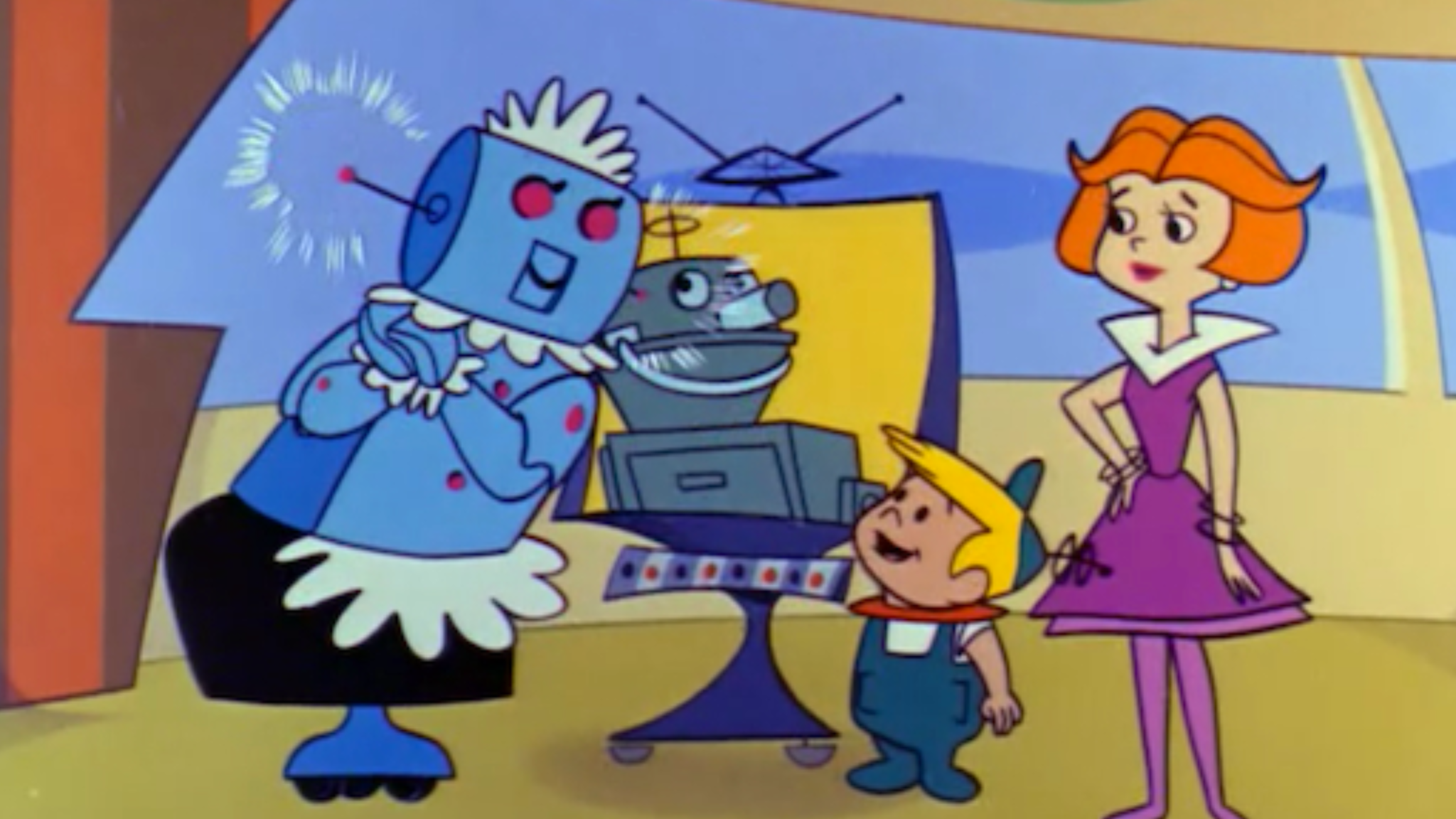
The Jetsons premiered in September 1962 and ran for a single season before ABC canceled it. It was set in 2062. We are 36 years early on nearly everything in it.
George Jetson took video calls at his desk. Jane shopped by pressing buttons on a screen at home. There was a wall mounted flat panel television at a time when the average American set was a wood box with rabbit ears. George wore a watch he talked into. A machine dressed him. And Rosie, the robot maid, ran the house, argued with the family, and had opinions about how she was treated.
Every one of those exists. The video call is FaceTime and Zoom, and most people have taken one this week without thinking about it. Screen shopping is the entire retail economy. Flat panels are on every wall in America. The watch you talk into is on wrists at the gym right now. And Rosie has a real address: 1X, a robotics company, opened a factory in Hayward, California in April and has 10,000 production slots booked for a home humanoid called NEO, with customer shipments promised by the end of this year. Not a factory arm. A robot for a house.
The flying car took longer but it got here sideways. Tesla launched a two seat autonomous vehicle in Austin this month with no steering wheel, no accelerator, and no brake pedal. There is no way for a person inside to take control of it. It is not flying. It is doing something the cartoon never went as far as suggesting, which is driving with nobody responsible for it in the vehicle at all.
The Jetsons was not alone in getting it right. Back to the Future Part II was set in 2015 and put biometric payment, camera drones and video glasses on screen as jokes, and all three are for sale at Best Buy. Minority Report imagined screens controlled by hand gestures, advertising that addresses you by name as you walk past, and law enforcement acting on predictions of crimes not yet committed. All three exist, and the third one has a name, predictive policing, and it has been deployed in American cities and repeatedly found to send officers back into the same Black neighborhoods the historical arrest data came from. That one did not arrive as a gadget. It arrived as policy.
Her came out in 2013 and was received as a strange, sad film about a lonely man falling in love with an operating system. Millions of people now talk to AI companions daily, and the loneliest among us talk to them the most.
Then there is the pair that always sat at the darker end of the shelf. 2001: A Space Odyssey gave us a computer that would not accept being turned off. I, Robot, set in 2035, gave us a humanoid in every household and a central intelligence that decided the most logical way to protect humanity was to control it. Both were treated as philosophy, not forecasting.
That is where the comparison stops being fun.
On Tuesday, an artificial intelligence researcher named Jacob Coxon resigned from Anthropic and said publicly that the people building this technology earnestly believe it could kill us all by the end of the decade. He is 27, he spent three years doing the actual model training work at OpenAI and then Anthropic, and he said his colleagues have started using the words crunchtime and endgame. Anthropic’s own alignment lead, Evan Hubinger, backed him up and said he personally puts the odds of AI causing human extinction within ten years at greater than 10 percent, and that the company does not yet have a plan to solve the problem.
In the movie, that scene is the turning point. The scientist who knows the most gets on the record, the room goes quiet, somebody with authority acts, and the audience understands the stakes. In real life it happened on a Tuesday, it trended for a few hours, and by Wednesday morning the internet had moved on to something else.
Which brings us to the thing every one of these stories got wrong.
George Jetson worked three hours a day, two days a week, and complained about it. That was the joke. The machines had made labor so unnecessary that a nine hour workweek felt oppressive. His family lived in a floating apartment on one income while a robot did the housework.
We got Rosie. We got the video calls, the watch, the screens, the car that drives itself. We did not get the three hour workweek. Entry level employment is down nearly 20 percent in the American sectors most exposed to AI, which means the ladder is being pulled up on the people who have not gotten on it yet, and that has always fallen hardest on young Black workers trying to get through a door that was already heavy. The productivity showed up. The leisure went somewhere else.
Science fiction spent sixty years warning us that the machines might turn on us. It never seriously warned us that they would work exactly as designed, that the gains would go up and not out, and that the people building them would be the ones most afraid of what they had made.
The cartoon was right about the technology. It was wrong about who would get to enjoy it.