

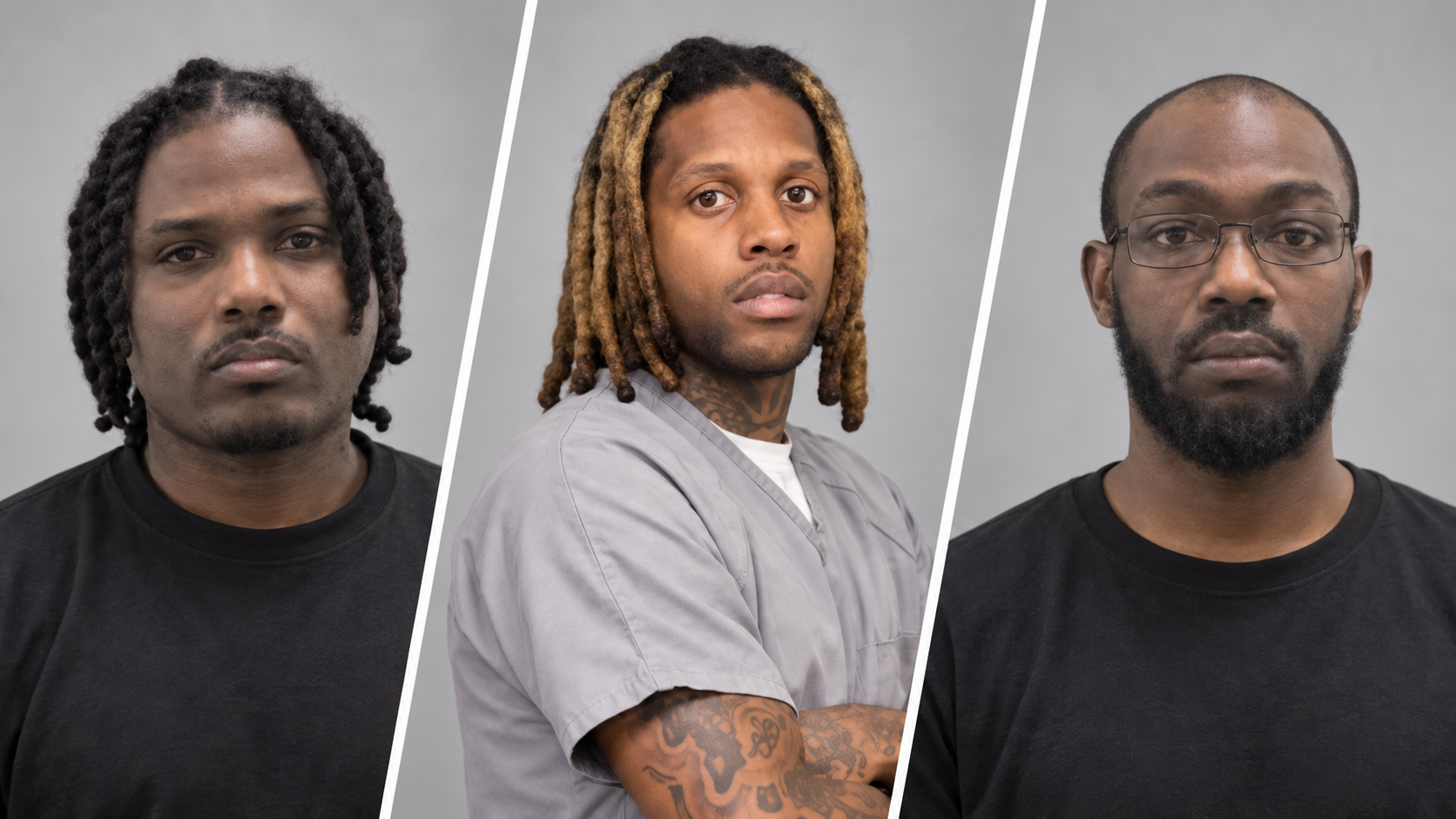
The legal fight surrounding Lil Durk’s federal case has shifted again, with Deandre “OTF Dede” Wilson and David “Browneyez” Lindsey asking a judge to undo the stalking convictions they received at the same trial that cleared Durk.
Attorneys for Wilson and Lindsey filed motions under Federal Rules of Criminal Procedure 29 and 33 following the September 11 verdict. The latest Lil Durk trial development gives both men another opportunity to challenge convictions that could carry significant prison time, even though the jury rejected the government’s murder for hire case against them.
The Associated Press reported that a federal jury in Los Angeles found Durk, whose legal name is Durk Banks, not guilty on all five counts after three days of deliberations. Wilson and Lindsey, who were tried alongside him, were also acquitted of the murder for hire charges. However, jurors convicted both men of conspiracy to commit stalking, stalking using a dangerous weapon, and stalking resulting in death.
Those split verdicts are now at the center of the new defense effort. The defense had already raised whether the evidence was sufficient before the case reached the jury, and the court preserved the issue for review after the verdict. The filing states:
“Defendants Lindsey and Wilson moved for judgment of acquittal under Federal Rule of Criminal Procedure 29 at the close of the government’s case on September 3, 2026; the Court reserved decision under Rule 29(b), and the motions were renewed at the close of all the evidence,” the motion reads.
The two rules provide different possible outcomes. According to Cornell Law School’s Legal Information Institute, Rule 29 allows a federal judge to set aside a guilty verdict and enter a judgment of acquittal when the legal standard for conviction has not been satisfied. A successful Rule 29 motion would therefore eliminate the conviction on the affected charge rather than send the case back for another jury trial.
Rule 33 offers another path. Cornell Law School’s Legal Information Institute explains that a federal court may vacate a judgment and grant a new trial when the interest of justice requires it. For Wilson and Lindsey, that means the court could potentially leave the prosecution alive while ordering another trial instead of allowing the current stalking verdicts to stand. No ruling on the motions had been reported as of September 22.
The convictions emerged from the same sprawling Lil Durk trial that focused on an August 2022 shooting near the Beverly Center in Los Angeles. According to the Associated Press, prosecutors accused Durk of helping organize an effort to kill rapper Quando Rondo, whose legal name is Tyquian Bowman. Bowman survived the shooting, but his cousin Saviay’a Robinson, also known as Lul Pab, was killed. Prosecutors argued the attack was connected to retaliation following the November 2020 killing of Durk’s close friend and fellow Chicago rapper King Von. Durk’s attorneys disputed the government’s theory, and the jury ultimately acquitted him of every charge presented in that trial.
That acquittal did not result in Durk’s release. According to Reuters, he remained in federal custody after the verdict because another criminal case was still pending. Wilson and Lindsey also face additional proceedings connected to that broader prosecution.
The next Lil Durk trial centers on racketeering-related allegations that were separated from the first case. According to The New York Times, federal prosecutors added Violent Crimes in Aid of Racketeering Activity allegations in June 2026 while describing OTF as part of a broader criminal enterprise. Prosecutors pointed to multiple alleged violent incidents, including the 2022 killing of Stephon Mack in Chicago. Durk’s defense challenged the expanded case, and U.S. District Judge Michael W. Fitzgerald ultimately ordered the racketeering allegations to be tried separately from the murder for hire case that ended in Durk’s acquittal. Those allegations remain accusations unless proven in court.
The government’s racketeering theory represents another major test for Durk after the first jury rejected prosecutors’ case against him. At the same time, Wilson and Lindsey are fighting on two fronts, challenging their stalking convictions while continuing to face the separate racketeering proceedings. The different outcomes also matter because Durk’s acquittal does not automatically affect the guilty verdicts returned against the other two defendants. Their convictions remain in place unless Judge Fitzgerald grants relief through their post-verdict motions or another part of the legal process changes the result.
Durk is also scheduled to return to court over his detention. Judge Fitzgerald set a bond review hearing for November 4 after Durk’s attorneys requested another opportunity to seek his release. The court also ordered U.S. Probation and Pretrial Services to provide an updated bail report. An October 5 date for the racketeering trial had been treated as a tentative date set immediately after the murder for hire verdict, meaning the schedule could still change through subsequent court orders.
The next phase of the Lil Durk trial saga is therefore unfolding on separate tracks. Durk has already been acquitted in the Los Angeles murder for hire prosecution, but he remains detained while the racketeering case moves forward. Wilson and Lindsey, meanwhile, are asking the same federal judge who oversaw their trial to either erase their remaining convictions or give them another chance before a jury.
