

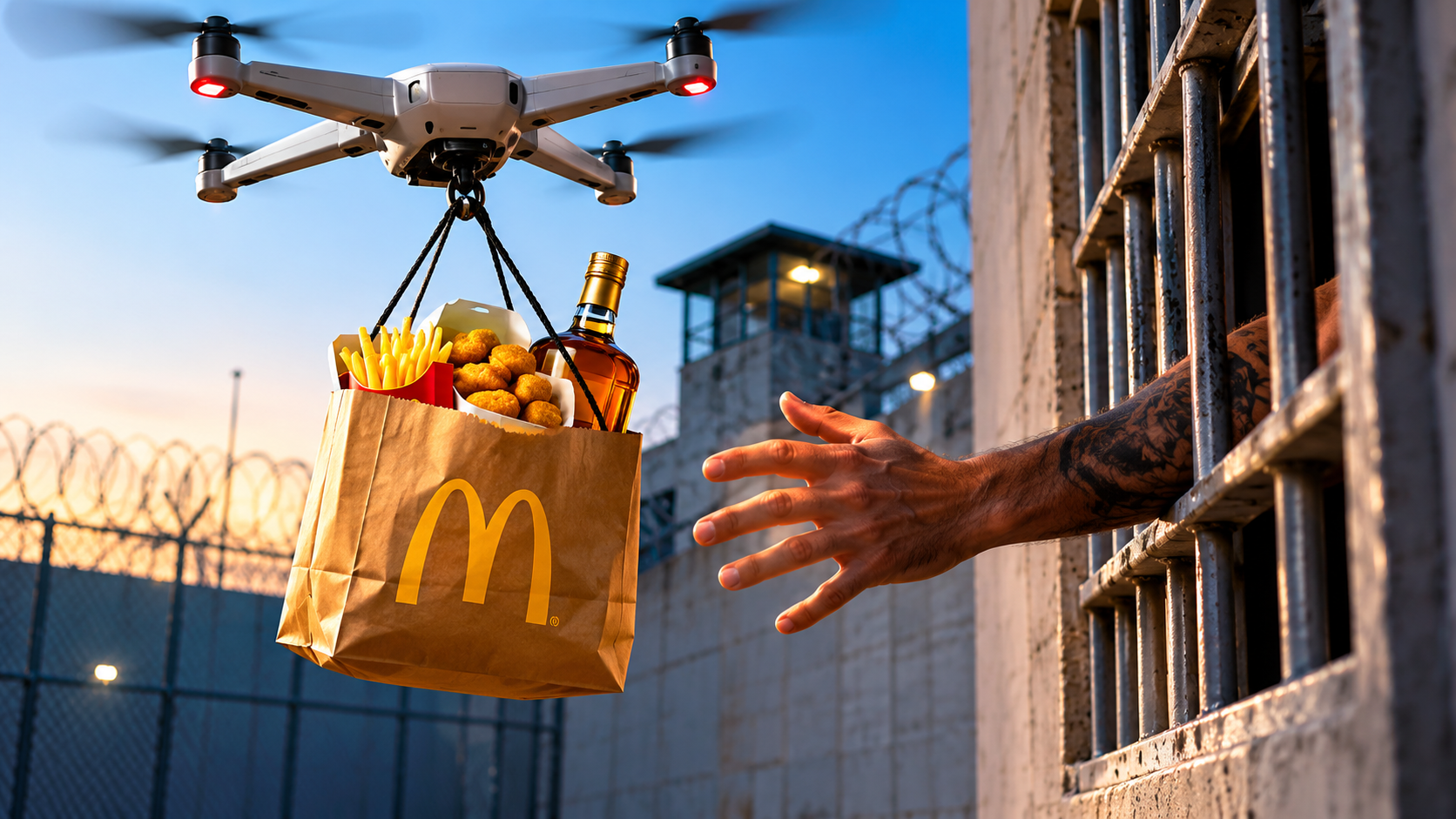
An inmate at one of Canada’s most secure prisons managed to get McDonald’s and alcohol delivered directly to his cell window by drone, prompting an investigation into how the unusual delivery slipped past security.
According to CBC News, the incident happened around 3 a.m. on October 15 at the Sainte-Anne-des-Plaines correctional facility in Quebec. The McDonald’s drone delivery reportedly included chicken nuggets, fries, dipping sauce, and alcohol.
The inmate was housed in the prison’s Special Handling Unit, which holds some of Canada’s most dangerous and high-risk offenders.
New details reported by The Canadian Press on October 20 reveal that the drone reportedly passed through a gap between protective fencing and a cell window that had been broken from inside. Correctional officers later discovered the inmate intoxicated, with remnants of the meal inside his cell.
Mike Bolduc, regional president of the Union of Canadian Correctional Officers, told CBC News that the inmate apparently found the situation amusing.
“The inmate found that really funny in the morning when the guards did their rounds,” Bolduc said.
However, prison staff are concerned about what the successful delivery could mean for their safety.
“We’re at the breaking point where an inmate went and delivered himself McDonald’s.… What’s the next thing? Is that a loaded gun? You know, it’s scaring us, it’s really scaring us,” Bolduc explained.
“It’s supposed to be the most secure jail in Canada, and he’s eating McDonald’s,” he added.
The McDonald’s drone delivery also exposed apparent weaknesses in the prison’s surveillance systems.
Bolduc told CBC News that existing detection equipment apparently failed to identify the drone. He suspects inmates may be using multiple flights to locate areas where security technology cannot detect them.
“So what happened here is that they beat the technology,” Bolduc said. “The drones are incredible [with] the damage that they’re causing.”
The Canadian Press subsequently reported that exterior surveillance cameras failed to capture the delivery. Frédérick Lebeau, national president of the correctional officers’ union, said the facility’s drone detection technology also missed the intrusion.
Union representatives have been demanding physical netting around vulnerable areas to prevent drones from reaching inmates.
“It’s not harder than that,” Bolduc said. “This now has to be a cry for help, saying that we need that netting as fast as possible.”
Following the incident, Correctional Service Canada spokesperson Kevin Antonucci confirmed to The Canadian Press on October 20 that officials were implementing additional protective measures, including netting at the Regional Reception Centre. However, officials did not provide a completion date.
The agency previously acknowledged that the incident remained under review.
“The introduction of contraband and unauthorized items into correctional institutions remains an important issue that CSC continues to actively address,” Antonucci told CBC News.
“CSC continues to implement a multi-layered approach that includes staff vigilance, security intelligence activities, searches, detection technologies and collaboration with police and other partners.”
Government figures show that drone activity has remained a persistent problem throughout Canada’s prison system.
According to Correctional Service Canada’s May 2026 parliamentary briefing, federal institutions recorded 899 drone-related incidents during the 2023 to 2024 fiscal year, followed by 1,064 in 2024 to 2025 and 839 in 2025 to 2026.
The agency has also received approval for expanded drone jamming trials. Government documents outline $60.4 million in funding over three years beginning in 2026 to 2027, plus $2.3 million annually afterward, for jamming technology and related security improvements.
“I’m scared for Canadians, for their security,” Bolduc said.
Conservative MP Frank Caputo, who serves as his party’s public safety critic, also questioned the government’s response.
Lebeau told The Canadian Press that additional outdoor security patrols introduced after the incident became public had already ended on Monday, October 19.
