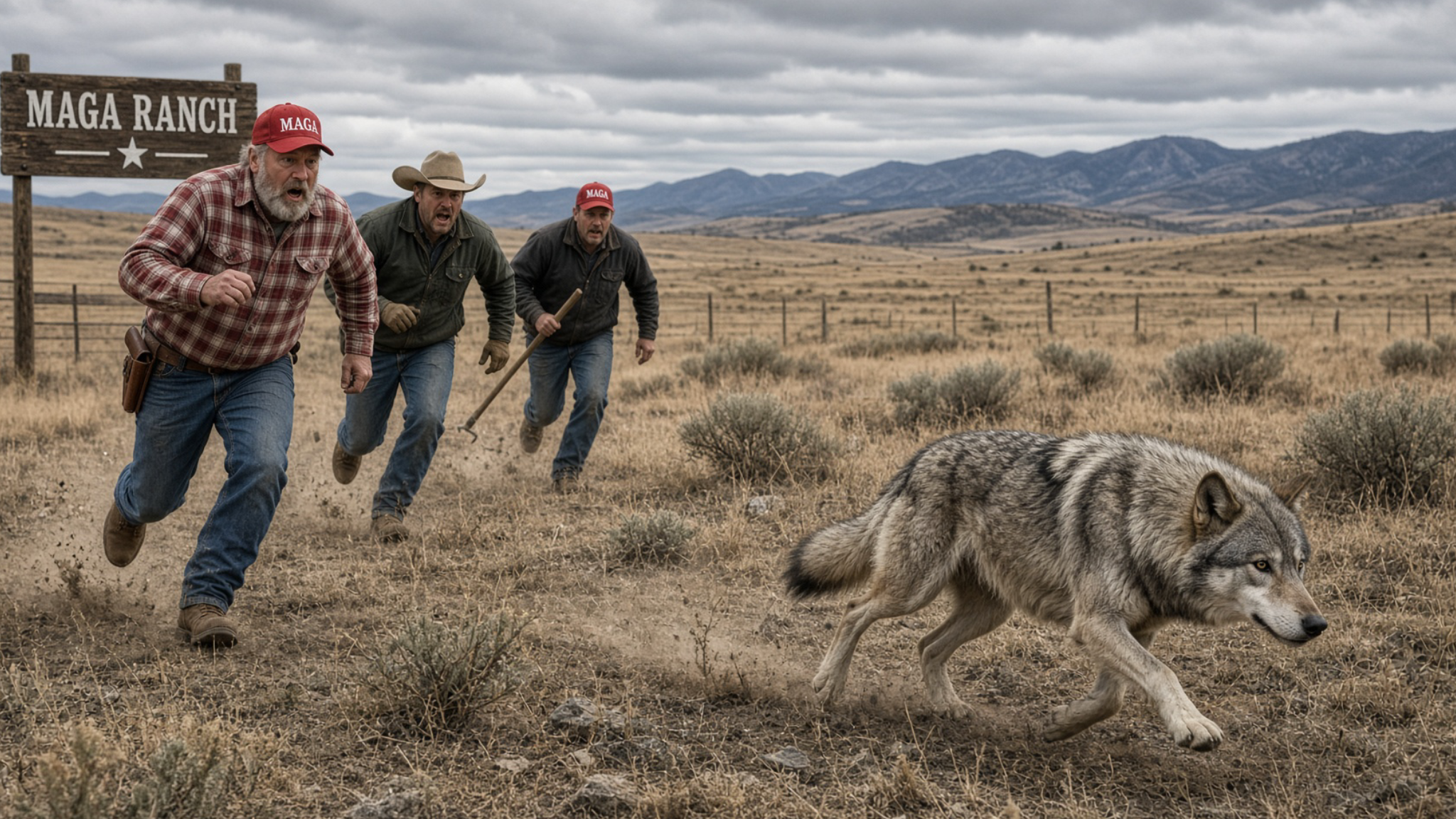
Trump signed an executive order on Friday that starts the process of removing federal protection from the Mexican gray wolf and the gray wolf, opening the door for ranchers to kill them legally. The order does not do it immediately. It gives Interior Secretary Doug Burgum 90 days to decide whether either animal has recovered enough to be taken off the list, and if he says yes, the government starts the paperwork to make it official.
The Endangered Species Act is the 1973 law that makes it a federal crime to kill or harm an animal the government has formally identified as at risk of going extinct. Delisting means removing an animal from that list entirely, which ends the protection. Downlisting means moving it from endangered to threatened, a lower tier that still carries some protection but far less. Either one would make it easier to shoot a wolf.
Here is what the Mexican gray wolf population actually looks like. In 1998, when the federal government reintroduced them to Arizona and New Mexico, there were four in the wild. Four. As of 2025, US Fish and Wildlife Service counts put the number at 319. The official federal recovery plan calls for an average of 320 across both states sustained over four years. So the animal is sitting right at the edge of a benchmark it has not held long enough to prove. There are roughly 18,000 gray wolves nationally, a separate and much larger population.
Sandy Bahr of the Sierra Club said the problem is not just headcount. It is genetic diversity, meaning the population is descended from too few original animals to stay healthy long term. Inbreeding leaves a species vulnerable to disease and reproductive failure even when the raw numbers look decent on paper. Claire Musser of the Grand Canyon Wolf Recovery Project said pulling protections now risks decades of work.
Now the part that explains the timing. This order did not arrive on its own. It came bundled in a package the White House labeled as supporting America’s ranchers, which also included changes to meat labeling rules and a directive for five federal agencies to report back within 90 days on every regulation affecting the cattle industry. Ranchers have spent months publicly furious with this administration over one specific thing, and it is not wolves. It is beef. The administration expanded imports of cheaper foreign beef at lower tariff rates, tariffs being the taxes the government charges on goods coming in from other countries. Lower tariffs mean cheaper imported beef competing with American cattle. Burgum posted on X that the White House is focused on bringing consumer prices down, which is the same policy ranchers say is undercutting them.
So a group of voters is angry about a trade decision, and the response is an executive order about predators.
Greta Anderson of the Western Watersheds Project put it directly, saying wolves are being used to distract a handful of ranchers into believing the animals are a bigger threat than the administration’s own policies. She added that the damage wolves do to the livestock industry is small next to what recent trade agreements and drought conditions in the West have done. The Center for Biological Diversity points out that ranchers are already entitled to full compensation for confirmed wolf kills through existing state and federal programs. Collette Adkins, an attorney there, said ranchers who work around wolves successfully use guard dogs and fencing, and that federal money would be better spent on those tools. Her organization has said it will sue over any delisting.
Not every rancher sees it that way. Dalton Dobson, who ranches on public land in Arizona, said he has lost calves, dealt with stressed herds, and found the compensation never fully covers what he is out. He supports delisting as a step toward local management.
The order itself makes the administration’s case in economic terms, noting that American livestock herds are at their lowest level in 75 years while beef demand has climbed 10 percent over the past decade, and that ranchers play a vital role in the food supply and in American cultural heritage.
Two pieces of this have gotten almost no coverage and deserve more. The order directs federal agencies to weaken the evidentiary standards around livestock predation, meaning the amount of proof required to establish that a wolf killed livestock rather than a coyote, a mountain lion, or disease. Lower that bar and more killings get authorized. The order also directs agencies to coordinate with states on their own local wolf protections, which conservation groups read as federal pressure on states to drop laws they passed themselves. Michelle Lute of Wildlife for All pointed to Montana’s wolf management as the cautionary example of what happens when states take over.
Arizona wildlife officials were already moving in this direction. In July they announced they were preparing their own petition to downlist Mexican gray wolves, citing the population thresholds. Twelve Mexican wolves were also transferred to Mexico earlier this year to begin rebuilding a population south of the border.
Burgum’s 90 day clock runs out in early December. Whatever he decides, this is headed to court.