

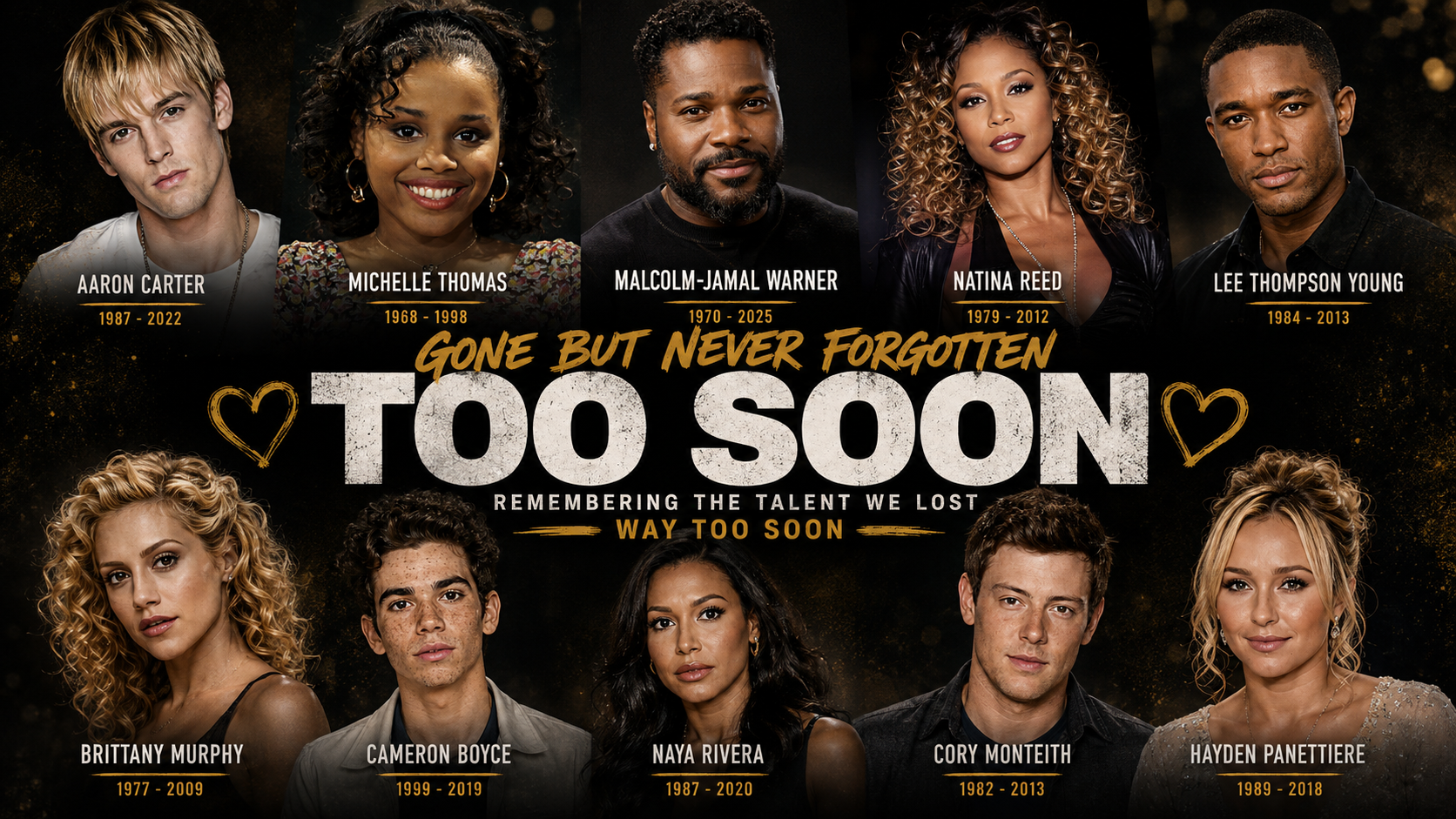
There’s a specific kind of grief that comes with losing someone you never actually knew, but who still somehow raised you a little. The actors, singers, and characters who filled up our TV screens and CD players in the 90s and early 2000s weren’t just entertainers; they were part of the wallpaper of childhood. So when they’re gone, especially gone too soon, it doesn’t just feel like celebrity news. It feels personal.
Hayden Panettiere’s recent death has millennials in their feelings again, and it’s brought a familiar wave of names back to the surface- the ones we lost far earlier than we should have. Here are nine of them.
Aaron Carter
Aaron Carter was pop royalty to an entire generation of kids who grew up blasting “I Want Candy” and watching him alongside his brother Nick in the boy-band era. He spent years afterward being open and public about his mental health struggles and addiction, which made his death in 2022, at just 34, feel less like a shock and more like a heartbreak that had been building for a long time.
Michelle Thomas
If you grew up on “Family Matters,” you knew Michelle Thomas as Myra Monkhouse, Steve Urkel’s on-again, off-again girlfriend, full of personality and warmth. What most fans didn’t know was that she was privately battling a rare form of stomach cancer. She died in 1998 at just 30, and the news landed as a total shock to a fanbase who had no idea anything was wrong.
Malcolm-Jamal Warner
Theo Huxtable helped define what a sitcom son could be for an entire generation watching “The Cosby Show.” Warner carried that legacy with grace for decades afterward, staying steadily working and beloved well into adulthood. He died in 2025 at 54 in a drowning accident while on vacation, and it hit millennials hard precisely because he’d remained such a constant, comforting presence for so long.
Natina Reed
Natina Reed was part of the girl group Blaque and played Lava in “Bring It On,” one of the defining teen movies of 2000. She died in 2012 at 32, after being struck by a car on a Georgia highway. She’d spoken openly in prior years about struggles with addiction, adding a heavier layer to a death that already felt sudden and senseless.
Lee Thompson Young
Lee Thompson Young made history as the star of “The Famous Jett Jackson,” one of the earliest Disney Channel original series to be led by a Black actor. He went on to build a strong adult career playing Detective Barry Frost on “Rizzoli & Isles.” He died in 2013 at 29, ruled a suicide, in the middle of what looked like a thriving career, a reminder that struggles aren’t always visible from the outside.
Brittany Murphy
Brittany Murphy was everywhere in that era: “Clueless,” “8 Mile,” “Girl, Interrupted.” She had a voice and presence that made her instantly recognizable, and her death in 2009 at just 32 remains one of the more mysterious and debated losses on this list, with the official cause tied to pneumonia and other contributing health factors.
Cameron Boyce
For a slightly younger millennial and Gen Z crossover audience, Cameron Boyce was Disney Channel royalty: Jessie, the “Descendants“ franchise, that specific 2010s Disney glow. He died in his sleep in 2019 at just 20, from a seizure related to epilepsy, a diagnosis that hadn’t been public knowledge before his death. His family has since built awareness and research funding around epilepsy in his name.
Naya Rivera
Naya Rivera’s role as Santana Lopez on “Glee” meant everything to a generation of fans who saw themselves represented in ways TV rarely offered at the time. She died in 2020 at 33 in a drowning accident, after saving her young son in the water, a detail that made an already devastating loss even harder to sit with.
Cory Monteith
Cory Monteith’s Finn Hudson was the heart of “Glee,” and his death in 2013 at just 31 was one of the first times a lot of millennials felt real, public grief over someone who felt like a friend from the world of a show that mattered deeply to them. His struggles with addiction had been part of his story for years, but the loss still landed like a gut punch.
There’s a reason these losses feel heavier than typical celebrity news. These weren’t just people we watched; they were part of how an entire generation processed growing up. They soundtracked breakups, filled up sick days home from school, and showed up on screen during some of the most formative years of our lives.
Losing them now, as adults ourselves, forces a kind of reckoning: with our own mortality, with how fast time has moved, and with the fact that the childhood we thought was frozen in reruns and old CDs was made up of real people carrying real struggles the whole time.
Grieving them isn’t dramatic. It’s just what happens when the wallpaper of your childhood starts coming down, one name at a time.
