


Mitch McConnell went nearly a month without telling the public where he was, and in that silence the internet built its own story. On Sunday he interrupted it with a photograph and a statement, sitting propped up in a bed in a red checkered shirt and jeans, glasses on, smiling faintly, his wife Elaine Chao seated beside him with her hand resting near his arm. The photo was the point. The words explained the rest. He fell at home last month, was briefly knocked unconscious, and was taken to the hospital on June 14, where he stayed for four weeks while his office said almost nothing beyond the assurance that he was receiving excellent care.
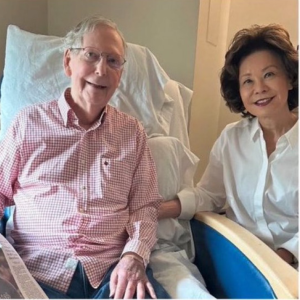
The statement is the longest thing Mitch McConnell has released since he disappeared from the Senate floor, and it reads like a man who understood exactly what he was answering. He addressed it to Kentuckians, thanked them for what he called their well wishes and their honest questions about what was keeping him away, and then acknowledged the thing that had actually created the vacuum. He wrote that folks of his generation often hesitate to share the vulnerability that comes with growing older, and that even in the public eye he feels that same instinct and cannot help it. That is as close to an apology for the blackout as he was going to give.
The medical details were laid out one by one, and the specificity is deliberate. His doctors confirmed no broken bones and no concussion. No heart attack. No stroke. No tumors and no hemorrhages. He was briefly unconscious, he was hospitalized, and early in that stay he developed a mild case of pneumonia. He says he has been a good patient, that at his age he tends to do what his doctors tell him, and that he has submitted to every test they could think of to help figure out what caused the fall in the first place. He has since been moved from hospital care to a rehabilitation center, where he says he will keep regaining his strength.
The office of the attending physician of Congress released its own statement, and that one carries the detail with the most weight. Mitch McConnell has experienced several falls throughout the year, all attributed to his post polio condition. He was admitted four weeks ago after falling at home with minor injuries. A multidisciplinary team evaluated him and found no fractures, no cardiac abnormalities, no stroke, no tumor, no hemorrhage. The pneumonia responded rapidly to antibiotics. The remainder of the hospital stay focused on physical therapy and on strategies to reduce his risk of falling again, and he has been medically cleared to continue an intensive physical therapy program.
That is a fuller picture than the phrase mild pneumonia suggests on its own. Mitch McConnell survived polio as a small child and has spent his entire life managing mobility challenges, something he referenced directly in his statement and something that has become visibly harder in recent years. He was hospitalized with a concussion in March 2023 after falling in a Washington hotel and missed weeks of work. He froze up twice at news conferences after returning, staring ahead in silence while colleagues and staff moved in around him. He fell again in 2024 and sprained his wrist walking out of a Republican luncheon. He now frequently uses a wheelchair to move around the Capitol. The falls are not new. What is new is that the official explanation finally names the cause.
The vacuum was real and it had consequences. With no information coming from his office for four weeks, speculation online moved from wondering to asserting, and by last week a meaningful chunk of the internet had decided Mitch McConnell was dead or permanently incapacitated. Kentucky Governor Andy Beshear, a Democrat, took the unusual step of issuing a public letter asking McConnell to update the public about his health in a transparent manner. When a sitting governor from the opposing party has to formally ask you to prove you are alive, the communications strategy has already failed.
Then Sunday arrived carrying two stories at once. Senator Lindsey Graham reportedly died, with the medical examiner indicating an aortic rupture as the likely cause. Mitch McConnell released a photograph proving he had not. Those two things landing in the same news cycle is what turned a routine health update into something people could not scroll past, and it forced the conversation the Senate keeps avoiding back into the open. The chamber is old. Its most powerful members have been in their seats for decades. The public gets information about their health only when the members decide to give it, and when they decide not to, there is no mechanism that compels them.
McConnell is not resigning. He said plainly that on the advice of his doctors he will not be returning to the Senate floor to vote quite yet, but that he is not taking a break from Senate business. He says he is working with his legislative staff on current issues, with his Kentucky team on constituent services, and with colleagues on appropriations and midterm politics. He announced last year that he would retire when his term ends in January, and he framed that decision in the statement as an honest reckoning with the demands of the job. Republicans have nominated Representative Andy Barr to replace him. Democrats nominated former state lawmaker Charles Booker.
Mitch McConnell was first elected in 1984 and led Senate Republicans from 2007 until stepping down from leadership last year, a run that reshaped the federal judiciary for a generation. He closed the statement by saying he has unfinished business and every intention of finishing the job Kentuckians elected him to do. Six more months are on the clock. Whether he spends them on the Senate floor or in physical therapy is a question his doctors have not answered yet.
