

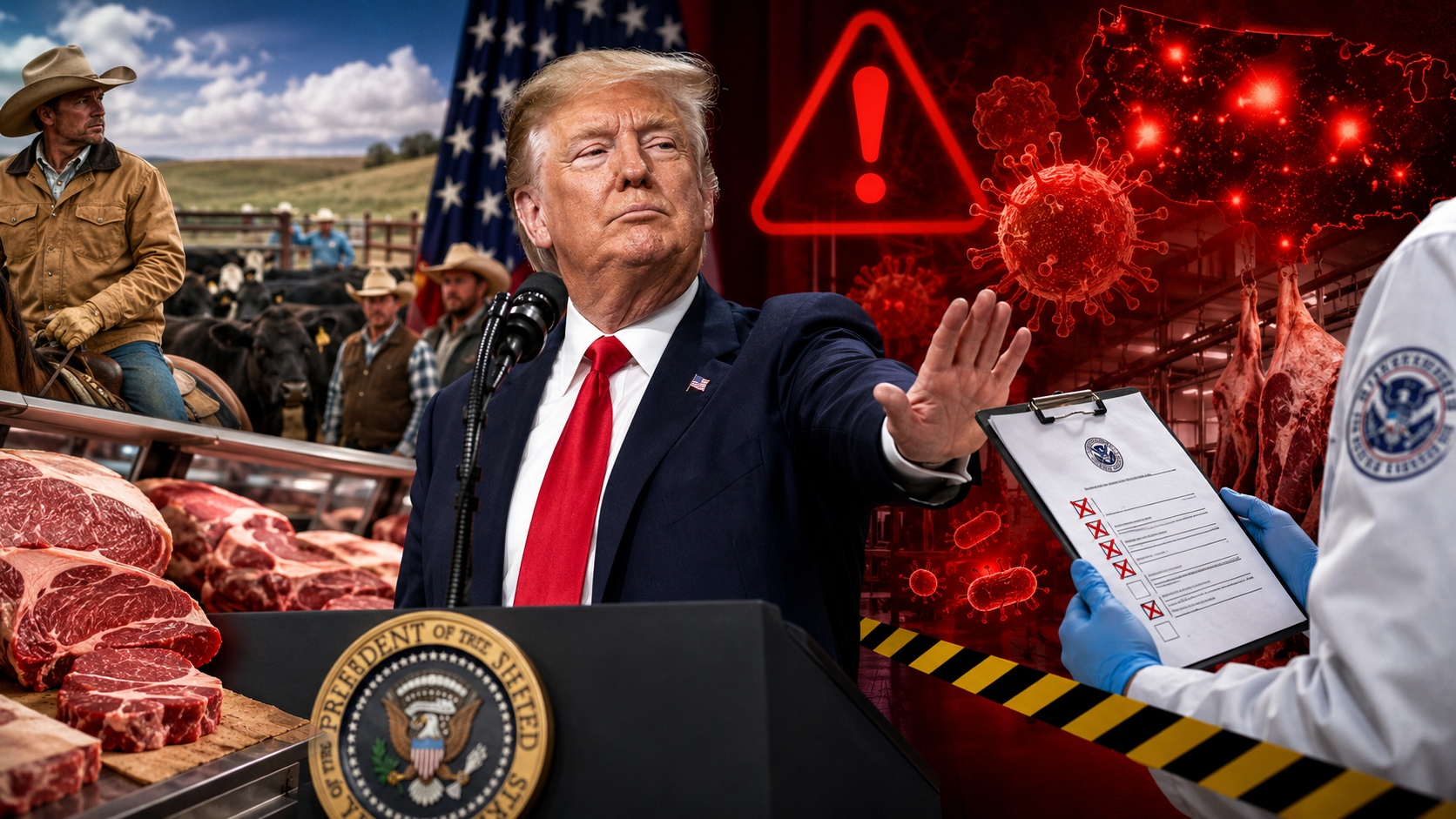
Trump announced Friday morning that he is having legal documents drawn up to change the rules on beef processing, a move that would let farmers and ranchers slaughter and sell their own meat outside the system that currently requires federal inspection.
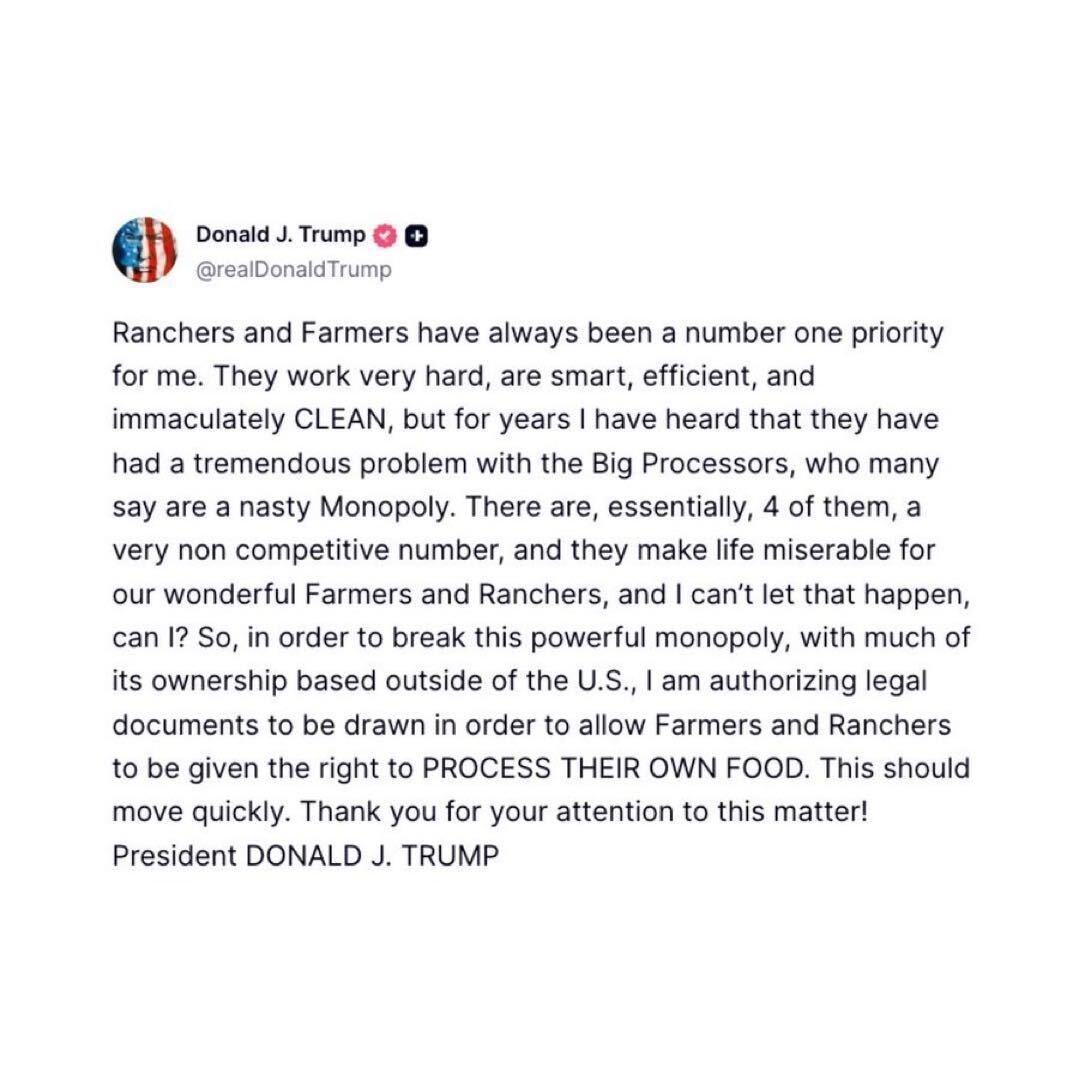
The announcement came in a Truth Social post. Trump wrote that ranchers and farmers have always been a number one priority for him, that they are smart, efficient, and “immaculately CLEAN,” and that for years he has heard they have a problem with what he called the Big Processors. He described the processing industry as a “nasty Monopoly,” noted that there are essentially four of them, called that a very non competitive number, and said much of the ownership is based outside the United States. He closed by saying he was authorizing legal documents to be drawn up to give farmers and ranchers the right to process their own food, and that it should move quickly.
Agriculture Secretary Brooke Rollins responded on X with “We are on it Mr. President,” and said her department would begin rolling out initiatives on Monday, including rescinding what she called outdated guidance, waiving red tape, and expanding the ability of ranchers to sell across state lines.Start with what the current rule actually is, because the announcement is being described as though ranchers are barred from touching their own cattle. They are not. A rancher can already slaughter and process their own animal today. What they cannot do is sell that meat to the public unless the facility meets federal safety and sanitation requirements and passes regular inspections. Under the current system, a USDA inspector is physically present at slaughter, examining animals before and after they are killed and pulling any carcass that shows disease. That inspection is the entire barrier being discussed here, and it is the thing standing between a cut of beef and a grocery store shelf.
CNN and Bloomberg both reported that it is unclear exactly what Trump intends to change about beef processing rules, and Bloomberg noted it is also unclear whether he has the legal authority to do it at all. Inspection requirements are written into federal statute. A social media post does not move them, and the practical effect of whatever documents get drafted remains unknown.
The grievance underneath it is real, and that part deserves a fair hearing. Four companies handle the vast majority of beef processing in this country, and ranchers have complained for years that this consolidation lets processors set the price they pay for cattle while ranchers absorb the risk. Small ranchers routinely wait months to get a slaughter appointment because there are so few independent plants left. Both Trump and Joe Biden campaigned on breaking up the meatpackers. Neither one meaningfully did it, and the market looks the same today as it did a decade ago.
The problem is that thinning inspection requirements does not break up a monopoly. It leaves the four companies exactly where they are and changes what the people at the bottom of the market are allowed to sell. If the goal is antitrust, there are antitrust tools. This is not one of them.
Then there is the timing, which is the part that should stop people. As of Thursday, the CDC counts 11,458 confirmed cases of Cyclospora across 20 states from recalled iceberg lettuce, with at least 495 hospitalizations and two deaths in Michigan. The FDA and CDC are separately investigating a Salmonella outbreak traced to jalapeños from Sinaloa, Mexico, which has infected 345 people across 27 states and hospitalized 36. And beef itself has been recalled repeatedly this year. CS Beef Packers pulled about 22,912 pounds of ground beef over E. coli contamination. City Foods recalled roughly 3,215 pounds of pastrami and corned beef over Listeria. On August 7, Corte Argentino USA recalled about 29,628 pounds of raw beef for a reason that lands strangely against Friday’s announcement. The USDA said the products had been imported without the benefit of required federal inspection.
That recall happened because the inspection requirement exists. Loosen it and the category of product that gets caught that way stops getting caught. This is also arriving after the federal government cut its own ability to detect outbreaks. FoodNet is the joint CDC, FDA, and USDA program that proactively tracked eight foodborne pathogens, meaning it went looking for cases instead of waiting for local health departments to report them. Under Health and Human Services Secretary Robert F. Kennedy Jr., it was cut down to two pathogens. Cyclospora was one of the six dropped, which is a direct reason the outbreak now sitting at more than 11,000 cases took as long as it did to trace. The CDC’s Epidemic Intelligence Service, the unit that trains the epidemiologists who investigate outbreaks on the ground, also lost significant staff.
So the proposal to reduce inspection in beef processing is landing at the exact moment the surveillance system that would catch the consequences has already been reduced. There is one more contradiction sitting in the middle of this. Trump’s stated reason for going after the processors is that much of their ownership is foreign. One week before this post, his administration rolled out a plan to import 300,000 metric tons of tariff-free foreign ground beef over 90 days to bring consumer prices down. That plan drew furious pushback from ranchers and from congressional Republicans. Senator Tim Sheehy of Montana said the import plan would make it harder for American ranchers to rebuild their herds and would harm ranching families. Sheehy then endorsed Friday’s announcement, posting simply that ranchers like this news.
Bloomberg framed the timing directly: beef prices are high, the midterms are in November, and this is the administration’s latest attempt to bring the cost of beef down before voters go to the polls.Rollins said the initiatives start Monday. Until the actual documents exist, nobody knows whether this means a modest expansion of interstate sales for small state inspected plants, which food safety experts have supported for years, or something that removes the inspector from the room entirely.
