

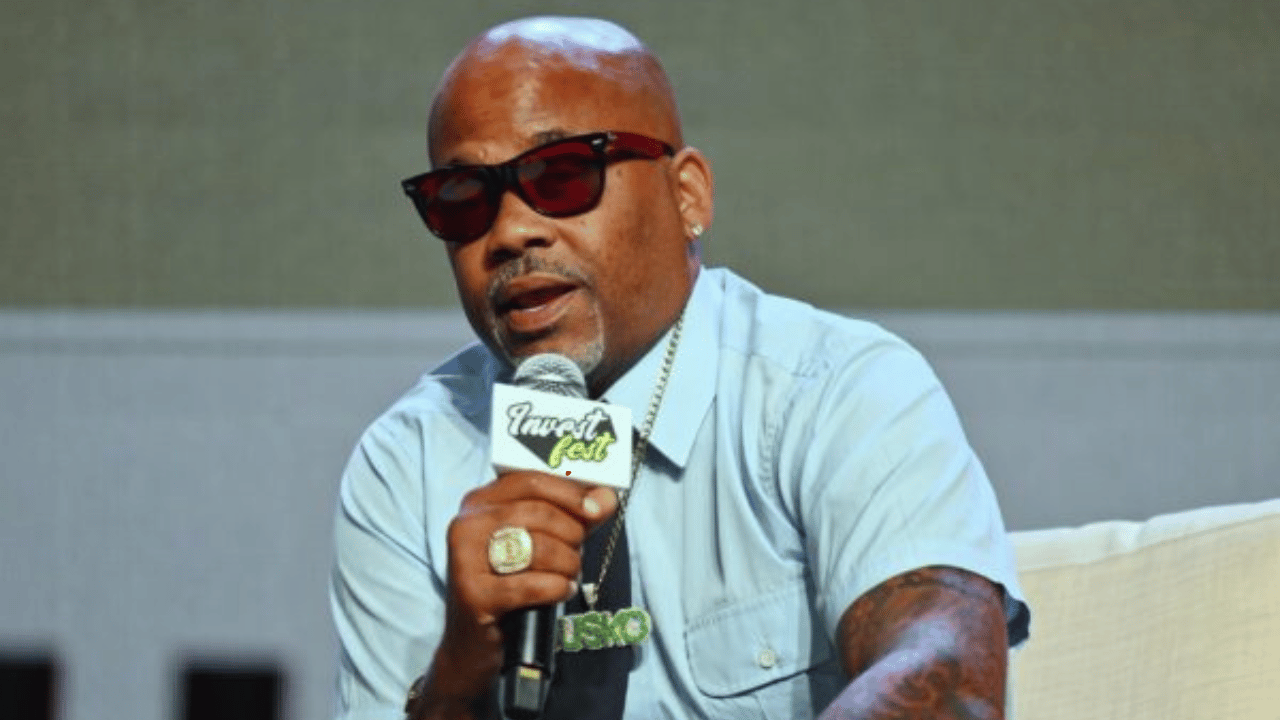
Dame Dash built much of his public image around ownership, independence and controlling the value of his work. Now, one of the most personal assets connected to the Roc-A-Fella Records co-founder is moving toward a court supervised sale. On September 1, 2026, U.S. Bankruptcy Judge Roberta A. Colton approved bidding procedures allowing the trustee overseeing Dash’s Chapter 7 bankruptcy to auction a package of assets tied to his life story. The ruling does not complete the sale. Instead, it establishes the process that could place Dash’s commercial life story rights, archival materials, and an unfinished film project in someone else’s hands. Dash did not appear at the hearing.
Everlasting Films LLC submitted the opening bid of $37,000. Other qualified bidders have until September 23 to make an offer. Since competing bids must increase by at least $10,000, the next qualifying bid would have to be at least $47,000. If multiple qualified bidders emerge, an auction is scheduled for October 1. Judge Colton is expected to consider final approval on October 27. Everlasting Films is connected to producer and writer Brianne Berkson and would receive a $3,700 fee if another bidder ultimately wins.
The winning bidder would receive rights connected to Dash’s biography, voice, image, likeness, and identifying characteristics. The package also includes “100 hours of video content, photographs, and memorabilia.” The buyer would additionally receive rights connected to “an unreleased, in-development documentary/film project” centered on the Roc-A-Fella story.
That archive could be valuable because Dash was present for one of hip hop’s most influential business runs. Alongside Shawn “Jay-Z” Carter and Kareem “Biggs” Burke, Dash helped build Roc-A-Fella Records in the 1990s. The company became central to Jay-Z’s rise and later became associated with artists including Ye, Cam’ron, Beanie Sigel and Freeway. Dash also expanded his name into fashion and film, while ownership became one of the central messages of his public persona.
The road to the current auction, however, was years in the making. Dash filed for Chapter 7 bankruptcy in Florida on September 4, 2025. His petition listed a staggering $25,303,049.47 in total liabilities against just $4,350 in assets. He reported no monthly income while listing $5,200 in monthly expenses. The court filing included $100 in cash, a $500 cellphone, clothing, jewelry, and two firearms among his personal property.
A significant portion of the financial pressure came from taxes and other government obligations. Dash’s bankruptcy schedules listed a $9.65 million claim from the New York State Department of Taxation and Finance and a $3.5 million claim from New Jersey’s tax agency. His petition also identified nearly $648,000 in domestic support obligations involving his former wife Rachel Roy and Cindy Morales.
The bankruptcy followed another major court-ordered loss tied directly to Dash’s Roc-A-Fella legacy.
Filmmaker Josh Webber and Muddy Water Pictures sued Dash over the film “The List,” later known as “Dear Frank.” After years of litigation, a federal jury found Dash and his company liable for copyright infringement and defamation. The court later entered judgments totaling more than $823,000 when attorney fees were included. After efforts to collect the money were unsuccessful, Webber and Muddy Water Pictures targeted Dash’s one third ownership interest in Roc-A-Fella Records.
In February 2024, a federal judge determined Dash’s stake could be sold at public auction to satisfy the judgment. Additional creditors later became involved because of claims connected to taxes and support obligations. In November 2024, New York State acquired Dash’s one-third Roc-A-Fella interest with a $1 million creditor bid as the government sought to recover money Dash owed.
By the time Dash entered bankruptcy in 2025, one of the biggest assets associated with his music industry legacy was already gone, and Chapter 7 raised the stakes even further. Unlike a simple payment plan, Chapter 7 generally involves identifying property that can be liquidated for creditors. Court-appointed trustee Traci K. Stevenson began examining what Dash still owned, including commercial and intellectual property assets that could potentially generate money. That examination eventually reached his life story and archive.
The trustee maintained that those rights could become property available for the benefit of creditors. With Everlasting Films stepping forward, Dash’s story suddenly had an opening bid attached to it.
Still, the phrase “life rights” can sound broader than it actually is. The ruling does not mean the eventual buyer literally owns every fact about Dame Dash’s life or that nobody else can ever discuss his history. The U.S. Copyright Office makes clear that facts, including biographical facts, are not protected by copyright. What makes this sale significant is the specific bundle of commercial rights and materials involved, including likeness-related rights, private archival footage, photographs, memorabilia, and the unfinished project.
For Dash, the situation carries an unmistakable irony. He spent decades publicly championing creators controlling their work and businesses. Now, bankruptcy law could result in commercially valuable rights connected to his own story being transferred to someone else, while the money generated from the sale goes toward his creditors.
And $37,000 should not be mistaken for the final value of Dash’s story. It is the opening floor. If other buyers enter the process, the price could climb before the court determines whether to approve a final sale.
Whatever the eventual price, the case represents another dramatic turn for a businessman once synonymous with Roc-A-Fella’s independence. After losing his stake in the company he helped build, Dash could now see someone else acquire the contractual rights and private archive needed to package his version of that history for movies, documentaries, books, and potentially much more.
