

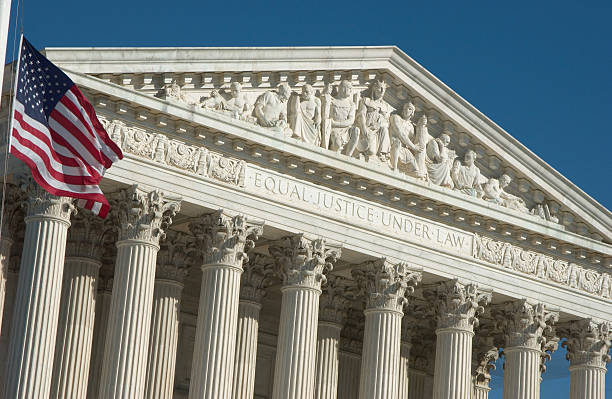
The Supreme Court campaign finance ruling handed down on Tuesday just blew open one of the last real guardrails on how political parties bankroll their candidates, and the consequences are going to ripple straight through the 2026 midterms. In a 6 to 3 decision split right down ideological lines, the justices struck down a federal law that had limited how much money national and state parties could spend in direct coordination with the candidates they back. The case, National Republican Senatorial Committee v. Federal Election Commission, was brought by JD Vance and other Republicans who argued the limits violated the First Amendment.
Justice Brett Kavanaugh wrote the majority opinion, joined by Chief Justice John Roberts and Justices Clarence Thomas, Samuel Alito, Neil Gorsuch, and Amy Coney Barrett. Kavanaugh argued that the coordinated spending caps, which dated back to a law Congress passed in 1974 in the wake of Watergate, choked off political parties’ ability to communicate and support their own candidates. He called the decision a move toward fairness, writing that it would let every party, from the RNC and DNC down to state level committees, coordinate more freely with the people running under their banner.
Justice Elena Kagan wrote the dissent for the court’s three liberal justices, joined by Sonia Sotomayor and Ketanji Brown Jackson. Kagan didn’t hold back, warning that the ruling lets parties become what she called an alternative checking account for campaigns, opening the door for big donors to funnel unlimited money to candidates through party committees instead of giving directly, which would have triggered contribution limits. That distinction matters because it strips away one of the few remaining checks meant to prevent wealthy donors and corporations from buying outsized influence over who gets elected.
This Supreme Court campaign finance ruling didn’t come out of nowhere. It’s the latest in a string of decisions stretching back to Citizens United in 2010, when the court ruled corporations have a First Amendment right to spend freely on elections. The court kept chipping away after that, striking down Arizona’s public financing system in 2011 and then knocking out limits on how much an individual donor could give across all federal candidates in 2014. Tuesday’s ruling specifically overturns a 2001 case known as Colorado II, which had upheld these exact coordinated spending limits as constitutional just twenty five years ago.
What makes this moment hit different is the timing. Midterms are coming up in November, and right now Republicans are sitting on a significant cash advantage over Democrats heading into those races. Removing the cap on coordinated spending means the RNC and its Senate and House arms can now pour essentially unlimited money straight into individual campaigns, working hand in hand with candidates instead of running so called independent expenditures on the side. Analysts are already calling this a short term boost for the GOP simply because they have more money sitting in the bank right now to take advantage of the new rules.
For Black voters, Black candidates, and Black owned political organizations, this Supreme Court campaign finance ruling raises real questions about access and influence going forward. Campaign finance reform has historically been framed as a fight against corruption, but it has also functioned as one of the only tools available to keep grassroots and community backed candidates competitive against deep pocketed party machines. When coordinated spending caps disappear, the candidates who already have institutional backing and access to major donor networks pull even further ahead of insurgent or first time candidates who are trying to build power from the ground up, which historically includes a disproportionate number of Black candidates running for the first time in competitive districts.
Richard Hudson and Senator Tim Scott, who chairs the National Republican Senatorial Committee, celebrated the ruling in a joint statement, saying the federal government has no authority to place arbitrary limits on how parties support the candidates they nominate. Trump posted his own reaction online, calling it a big win for Republicans and, even more so, for the First Amendment. On the other side, Democratic Party leadership pushed back hard, with DNC Chair Ken Martin and others releasing a statement calling the decision a win for billionaire donors and special interests, accusing Republicans of rewriting the rules in their own favor right before a major election cycle.
It’s worth remembering what coordinated spending actually means in practice, because the term sounds technical but the impact is anything but. Independent expenditures, the kind super PACs run, have to be done completely separately from a candidate’s own campaign, no direct communication, no strategy sessions, nothing. Coordinated spending is different. It means the party and the candidate can work together directly, deciding jointly how money gets spent on things like advertising, mailers, and outreach. Before Tuesday, federal law capped how much of that joint spending could happen. Now there’s no ceiling at all, as long as parties are otherwise playing by campaign finance rules.
The scale of what’s now allowed is significant. Under the old limits for this election cycle, party committees could only coordinate between roughly $65,300 and $130,600 in spending with congressional campaigns, and up to $4 million with certain Senate candidates depending on a state’s population. Those numbers are now gone entirely, meaning a party with deep enough pockets can pour as much as it wants directly into a candidate’s race, working side by side with that candidate’s own team.
This ruling lands at a moment when trust in the Supreme Court’s handling of money in politics is already shaky among a lot of Black voters, who have watched campaign finance protections erode case by case since 2010 while wondering who these decisions are actually built to protect. Six rulings deep into this pattern, the message from the court’s conservative majority has stayed consistent, that restricting how money moves through politics restricts speech, full stop, regardless of who benefits most when the floodgates open.
What happens next will play out fast, with November on the horizon and both parties now free to spend without the old coordinated spending ceiling holding them back. Whether that translates into more competitive races or just cements the advantage of whichever party already has the bigger war chest is the real question hanging over this Supreme Court campaign finance ruling, and it’s one voters, candidates, and organizers across Black communities will be watching closely as the midterms approach.
