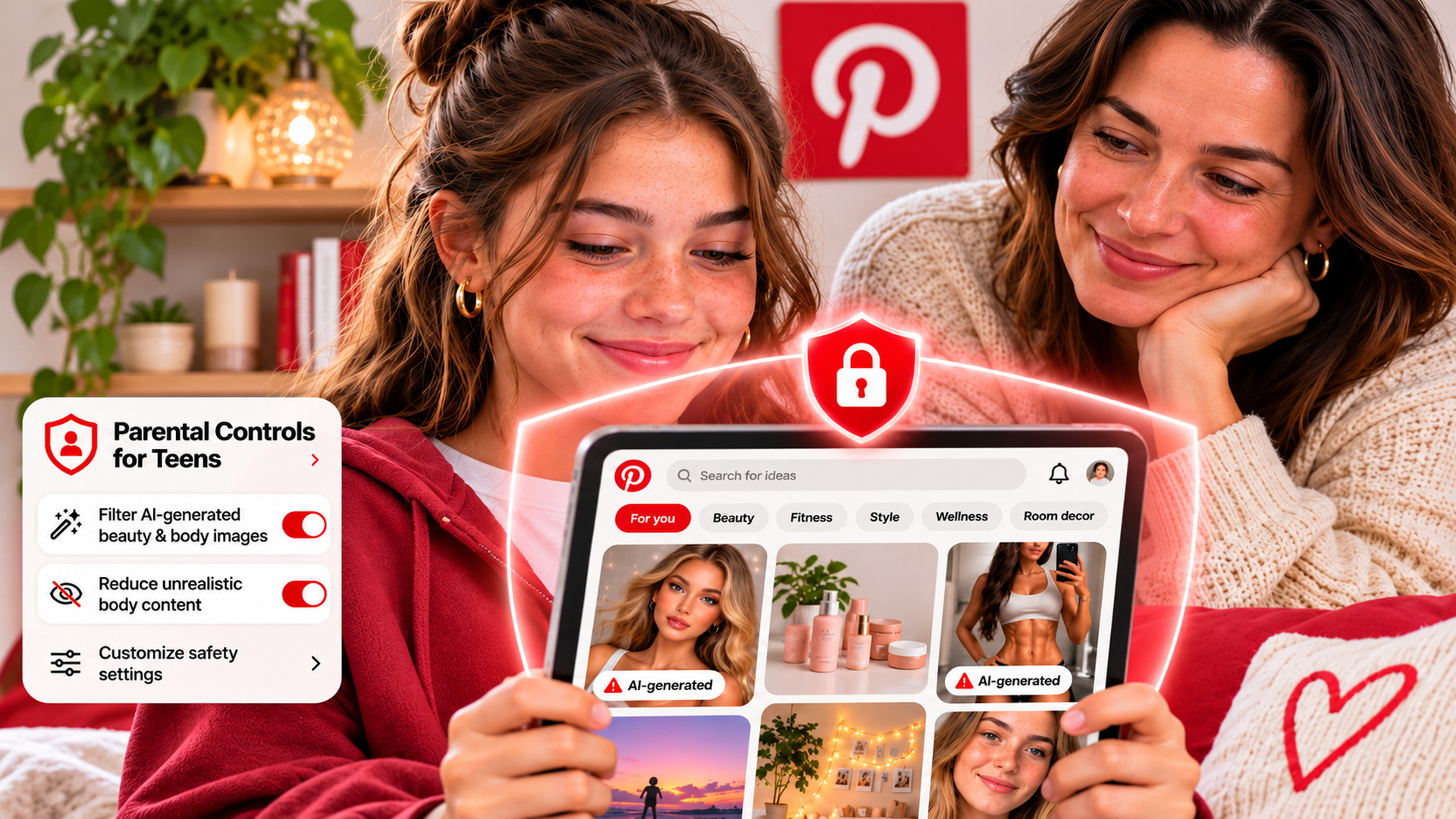
Pinterest parental controls now let parents limit how much AI-generated content shows up in their teen’s feed. That could make a real difference for teens who use the app to figure out how they want to look.
Pinterest rolled out the change this week as part of a redesigned Parental Controls page. Along with the new AI setting, parents can now stop videos from autoplaying and control how often their teen gets push, browser, in-app, and email notifications. They can also manage settings tied to personalized ads. Every oversight tool now sits in one dashboard instead of being scattered around the app, from profile visibility to who can connect with a teen.
TechCrunch called Pinterest one of the first major social platforms to let parents control how much AI content appears across a child’s overall feed. Other apps have mostly gone after the AI tools themselves. Snap added a setting that blocks its AI chatbot from responding to teens. Meta paused teen access to its AI characters. WhatsApp lets parents adjust how much their teens can use Meta AI. Far fewer controls exist for the AI images and videos that quietly fill up the feed itself.
For teens, that feed is where the real impact lives. When Pinterest launched its AI content controls for all users in October 2025, the company itself named beauty, fashion, art, and home decor as categories highly prone to AI-generated or AI-modified images. Those are the exact boards teens build for hair inspiration, outfit ideas, makeup looks, and fitness goals.
An AI beauty image works differently from a filtered selfie. A filtered photo starts with a real person. An AI image can show skin with no texture, a waist that doesn’t match the hips, or a face no human being has ever had. A teen comparing herself to that image is measuring herself against someone who doesn’t exist.
Most young users can’t tell the difference, either. Fortune reported earlier this year that even adults correctly identify AI-generated content only about half the time. A 15-year-old scrolling between classes has even less reason to stop and question a pin.
The problem gets personal fast in the culture. A teen saving braid inspiration before her next appointment could end up pinning a style no stylist can recreate, because the parting, the length, or the hairline in the image was never real. The same goes for “natural” makeup looks and body goals that started as a computer prompt instead of a person. With Pinterest parental controls dialed in, more of what teens see will come from real people with real faces, real hair, and real bodies.


Made to order and shipped to your door.
The other new settings help, too. Turning off autoplay breaks the loop of one video rolling into the next. Turning down notifications means fewer pings pulling a teen back into the app during homework or late at night.
Pinterest isn’t making these moves in a vacuum. In April, the children’s advocacy group Fairplay sent a letter to YouTube CEO Neal Mohan and Google CEO Sundar Pichai. More than 200 organizations and experts signed it, including child psychiatrists and educators. The letter called on YouTube to pull AI-generated content from YouTube Kids and to stop recommending AI videos to users under 18. Parents behind that push argue that the flood of cheap AI content is hurting kids’ well-being so platforms can boost profits.
Pinterest has made teen safety part of its public pitch for a while now. In September, the company backed Adam’s Law, a new California law that puts guardrails on AI companion chatbots used by minors. Pinterest CEO Bill Ready said at the time, “Teens deserve technology that supports their wellbeing, not technology that puts it at risk.”
The new tools come with a catch. TechCrunch reports that AI content still slips into users’ feeds even when Pinterest’s 2025 AI filters are turned on. Parents who flip the switch should expect less AI content, not zero.
That makes the setting a starting point, not a cure. Pinterest parental controls can cut down how many fake faces and bodies a teen sees in a day. The talk at home about what is real online still has to come from parents, who can make sure their kids know a perfect image might not be a person at all.