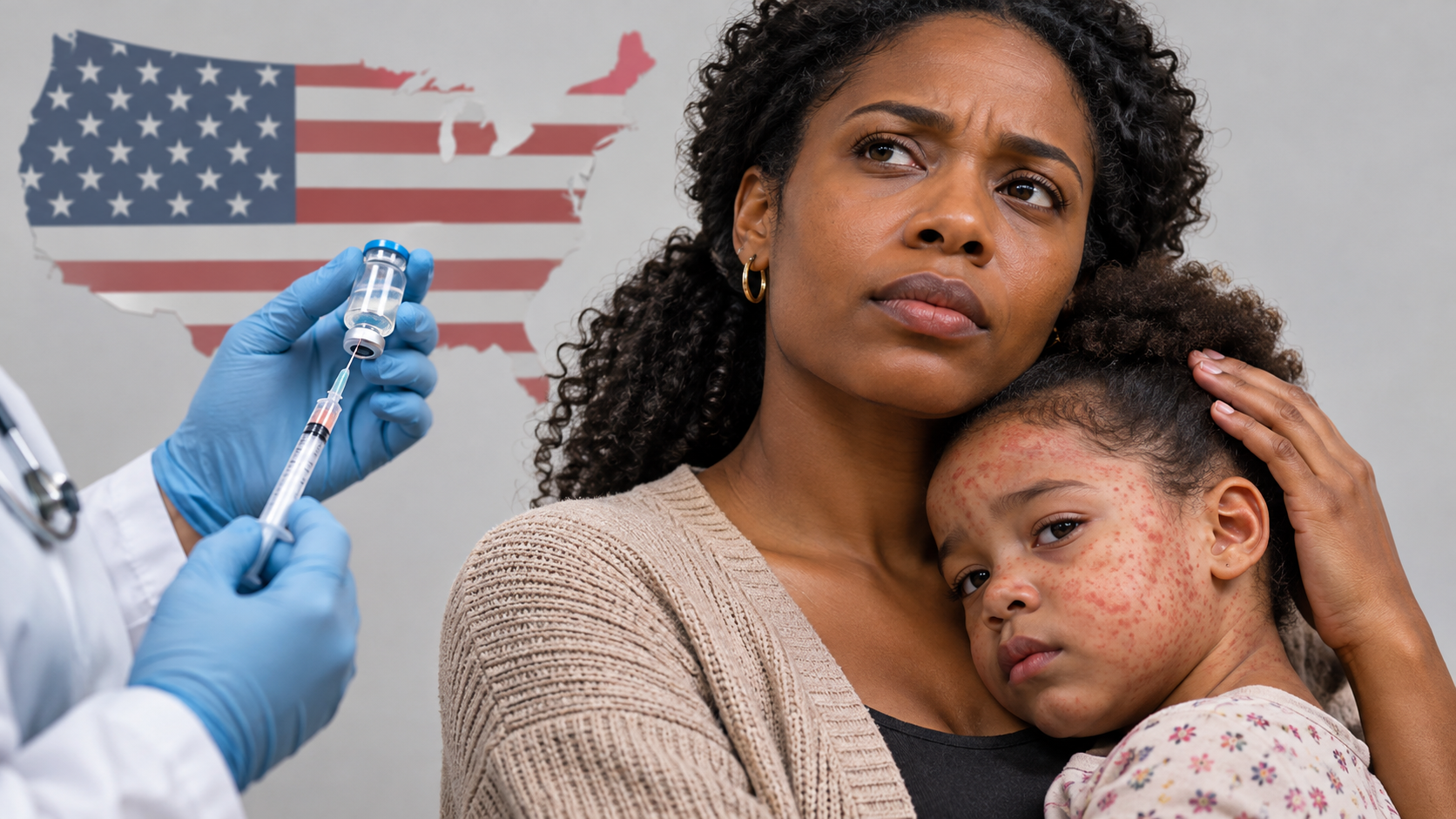
The United States has lost the measles elimination status it held for 26 years, according to multiple reports on a decision by the Pan American Health Organization. The formal announcement is expected Tuesday, November 17.
The Pan American Health Organization, known as PAHO, is the arm of the World Health Organization that oversees public health across North, Central and South America and the Caribbean. Last week it held a three day meeting, closed to the public, where an independent panel of experts reviewed whether the U.S. and Mexico still qualify as measles free. People familiar with the deliberations told The Wall Street Journal, KFF Health News, CNN and NBC News that the panel decided the U.S. no longer meets that standard. An official told Reuters that PAHO informed the Trump administration in a letter on Friday.
Measles elimination status does not mean a country has zero measles cases. It means the virus is not spreading on its own inside that country. Cases still happen, but they mostly start with travelers who caught measles somewhere else, and outbreaks get stamped out before they take root. A country loses the status when a single chain of measles spreads continuously within its borders for 12 months or longer. The panel reportedly concluded that is exactly what has happened here.
The numbers show why. The CDC has confirmed 5,412 measles cases in 2026 as of November 12, along with 43 new outbreaks. That is more than double the roughly 2,289 cases recorded in all of 2025, which was already the worst year for measles in the U.S. in more than three decades. The CDC lists six measles deaths this year and notes that number may change. State health departments put the count at 10.
The surge started with an outbreak in West Texas in January 2025 and kept moving. Utah became one of the hardest hit states, with 715 cases by August 2026, spread across 22 of its 29 counties. Most of Utah’s cases since August 2025 started inside the state, which is the kind of homegrown spread that costs a country its status. Federal health officials argued late last year that the Utah and Arizona cases were not directly linked to Texas, and that argument helped the U.S. hold on to its status for a while. It did not hold up through 2026.
Almost every person who got sick this year was unprotected. A KFF analysis found 96% of 2026 cases were in people who were unvaccinated or whose vaccination status was unknown. Two doses of the MMR vaccine, which covers measles, mumps and rubella, protect about 97% of people from measles.
The problem is that fewer kids are getting those shots. During the 2025 to 2026 school year, 92.4% of kindergartners had both MMR doses, down from 95.2% in 2019 to 2020. Public health experts say a community needs about 95% coverage for herd immunity, the point where enough people are protected that the virus cannot find new people to infect. Only 10 states reached that mark. Idaho came in lowest at 75.2%, while West Virginia led the country at 98.9%.


Made to order and shipped to your door.
Herd immunity matters most for people who cannot protect themselves. Babies usually do not get their first MMR shot until they are 12 months old, so they rely on the people around them being vaccinated. The same goes for people with weakened immune systems, such as cancer patients.
Officials in the Trump administration have downplayed the loss. In January, CDC principal deputy director Ralph Abraham called losing elimination status the “cost of doing business,” and pointed to open borders and vaccine choice. “We have these communities that choose to be unvaccinated,” Abraham said. “That’s their personal freedom.” CDC Director Erica Schwartz has said that if the U.S. loses its status, the agency would keep doing “the same exact thing” it does now.
Dr. Paul Offit, director of the Vaccine Education Center at Children’s Hospital of Philadelphia, took a different view ahead of the decision. “At best, losing the elimination status would be a call to arms,” he told ABC News.
Before the measles vaccine became widely available in the 1960s, the CDC estimates 3 to 4 million Americans got measles every year. About 48,000 were hospitalized, around 1,000 developed swelling of the brain, and 400 to 500 died. Decades of vaccination pushed those numbers down until the U.S. declared measles eliminated in 2000.
The U.S. is not alone. Canada lost its measles elimination status in November 2025 after its own outbreak lasted more than a year. Mexico was reviewed alongside the U.S. last week and has recorded 13,761 cases this year. Across the Americas, PAHO counted 57,666 confirmed cases in 17 countries and territories through October 31, about 4.7 times as many as the same period last year.
Getting the status back will not be quick. The U.S. would need to go at least 12 months without measles spreading continuously, and prove it has a strong system for tracking cases. Brazil lost its status in 2019 and did not regain it until November 2024. Venezuela lost its status in 2018 and was certified measles free again in 2023.