


Soulja Boy is speaking out about the massive demonstrations sweeping France, warning that the growing frustration among everyday people should serve as a lesson for governments around the world. As the France protests intensify, the rapper is drawing attention to the financial struggles that have pushed thousands of citizens into the streets.
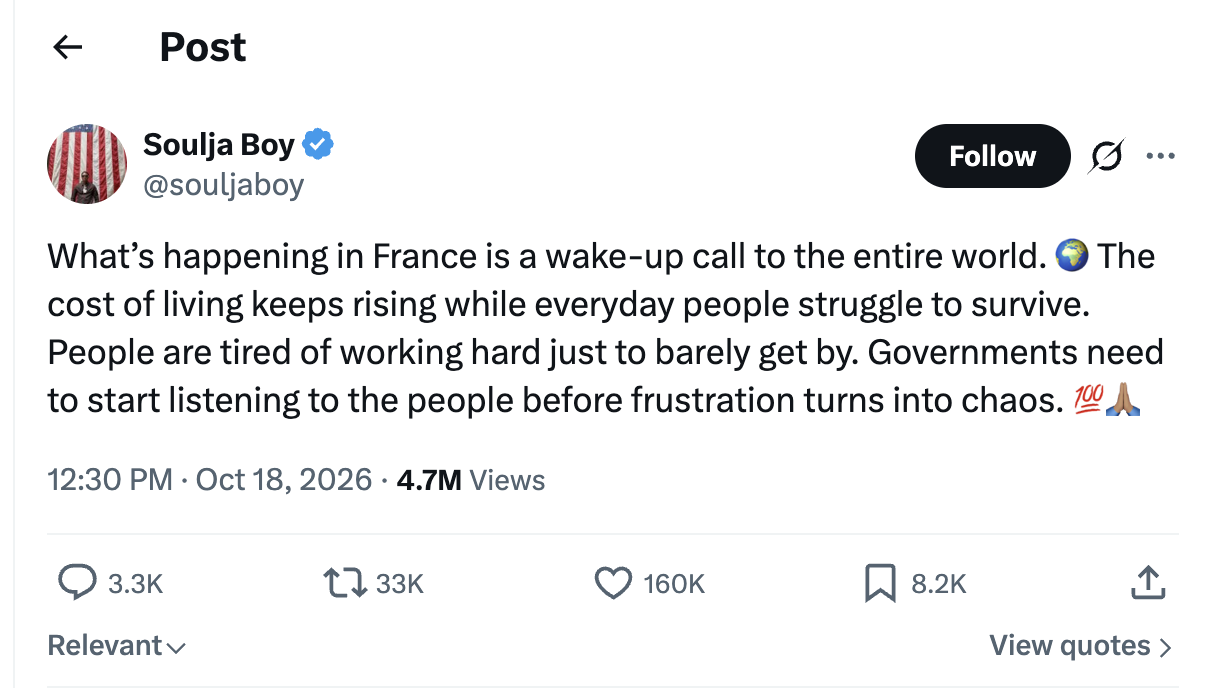
In a message shared on X, Soulja Boy addressed the unrest and called on political leaders to recognize the pressures facing working people.
“What’s happening in France is a wake-up call to the entire world. 🌍 The cost of living keeps rising while everyday people struggle to survive. People are tired of working hard just to barely get by. Governments need to start listening to the people before frustration turns into chaos.”
His message comes as France faces one of its most significant periods of civil unrest in years. What began as student demonstrations over deteriorating school conditions has grown into a nationwide movement fueled by rising expenses, concerns about inequality, and frustration with government policies.
According to the Associated Press, hundreds of thousands of demonstrators participated in protests across France on October 17, 2026. French authorities estimated approximately 550,000 participants, while organizers placed attendance closer to 800,000.
Demonstrations took place in Paris, Marseille, Lyon, Bordeaux, and other cities. Students, workers, labor unions, and supporters of earlier protest movements joined forces to demand economic relief and improvements to public services.
Although most participants demonstrated peacefully, violence erupted in several locations. Groups clashed with police, businesses were looted, and public buildings were damaged. Officers responded with tear gas and other crowd control measures.
The France protests have exposed problems that extend beyond one political disagreement or a single government decision.
According to Al Jazeera’s reporting, the current movement began in September when high school students in working-class communities outside Paris protested teacher shortages, poor facilities, and inadequate educational resources.
Students complained about overcrowded classrooms, exhausting schedules, and buildings that were not properly maintained. As demonstrations spread, university students and labor organizations joined the movement, turning a dispute over education into a broader confrontation over living standards.
For many French workers, the frustration centers on the increasing difficulty of covering everyday expenses. Fuel, transportation, housing, food, and electricity have placed growing pressure on household budgets, leaving some people struggling despite working regularly.
An October 12 investigation by Le Monde highlighted just how serious the financial strain has become. Citing research from the CEPREMAP economic research center, the newspaper reported that only 28% of surveyed households considered themselves financially stable. Another 22% were using their savings, while 6% were taking on debt.
Those figures help explain why Soulja Boy’s message about people working hard without getting ahead connects directly to the grievances behind the demonstrations.
France’s financial problems have also complicated the government’s response.
According to Le Monde’s analysis of France’s economic crisis, public debt has surpassed 119% of the country’s gross domestic product. Sluggish economic growth, rising unemployment, and higher borrowing costs have placed additional pressure on government finances.
The proposed 2027 budget has become another source of controversy. Al Jazeera reported that the government’s plan includes approximately 54 billion euros in spending reductions and tax measures intended to address the deficit. Labor unions have challenged proposed restraints on public sector compensation and warned that cuts could worsen already strained public services.
That creates a difficult situation for French leaders. Demonstrators want more funding for schools, better wages, and relief from household expenses, while the government faces pressure to reduce borrowing and control spending.
The current France protests also carry similarities to the Yellow Vest movement that emerged in 2018.
According to the Associated Press, those demonstrations initially centered on fuel prices before expanding into a larger protest against economic inequality and policies viewed as favoring wealthier citizens.
Yellow Vest supporters have now joined students and workers in the latest demonstrations, bringing together different generations with similar frustrations about economic security.
Meanwhile, the situation has become increasingly serious for French President Emmanuel Macron and Prime Minister Sébastien Lecornu.
In an October 19 report, the Associated Press said at least 2,400 people had been arrested following the weekend’s unrest. Authorities also estimated that at least 3,000 businesses had been damaged or looted.
The destruction included a major fire at the historic city hall in Limoges, where significant portions of the building were destroyed.
Macron condemned the violence, while government officials blamed far-left activists and organized groups of looters for much of the destruction. Lecornu called for limited, localized curfews to help restore order.
Interior Minister Laurent Nuñez also offered his resignation amid criticism of the government’s preparation and policing response, but Macron rejected it.
However, the violence represents only one part of a much larger situation. Many demonstrators have continued calling attention to school funding, purchasing power, and economic conditions without participating in the destruction.
The political consequences could be significant as France approaches its 2027 presidential election. With public frustration growing and the country’s financial problems unresolved, political leaders face mounting questions about their ability to restore public confidence.
Soulja Boy did not offer a detailed political solution in his message. Instead, he focused on the basic economic concern connecting people across different countries: the growing gap between the cost of everyday life and what ordinary workers can afford.
His comments have added an international celebrity voice to a conversation already taking place far beyond France.
For the hundreds of thousands of French citizens demanding change, the central issue is whether their government can provide meaningful economic relief, protect public services, and address the concerns that brought them into the streets before the unrest deepens.
