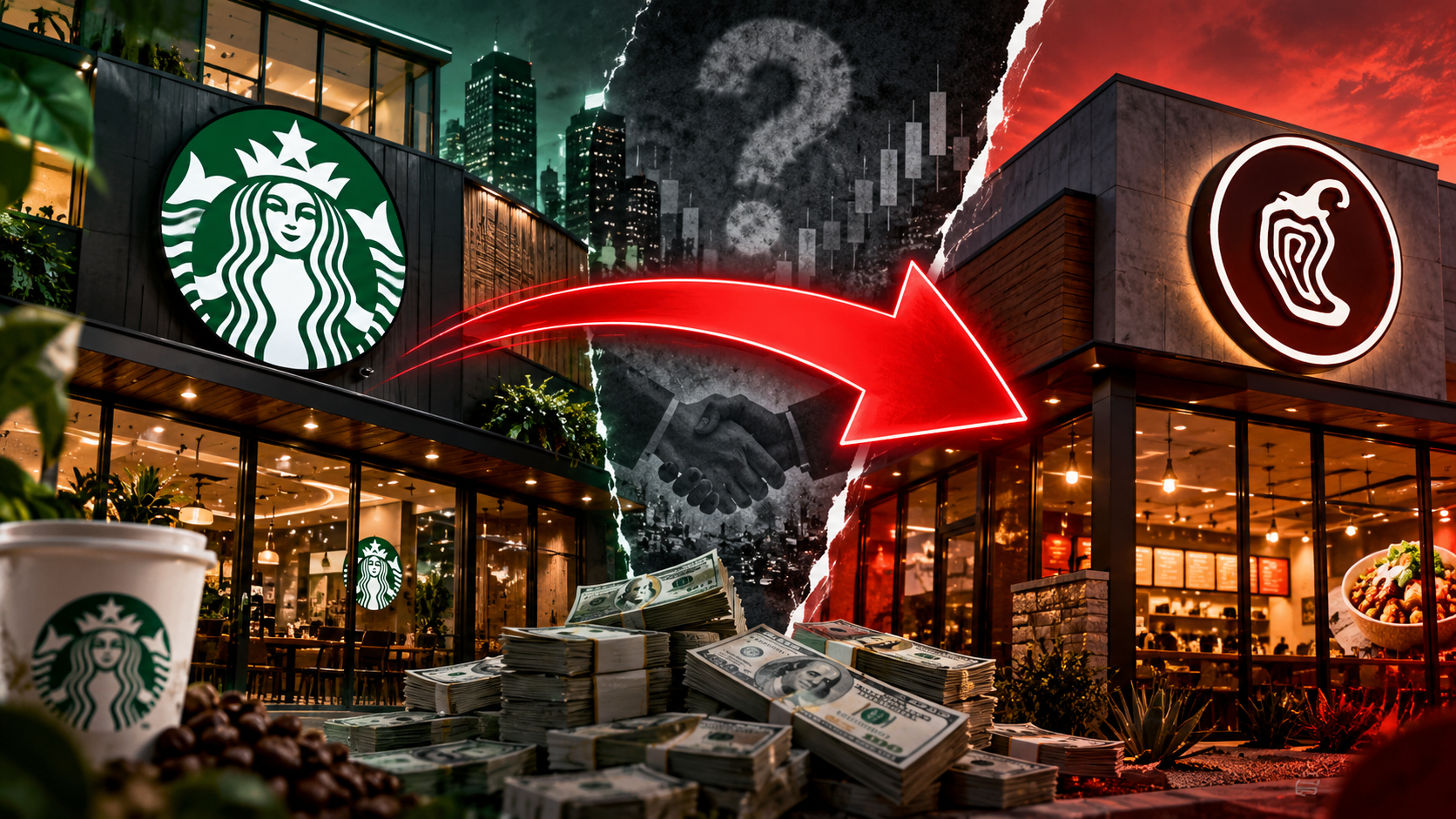
Starbucks may be looking to add Chipotle to its business empire, but buying the popular burrito chain could be a much bigger gamble than investors are willing to accept.
According to the Financial Times, Starbucks has worked with financial advisers in recent months to explore a potential acquisition of Chipotle Mexican Grill. The possible Starbucks-Chipotle merger could become the largest restaurant industry takeover in history, although no formal offer or agreement has been confirmed.
The reported acquisition would also create an unexpected reunion between Starbucks CEO Brian Niccol and the company he previously helped transform.
Niccol served as Chipotle’s CEO from 2018 until 2024, when he left to lead Starbucks. During his tenure, he helped rebuild Chipotle’s reputation following food safety problems, expanded digital ordering, and strengthened the chain’s business performance.
Per Reuters, news of the possible acquisition immediately drew mixed reactions from Wall Street. Chipotle shares climbed approximately 6% during Thursday’s trading, while Starbucks shares declined roughly 3%.
The reaction reflects an important distinction. Chipotle investors could benefit from an attractive buyout offer, while Starbucks shareholders would have to consider whether the company could afford the acquisition and generate enough profit to justify it.
With Chipotle valued at nearly $39 billion and Starbucks worth approximately $107 billion at the time of the report, the potential transaction would be massive.
One of the strongest arguments supporting a Starbucks-Chipotle merger is the opportunity to accelerate Chipotle’s international expansion.
According to Starbucks’ latest quarterly earnings report, the coffee company operated 41,304 locations worldwide at the end of June 2026, with approximately 67% operating under licensing agreements.
By comparison, Chipotle’s second-quarter financial results showed 4,186 company-operated restaurants and just 15 partner-operated locations.
That difference creates a potential growth opportunity.
Starbucks has extensive experience working with international operating partners, while Chipotle remains concentrated in North America. Access to established business relationships could help Chipotle enter new markets without building every restaurant operation from scratch.
Northcoast Research analyst Jim Sanderson highlighted that advantage in comments reported by Reuters.
“What I like about this potential is the opportunity CEO Brian Niccol would have to leverage Starbucks’ licensed partnerships in Europe to expand Chipotle more aggressively,” Sanderson said.
However, there is an important counterargument.
Chipotle is already building international partnerships without being acquired by Starbucks.
In July 2026, Chipotle expanded into Mexico through an agreement with Alsea, a restaurant operator that already includes Starbucks among the brands in its portfolio, according to Chipotle’s official announcement.
That existing partnership raises a critical question: Does Starbucks really need to spend tens of billions of dollars to help Chipotle grow internationally when the two brands already have access to some of the same operating partners?
Supporters of the potential merger could also point to digital ordering, customer loyalty programs, and technology.
Both companies have established mobile ordering businesses. A combined organization could potentially share technology investments, improve customer data analysis, and explore coordinated rewards or promotional campaigns.
Customers might eventually see new incentives involving both brands. However, neither company has announced joint rewards programs, menu collaborations, or changes to existing customer benefits.
Those possibilities remain speculative, and combining two recognizable brands would not automatically guarantee stronger sales.
The biggest obstacle to a Starbucks Chipotle merger may be its enormous cost.
Acquiring Chipotle would likely require Starbucks to pay a premium above the chain’s market value. That could force the coffee company to borrow heavily, issue additional shares, or combine multiple financing methods.
“A deal could require heavy borrowing or issuing shares,” said Lale Akoner, global market strategist at eToro.
“Without a compelling financial case, investors may view the deal as an expensive distraction.”
The concerns become more significant when examining Starbucks’ existing financial commitments.
According to Starbucks’ June 2026 SEC filing, the company carried approximately $13.3 billion in current and long-term debt, compared with roughly $3.45 billion in cash and cash equivalents.
Taking on substantial additional debt could increase interest expenses and leave Starbucks with less flexibility to invest in stores, employees, and new products.
Issuing shares presents another problem because it could reduce existing investors’ percentage ownership and dilute earnings per share, depending on how the transaction is structured.
There is also the question of timing.
Starbucks is still executing its Back to Starbucks turnaround strategy, which focuses on improving customer service, staffing, store operations, and the overall coffeehouse experience.
The company has committed at least $500 million to labor investments as part of those efforts, Reuters reported.
The strategy has begun delivering measurable results. Starbucks reported 7.9% global comparable store sales growth in its fiscal third quarter of 2026, marking four consecutive quarters of growth. Its adjusted operating margin also improved from the previous year.
Still, the 14.4% adjusted margin remained below the 16.7% reported for the comparable quarter two years earlier, according to the LSEG figures cited by Reuters.
During a July business update, Niccol acknowledged, “We have more work to do.”
That unfinished turnaround is precisely why some analysts question whether Starbucks should pursue another major corporate challenge.
“The timing of this would be a little weird, given that Starbucks is in the middle of their transformation and hasn’t yet shown the margin improvement investors are probably hoping for. Instead of jump-starting the transformation, at first blush, this seems more like jumping the shark instead,” said Brian Jacobsen, chief economic strategist at Annex Wealth Management.
Chipotle has challenges of its own, but its latest results also suggest that an acquisition is not necessarily required for the company to recover.
Under CEO Scott Boatwright, Chipotle reported second-quarter 2026 revenue of $3.3 billion, an increase of 9.3% from the previous year. Comparable restaurant sales increased 2.2%, including a 1% improvement in transactions.
Profitability, however, remained under pressure. Chipotle’s operating margin fell to 15.7% from 18.2% a year earlier, while food and labor expenses increased.
Those figures highlight another potential risk. A Starbucks-Chipotle merger would bring together two businesses facing their own operating pressures, rather than allowing each leadership team to concentrate exclusively on improving performance.
The companies also have different business models.
Starbucks emphasizes coffee, beverages, convenience, and its coffeehouse environment. Chipotle centers its business on freshly prepared, customizable meals and restaurant operations that require different ingredients, cooking equipment, and staffing.
That distinction could limit the savings generated by combining purchasing operations. The companies might reduce some administrative and technology costs, but their core supply chains are not interchangeable.
For employees, a takeover could potentially create opportunities within a larger organization. It could also introduce uncertainty about management structures, staffing decisions, and operational changes. No workforce restructuring associated with a possible acquisition has been announced.
For customers, the immediate effects would likely be limited unless the companies eventually decided to change pricing, rewards programs, or restaurant operations. A corporate combination would not mean Chipotle burritos would suddenly appear in Starbucks stores.
Any transaction of this size would also face regulatory review and a complicated integration process, adding more uncertainty to its potential financial benefits.
Ultimately, a Starbucks Chipotle merger presents two competing possibilities.
On one hand, Starbucks could gain another major restaurant brand, Chipotle could benefit from broader international relationships, and Niccol could apply his experience across both businesses.
On the other, Starbucks could spend billions acquiring a company that is already pursuing its own recovery, potentially adding debt and management complexity while its existing turnaround remains unfinished.
Neither Starbucks nor Chipotle had announced a transaction as of Thursday’s reporting, and the companies had not immediately provided comments to Reuters.
The deciding factor will not be Niccol’s history with Chipotle or the size of the combined restaurant empire. It will be whether Starbucks can demonstrate that owning Chipotle would create significantly more value than allowing the two companies to grow independently.